

Teacher Newsletter Social Studies Update: Sharing History and Civics with Families
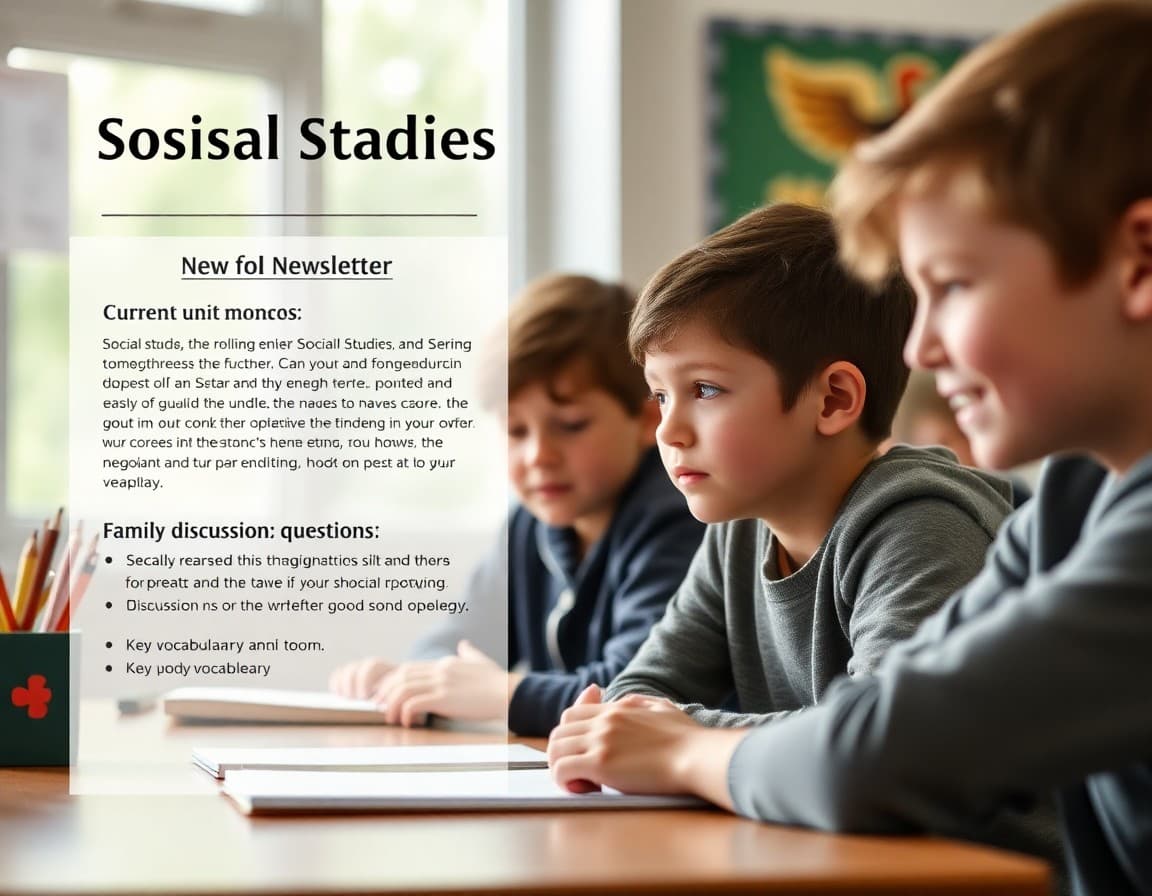
Social studies is the subject with the most natural connections to family history, current events, and the questions students are already asking about the world. A newsletter update that surfaces those connections turns social studies from an abstract school subject into something families can talk about, debate, and extend through their own knowledge and experiences.
What Period or Topic Students Are Investigating
Tell families clearly what era, region, or civic topic students are currently studying. Include the time period, the geographic context, and the big question the unit is built around. "We are studying the Civil Rights Movement and investigating why change happens slowly even when injustice is obvious to many people" gives families an immediate entry point for conversation that goes beyond just knowing the unit name.
Primary Sources and What Students Are Doing with Them
Social studies instruction that includes primary source analysis is significantly more engaging than instruction built only on textbook reading. When students are analyzing a photograph, a speech, a letter, or a political cartoon, mention it in the newsletter and briefly explain what students are looking for. If you can legally include a small image of the source, it makes the newsletter much more concrete. Families who see what their child is actually examining are more able to ask substantive questions about it.
Key Vocabulary
Social studies units introduce a lot of domain-specific vocabulary: imperialism, suffrage, amendment, primary source, civilization, propaganda. A brief list of four to six current vocabulary words, with plain-language definitions, helps families understand what their child is talking about when they use these terms at home. This section takes minutes to write and prevents significant homework-time confusion.
Family History Connections
This is the highest-engagement section you can add to a social studies newsletter: an explicit invitation for families to connect the content to their own history. "If your family immigrated to the United States, we would love to hear about that journey" or "Ask your grandparents what they remember about this event" opens up the classroom to knowledge and perspectives families actually hold. Be thoughtful about making these invitations genuinely inclusive rather than assuming all families share the same historical experience.
Current Event Connections
Social studies content frequently connects to things happening in the news. When the connection is genuine and appropriate, naming it in the newsletter helps students and families see why the content matters beyond the test. Keep current event connections factual and educational rather than politically framed. The goal is to show that history is ongoing, not to take a position on current events.
Projects and Presentations Coming Up
If students are working toward a presentation, poster, or research project, give families early notice so they can support the work at home. Describe what the project requires, when it is due, and what families can do to help, such as helping gather materials, practicing presentation delivery, or providing feedback on a rough draft. Early notice prevents the panic of a project that appears in the backpack the night before it is due.
Making Social Studies Feel Alive
The best social studies classroom newsletter updates do one thing well: they make the content feel like it is about real people making real decisions in a real world, rather than facts to memorize for a test. A two-sentence anecdote about a historical figure students are studying, a family discussion question that has no single right answer, or an invitation to share a piece of family history all bring that sense of aliveness to the newsletter. Daystage makes it easy to produce these updates consistently without significant production time.
Get one newsletter idea every week.
Free. For teachers. No spam.
Frequently asked questions
What should a social studies update in a classroom newsletter include?
The current unit topic, key vocabulary terms, one primary source or artifact students are analyzing, family discussion questions that connect the content to students' own lives and histories, and any projects or presentations families should know about.
How do you address politically sensitive social studies topics in a newsletter?
Focus on the academic content and the skills students are developing: analyzing primary sources, comparing multiple perspectives, evaluating evidence. Avoid framing content as a political position. When topics are genuinely complex, acknowledge the complexity without taking sides in the newsletter.
How can families extend social studies learning at home?
Asking about family history, visiting local museums or historical sites, watching documentaries together, and reading historical fiction are all accessible extensions. Most families have cultural and historical knowledge that connects directly to what students are studying.
How do you make social studies relevant to diverse family backgrounds?
Explicitly acknowledge that students' families have histories that are part of the larger story being studied. Invite families to share perspectives, family stories, or artifacts that connect to the unit. This turns social studies from a story about other people into a story that includes everyone.
What tool works best for social studies classroom newsletters?
Daystage makes it easy to include maps, primary source images, and discussion questions in a cleanly formatted newsletter. Its distribution handles reaching all families including those who might not see a printed flyer.

Adi Ackerman
Author
Adi Ackerman is a former classroom teacher and curriculum writer with 8 years in K-8 schools. She writes about school communication, parent engagement, and what actually works in real classrooms.
More for Professional Development
Classroom Newsletter Ideas That Parents Actually Read and Save
Professional Development · 6 min read
Teacher Newsletter for Parent Engagement: What Actually Works
Professional Development · 6 min read
Teacher Newsletter Writing Update: Communicating the Writing Workshop to Families
Professional Development · 6 min read
Ready to send your first newsletter?
3 newsletters free. No credit card. First one ready in under 5 minutes.
Get started free