
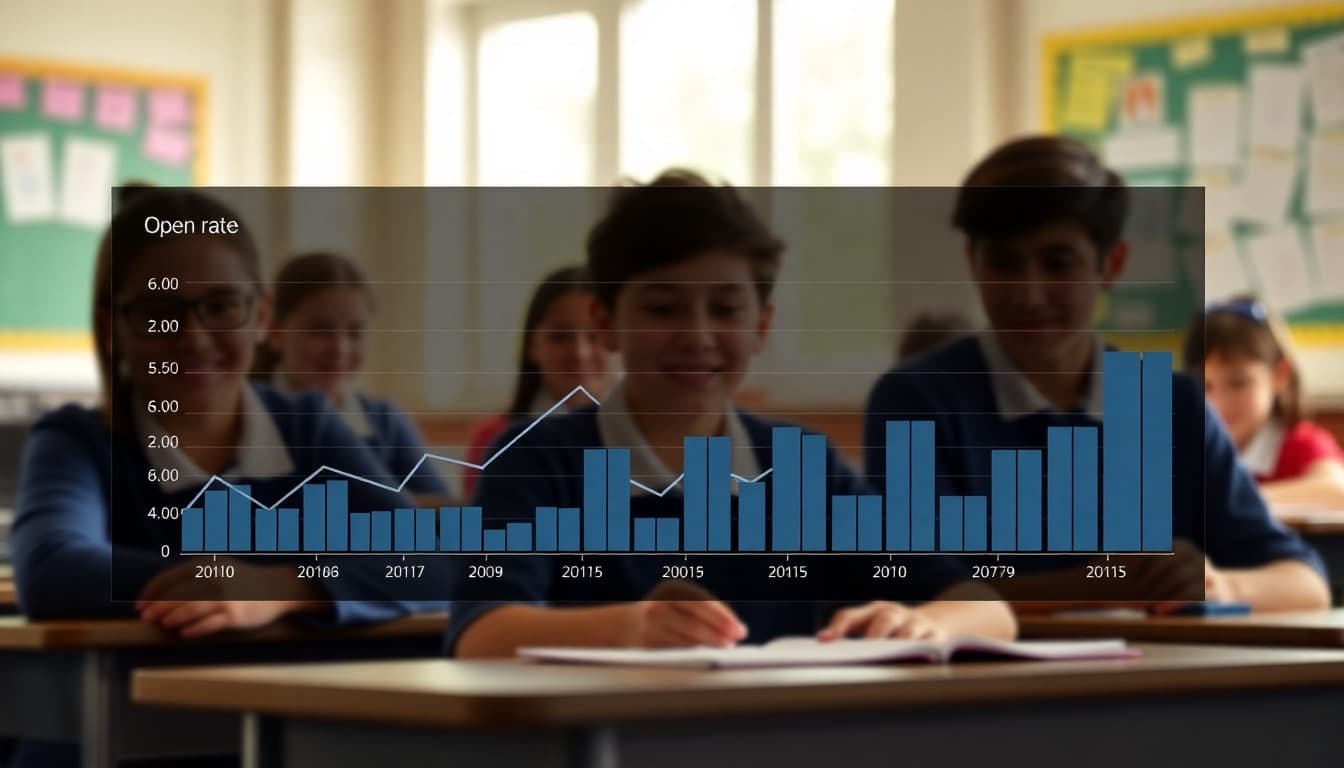
School Newsletter Open Rates: What's Good and How to Improve Yours

Open rate is the single most useful metric a principal has for understanding newsletter effectiveness. It tells you what percentage of families are engaging with your communication at all, before questions of content or quality even come up. Here is how to interpret it and improve it.
What open rate numbers actually mean
An open rate is the percentage of delivered emails that were opened. If you send to 500 families and 200 open the newsletter, your open rate is 40 percent.
One important caveat: open rate tracking works by loading a tiny invisible image in the email. Email clients that block image loading (a privacy setting increasingly common in Apple Mail and Outlook) do not trigger the open signal even when the email was read. This means open rates are likely undercounting actual reads by 10 to 20 percent. The number is still useful for trend analysis, but treat it as a floor, not a ceiling.
Benchmarks for school newsletters
For context, the general email marketing industry average open rate is around 20 to 25 percent. School newsletters routinely perform above that because families are opted in and have a real interest in the content.
School newsletter benchmarks by school level:
- Elementary school: 40 to 55 percent. Elementary parents are the most engaged segment of the K-12 family community.
- Middle school: 35 to 45 percent. Engagement drops as students become more independent and parents receive fewer direct invitations to be involved.
- High school: 30 to 40 percent. Senior families show a second spike in engagement around college-related communication.
The three levers that move open rates
Open rate is primarily a function of three variables:
- Deliverability. Is the email reaching the inbox at all, or landing in spam, promotions, or being blocked by school district email filters? Check your bounce rate and undeliverable count. If you are seeing above 5 percent bounces, your list needs cleaning.
- Subject line. This is the only variable families see before deciding to open. Specific, date-anchored, or question-based subject lines consistently outperform generic monthly labels.
- History. Families who have opened your newsletter and found it valuable will open the next one. Families who have opened and found it empty of useful content will eventually stop. The single best open rate strategy is sustained quality over time.
When to send for maximum opens
Tuesday, Wednesday, and Thursday mornings between 7 and 9 a.m. are the highest-open windows for school newsletters, based on consistent data across school communication platforms. The morning school commute window is when families are most likely to check and act on school emails.
Avoid Friday afternoons, weekend sends, and late evenings. Families who see a school newsletter arrive on a Friday afternoon at 5 p.m. are more likely to mark it 'read later' and never return to it.
Cleaning your list matters
Old email addresses for families who have left the school, generic district email aliases that no one checks, and duplicate entries all dilute your open rate and your deliverability. At the start of each school year, review and update your contact list. Remove families who have withdrawn and add new family contacts promptly.
Track trends, not individual newsletters
Any individual newsletter can have an unusual open rate for reasons unrelated to quality: a major local news event, a holiday weekend, a competing district communication. Track your open rate as a three-month rolling average. That trend line tells you whether your engagement is building, holding, or declining, and that is the number worth acting on.
Daystage shows open rate data for every newsletter you send, making it easy to track trends over a semester and test different subject line approaches against your actual readership.
Get one newsletter idea every week.
Free. For teachers. No spam.
Frequently asked questions
What is a good open rate for a school newsletter?
School newsletters from principals typically see open rates between 35 and 55 percent when sent to an active, current list with consistent delivery. Rates above 45 percent are strong. Rates below 25 percent usually indicate list quality issues, delivery problems (landing in spam), or a history of low-value content that has trained families to ignore the sender.
Why do some families never open school newsletters?
Three main reasons: the email lands in spam or promotions tabs, the subject line does not communicate relevance, or the family has been trained by past experience that your newsletter rarely contains anything they need to act on. All three are fixable, but they require different interventions.
Does send time affect open rates for school newsletters?
Yes. Tuesday through Thursday mornings between 7 and 9 a.m. consistently outperform Friday afternoons, weekends, and late-evening sends for school newsletters. Families checking email in the morning commute window or before drop-off are more likely to open school communication. Avoid sending after 4 p.m. on Friday when open rates drop significantly.
How do I get families off the habit of ignoring my newsletter?
The only reliable path is sustained consistency plus quality: send on the same schedule, make sure every newsletter contains at least one thing genuinely useful to the reader, and improve your subject lines to signal value before families open. It takes three to six months of consistent quality to reverse a low-engagement pattern.
What tool helps principals send newsletters efficiently?
Daystage tracks open rates per newsletter so you can see trends over time and identify which subject lines and content types get the best engagement from your specific school community. It also delivers inline to Gmail and Outlook, which reduces the number of emails that land in promotions tabs or require a click-through.

Adi Ackerman
Author
Adi Ackerman is a former classroom teacher and curriculum writer with 8 years in K-8 schools. She writes about school communication, parent engagement, and what actually works in real classrooms.
More for Principals
Ready to send your first newsletter?
3 newsletters free. No credit card. First one ready in under 5 minutes.
Get started free