
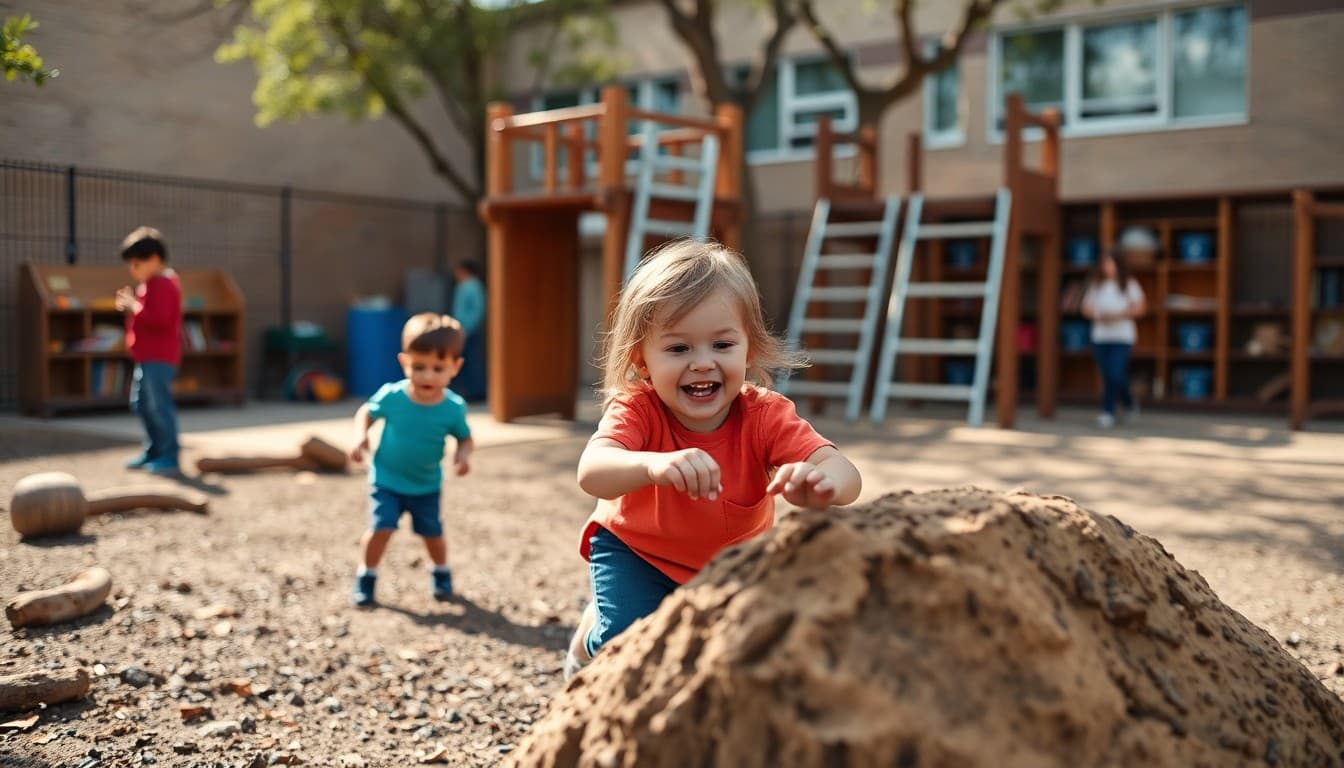
How to Write an Outdoor Play Newsletter for PreK Parents

Outdoor play is one of the most research-supported activities in early childhood development, and one of the most undervalued by families who equate learning with sitting at a table. Your outdoor play newsletter can close that gap by explaining what happens to children's brains, bodies, and learning capacity when they have regular, meaningful time outside.
What the Research Actually Says About Outdoor Play
Start your outdoor play newsletter with the research, because it is compelling and families respond to it. Studies consistently show that children who have more unstructured outdoor time have better attention in the classroom, lower cortisol (stress hormone) levels, stronger executive function, and better physical health markers than children who spend more time indoors. The American Academy of Pediatrics has published statements calling outdoor play essential to healthy development, not supplemental. Countries with the highest international academic performance, including Finland and Japan, build significantly more unstructured outdoor play into the school day than the United States. This is not soft science. It is strong, consistent research across decades.
Gross Motor Development That Only Happens Outside
Indoor classrooms, however well-designed, cannot provide what outdoor spaces provide for gross motor development: scale, variability, and genuine physical challenge. Running across a field, climbing a structure, jumping over a puddle, balancing on a log, and navigating uneven terrain all build the proprioceptive and vestibular systems in ways that indoor movement cannot replicate. These sensory systems, which tell the brain where the body is in space and how it is moving, are foundational for coordination, writing, and sustained seated attention. A child who has had outdoor physical activity arrives at a learning task more focused and more physically ready than one who has not.
Nature as a Science Curriculum
The natural world outside your classroom window is one of the richest science curricula available. Observing insects, watching clouds change shape, noticing how mud behaves differently when it is wet vs dry, finding an acorn and wondering what grew it, and tracking how the season changes week by week are all genuine science activities. The vocabulary that emerges from these observations (camouflage, metamorphosis, erosion, germination, migration) is vocabulary that a worksheet cannot generate because it requires the thing itself to be present. Your newsletter can highlight what specific nature observation you are doing this week and ask families to extend it at home.
A Sample Newsletter Excerpt to Copy
“This week we spent extra time outside investigating insects. We found worms after the rain, watched a beetle carry something three times its size, and discovered a caterpillar that turned out to be a very specific species when we looked it up together. The conversations were extraordinary. Children who rarely speak in circle time were narrating what they observed in full paragraphs. That is what meaningful context does for language. At home this week: go on a bug hunt together. Bring a magnifying glass if you have one. Ask your child: how does it move, where is it going, what do you think it eats? You do not need to know the answers. The wondering is the point.”
Unstructured Outdoor Time: Why Free Play Outside Matters
The specific value of unstructured outdoor play, time outside without an adult directing the activity, deserves explanation in your newsletter. When children direct their own outdoor play, they make decisions, take risks, solve problems, and self-regulate without adult mediation. They negotiate who gets the best spot, figure out how to include someone who wants to join, and manage small physical challenges on their own. These are executive function, social, and self-regulation skills that emerge specifically in the context of child-directed activity. An adult who organizes every outdoor minute into structured games removes exactly the developmental work that unstructured outdoor time is there to do.
Addressing the Barrier of Weather and Time
Your newsletter can proactively address the most common barriers families cite for limiting outdoor time. Weather is the most common: it is too cold, too hot, too rainy, too muddy. The research response is clear: there is very little weather that properly dressed children cannot be outside in, and the cultures with the highest rates of outdoor childhood play tend to have worse weather than the United States, not better. Time is the second barrier: the evening schedule does not allow for outdoor time. This is a real constraint and your newsletter does not need to dismiss it. Even fifteen minutes of outdoor time after school before homework and dinner is enough to produce the attention and regulatory benefits. Fifteen minutes outside and then homework works better than homework right after school for most children.
Sending Your Outdoor Play Newsletter With Daystage
Daystage makes it easy to send an outdoor play newsletter with a photo of children engaged outdoors, a brief explanation of the developmental work being done, and one specific outdoor activity for families to try that week. When families see their child running, climbing, or crouched over an insect observation, and then read your explanation of what that experience is producing developmentally, the case for outdoor time makes itself. Your newsletter is just the delivery mechanism.
Get one newsletter idea every week.
Free. For teachers. No spam.
Frequently asked questions
What does outdoor play build that indoor play cannot?
Outdoor play builds gross motor skills at a scale that is impossible indoors: running, jumping, climbing, throwing, and balancing on uneven surfaces all require space. Nature exposure builds science vocabulary, ecological curiosity, and sensory richness that manufactured indoor environments cannot replicate. Unstructured outdoor time builds risk assessment, physical confidence, and independent problem-solving because children must navigate a more unpredictable environment. Outdoor play also reduces stress hormones and improves attention capacity, which benefits all subsequent learning.
How do I explain the value of unstructured outdoor play to parents who want more academic time?
Research is clear that outdoor recess and unstructured play improve concentration, working memory, and classroom attention, which directly benefits academic learning. Countries with the highest academic performance metrics in the world, including Finland and Japan, build significantly more unstructured outdoor time into the school day than the US. Your newsletter can cite this research so families understand that outdoor play is not time away from learning. It is what makes learning possible.
What should Pre-K families be doing outdoors with their child to maximize learning?
The most valuable thing families can do is provide unstructured outdoor time with minimal adult direction. Let the child lead. If they want to dig in the dirt, dig. If they want to observe ants for twenty minutes, stay with them. If they want to run back and forth, run. Resist the impulse to impose an educational agenda on every outdoor moment. The value of outdoor play is partly in its freedom. That said, nature walks with observation questions, looking for bugs, noting the colors of leaves, listening for bird calls, add rich science vocabulary naturally.
How do I address parents who are concerned about outdoor safety or weather?
Dress for the weather is the simplest and most accurate response to the weather concern. There is very little weather that is genuinely too dangerous for properly dressed Pre-K children to be outside, and the message that weather is an obstacle to outdoor play is itself worth gently challenging. Muddy boots, cold cheeks, and wet sleeves are features rather than bugs. The concern about stranger safety and physical safety is real in some neighborhoods and deserves to be acknowledged honestly rather than dismissed.
How does Daystage help teachers send outdoor play newsletters to Pre-K families?
Daystage makes it easy to send an outdoor play newsletter with a classroom photo of children engaged outdoors, a brief explanation of the developmental work being done, and one specific outdoor activity for families to try that week. Families receive it on their phones and can act on the suggestion the same day if the weather cooperates.

Adi Ackerman
Author
Adi Ackerman is a former classroom teacher and curriculum writer with 8 years in K-8 schools. She writes about school communication, parent engagement, and what actually works in real classrooms.
More for Pre-K
Ready to send your first newsletter?
3 newsletters free. No credit card. First one ready in under 5 minutes.
Get started free