
Preschool Curriculum Newsletter: Explaining What and Why to Families
One of the most common points of tension between preschool teachers and families is curriculum. Families want their children to be academically prepared for kindergarten. Teachers know that the best preparation for kindergarten looks, to outside observers, a lot like play. Closing that gap requires communication that is specific, honest about the evidence, and connected to outcomes parents care about.
What Preschool Curriculum Actually Includes
Most families imagine preschool curriculum as circle time, letter recognition, and counting practice. A high-quality pre-K curriculum covers much more and does it through a range of approaches. Your newsletter can help families see the full picture:
- Literacy: Phonological awareness, print concepts, vocabulary, comprehension, love of books
- Math: Counting, number concepts, patterns, shapes, measurement, spatial reasoning
- Science: Observation, questioning, experimenting, building cause-and-effect understanding
- Social studies: Family, community, roles, maps, time
- Social-emotional: Emotional regulation, relationship skills, executive function
- Physical development: Fine and gross motor skills that underlie writing and physical learning
When families see this list, they often understand why free choice time, dramatic play, and block building are not filler activities. They are the primary vehicle for most of this curriculum.
How to Describe What You Are Teaching
The most effective curriculum newsletters connect the specific activity to the underlying skill and to why that skill matters. A three-part structure works well: what we are doing, what skill it builds, and why that skill matters for later learning.
Example: "This month we are spending a lot of time in dramatic play around a pretend restaurant. This builds vocabulary through conversation, encourages math thinking through counting and ordering, and develops the ability to hold a role and a set of rules in mind at the same time. That last skill, called working memory, is one of the strongest predictors of kindergarten readiness according to research in early childhood development."
Connecting to Kindergarten Readiness
Kindergarten readiness is the frame that most preschool parents use to evaluate their child's program. Your curriculum newsletter should speak directly to that frame, not defensively but proactively. What will children be able to do by the end of the year? What are the kindergarten teachers in your district actually looking for?
If you know what skills the receiving kindergarten programs prioritize, name them. "The kindergarten teachers at Lincoln Elementary have told us that children who come in able to manage a small frustration without melting down, hold a pencil with control, and recognize most letters of the alphabet are well prepared. Those are our targets for the year."
Handling the Push for More Worksheets
Some families will ask why their child is not doing more seat work. A curriculum newsletter that explains the evidence is the most effective response to that pressure. Children who develop foundational skills through exploration, play, and rich conversation enter formal schooling better prepared than children who spent their preschool years on worksheets. This is documented extensively in early childhood research and is worth saying plainly.
You are not dismissing families who ask for more structure. You are giving them the honest picture of what the research shows and trusting them to engage with it.
Updating Families When Units Change
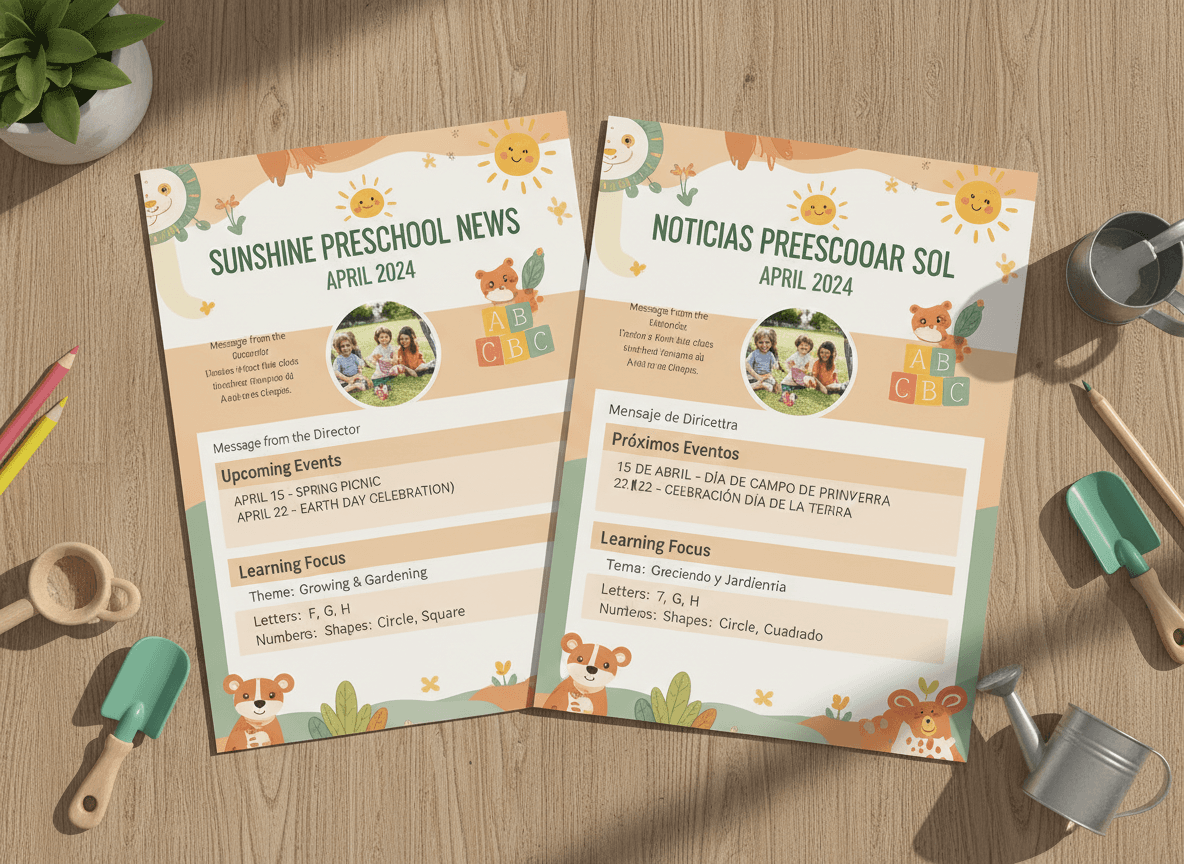
Send a curriculum update at the start of each new unit or seasonal shift. Daystage makes it easy to build a template with the three-part structure described above and update it with new content each time rather than rebuilding from scratch. Families who receive consistent, specific curriculum updates throughout the year arrive at spring conferences with a much better understanding of what their child has been doing and why.
Get one newsletter idea every week.
Free. For teachers. No spam.
Frequently asked questions
How do you explain preschool curriculum to parents without jargon?
Replace curriculum terms with specific activities and outcomes. Instead of writing about 'emergent literacy development,' describe what children are doing: looking at books independently, noticing that words go left to right, learning the sounds that letters make. Parents understand activities better than frameworks, and activities are more interesting to read about.
How often should preschool teachers send curriculum newsletters?
A curriculum overview at the start of each major unit or season, plus brief updates in your weekly newsletter, covers most of what families need. A stand-alone curriculum newsletter four to six times per year is enough to give families the big picture without overwhelming them.
What do parents most want to know about preschool curriculum?
Most parents want to know what their child is working on, why it matters for kindergarten readiness, and what they can do at home to support it. Connecting curriculum content to kindergarten preparation is consistently the most effective way to hold parent attention in curriculum communication.
How should teachers handle parents who push for more academic content?
Address the concern directly in your curriculum newsletter by explaining the research on how young children learn. Play-based learning and direct instruction in early childhood are not opposites. Children who develop foundational skills through exploration and play enter formal academic settings with stronger foundations than children who were drilled on worksheets. A newsletter that explains the evidence is more persuasive than one that simply defends the approach.
How does Daystage support curriculum communication for preschool programs?
Daystage lets teachers build structured curriculum newsletters with distinct sections for different domains, so families can see at a glance what areas are being covered and what their child is working toward.

Adi Ackerman
Author
Adi Ackerman is a former classroom teacher and curriculum writer with 8 years in K-8 schools. She writes about school communication, parent engagement, and what actually works in real classrooms.
More for Pre-K
Preschool Field Trip Communication Newsletter: What Families Need Before the Day
Pre-K · 5 min read
Preschool Community Helpers Newsletter: Teaching Children About Police, Fire, and Community Support
Pre-K · 5 min read
Transitional Kindergarten Newsletter: Bridging Pre-K and Kindergarten for Families
Pre-K · 7 min read
Ready to send your first newsletter?
3 newsletters free. No credit card. First one ready in under 5 minutes.
Get started free