

Pre-K Parent Newsletter: School Morning Routine Tips
Chaotic mornings send children into school already dysregulated, and that sets the tone for the whole day. When Pre-K families have a reliable morning routine, children arrive calmer, more focused, and ready to engage. Your newsletter is a simple way to share what actually works without turning it into a parent education seminar.
The Night Before Is When Mornings Get Fixed
Emphasize this point in your newsletter: the most impactful morning routine changes happen the evening before. When clothes are chosen, the backpack is packed, lunches are made, and breakfast is loosely planned the night before, the morning decision load drops dramatically. A 4-year-old who already knows what they are wearing and what they are eating is much easier to move through the morning than one facing choices at 7 AM. One paragraph in your newsletter making this case clearly will save some families weeks of struggle.
Same Steps, Same Order, Every Day
Predictability is the engine of a smooth Pre-K morning. Young children do not generalize instructions well across days. When the routine is identical every morning, children begin to execute it with less adult prompting over time because the sequence becomes automatic. Share a simple sample routine in your newsletter: wake up, bathroom, get dressed, breakfast, shoes and backpack, out the door. Families can adapt the specifics, but the principle of consistent order is what makes it work.
Visual Schedules for Independent Follow-Through
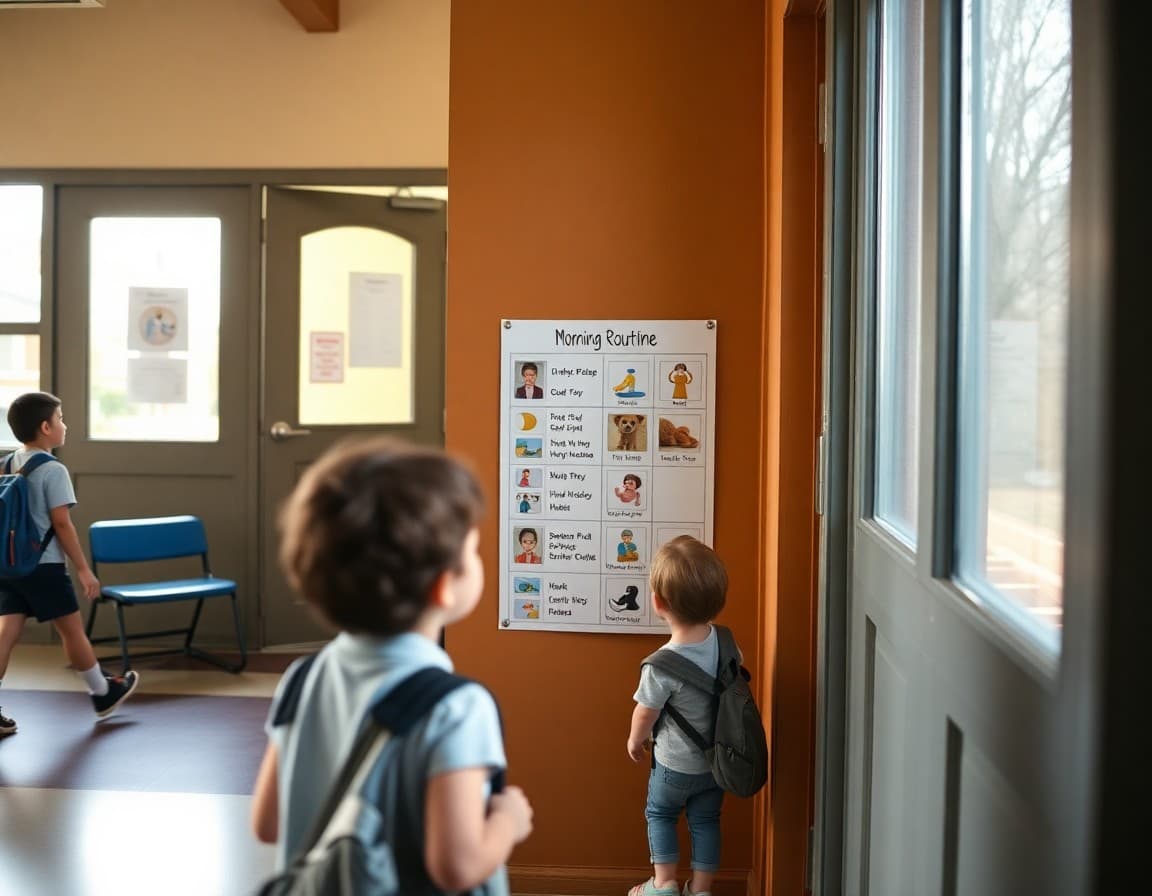
Suggest that families create a simple visual morning chart and post it near the front door or bathroom mirror. It does not need to be fancy. Photos printed from a phone, cut from a magazine, or even hand-drawn pictures in sequence work just as well as laminated cards. Children who can look at a chart and check off what they have done develop a sense of agency and completion that reduces resistance. It also moves the nagging from the parent to the chart, which changes the dynamic entirely.
A Sample Newsletter Excerpt to Copy
“If mornings feel rushed, one of the easiest changes is doing the prep work the night before. Pack the backpack. Set out the clothes. Have breakfast planned. When your child wakes up, the decisions are already made. We also love the idea of a simple picture chart on the wall showing the morning steps in order. Once a child can follow the chart on their own, mornings get a lot calmer for everyone.”
Managing the “Just Five More Minutes” Problem
Young children have no reliable sense of how long five minutes actually is. Giving transition warnings using concrete language works better than time references. Say “after you finish that puzzle, we put on shoes” rather than “you have five minutes.” A visual timer, like a sand timer or a basic digital countdown, can help because children can see the time passing rather than trying to imagine it. Include a note about visual timers in your newsletter. They are inexpensive and genuinely useful for this age group.
Separation and the Drop-Off Moment
For many Pre-K families, the hardest part of the morning routine is the goodbye at drop-off. Address this directly if your class is in a phase where separation is hard. Acknowledge that a confident, predictable farewell ritual, saying the same thing, giving the same hug, leaving quickly and without looking back, is kinder to the child than a drawn-out goodbye. Prolonged or uncertain farewells amplify anxiety rather than calm it. Share a few specific phrases families can use: “I love you. I'll be here when school is done. Have a great day.”
Getting Ready as Skill-Building
Pre-K children who participate in their own morning routine build independence and fine motor skills at the same time. Putting on shoes, zipping a backpack, and choosing between two breakfast options are all developmentally appropriate tasks that build capability and confidence. Your newsletter can encourage families to build in a few extra minutes so the child can do these things themselves rather than having a rushed parent do it for them. Slower mornings now lead to more capable children in kindergarten.
Sending Routine Tips Through Daystage
Daystage makes it easy to include a practical morning tips section in your regular Pre-K update. You can add a photo of a visual morning chart, a quick tip about nighttime prep, or a printable the family can put on their fridge, all within the same newsletter families already open to see classroom news. That kind of integrated communication lands more consistently than a one-time flyer sent home in a backpack.
Get one newsletter idea every week.
Free. For teachers. No spam.
Frequently asked questions
Why do Pre-K mornings so often become stressful?
Mostly because young children are not naturally oriented toward efficiency, and mornings require a lot of transitions in a short time. A 4-year-old who gets absorbed in one thing and refuses to shift is not being difficult on purpose. Their prefrontal cortex is still developing and cannot reliably override an engaging activity for a future abstract goal like ‘we need to leave in five minutes.’ Predictable routines, visual supports, and advance warnings help because they give the child's brain something to latch onto.
What should a Pre-K morning routine look like?
The most effective Pre-K morning routines have the same steps in the same order every day. A simple sequence might be: wake up, bathroom, get dressed, eat breakfast, put on shoes and backpack, out the door. The fewer decisions required in the morning, the smoother it goes. Laying out clothes the night before, packing the backpack the evening before, and having breakfast foods chosen in advance all reduce morning friction significantly.
How can visual schedules help Pre-K children with their morning routine?
Children this age respond very well to pictures rather than verbal reminders. A simple visual chart posted near the front door, showing the steps of the morning routine in order with photographs or drawings, gives the child a concrete reference point. Instead of a parent telling them to brush teeth again, the child can look at the chart and see what comes next. This shifts the routine from a power struggle to a system the child can follow.
What is the single biggest morning routine mistake parents make?
Trying to accomplish too much. Mornings work best when the only goal is getting the child out the door fed, dressed, and calm. Any screen time, extended play, or complex decisions in the morning window create friction that rarely resolves before departure. Families who move screen time to the evening and lay out everything the night before consistently report smoother mornings even with no other changes.
How can teachers send morning routine tips to families efficiently?
Daystage lets you include a practical family tip in your weekly Pre-K newsletter alongside classroom news. A short morning routine section with a downloadable visual chart template or a photo example from a family who gave permission takes just a few minutes to write and lands directly on families' phones where they are most likely to act on it.

Adi Ackerman
Author
Adi Ackerman is a former classroom teacher and curriculum writer with 8 years in K-8 schools. She writes about school communication, parent engagement, and what actually works in real classrooms.
More for Pre-K
Ready to send your first newsletter?
3 newsletters free. No credit card. First one ready in under 5 minutes.
Get started free