

Engineering Challenge Newsletter: How to Talk About the Project at Home
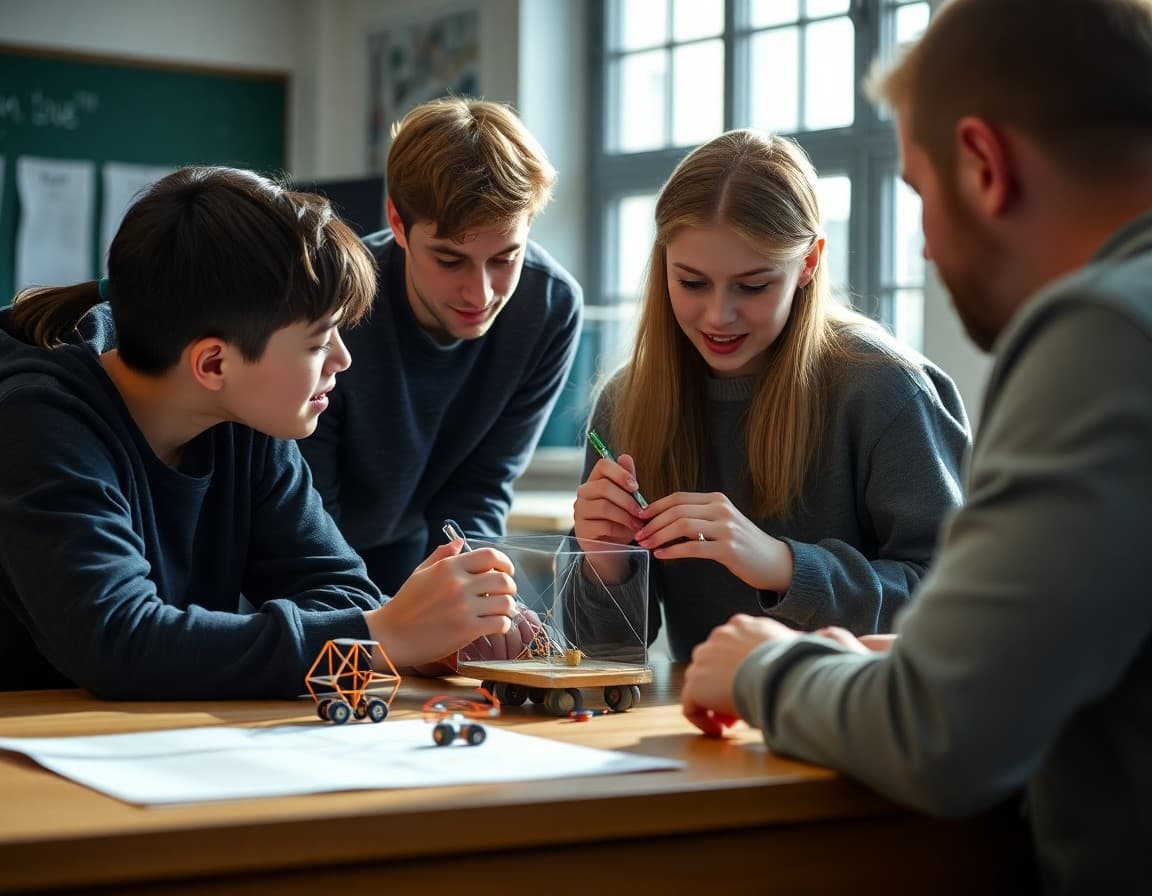
Engineering challenges are among the most remembered learning experiences in middle school. Students who participated in a bridge-building or egg-drop challenge ten years ago can often describe in detail what they built, why it worked or failed, and what they learned. The combination of physical making, real constraints, immediate feedback, and team dynamics creates a learning experience that sticks. A newsletter that frames this experience for families, explains the educational purpose, and prepares them for the conversation when a student comes home saying their design failed, sets up the support structure the assignment deserves.
What the Challenge Involves
Students in this challenge will receive a design problem, a set of allowable materials, and specific performance criteria. They will work in teams to design a solution, build a prototype, test it against the criteria, and iterate on their design based on what they observe. The timeline includes planning time, building time, and testing and reflection time. Students will document their design process and present their thinking to the class whether their design succeeded or not. The challenge is designed to produce a range of outcomes, which means some teams will meet the performance criteria and some will not. Both outcomes are valuable.
Why Failure Is the Point
Engineering challenges are deliberately designed so that not every team succeeds on the first try, and often not at all. This is intentional. Students who only work on problems with guaranteed solutions develop a very different relationship with challenge than students who work on problems that might not resolve. The engineering design process normalizes iteration: you try something, observe what happens, understand why it did or did not work, and try something better. Students who internalize this process are significantly more resilient in academic settings and in life. When a student comes home saying their bridge collapsed or their egg broke, the right response is genuine curiosity about what happened and what they would do differently, not consolation that implies failure is a bad outcome.
The Role of Constraints
Constraints in an engineering challenge are not obstacles. They are the thing that makes design interesting. If students could use any material in unlimited quantities, the challenge becomes a spending problem rather than a design problem. Limiting students to fifty index cards and one meter of tape forces them to think carefully about where each piece of material adds value. Real engineering always happens under constraints: budgets, available materials, physical laws, safety requirements, and time. The constraints in a classroom challenge are a simplified version of the constraints every engineer works within. Students who learn to work creatively within constraints in middle school have an advantage in every project-based context they encounter later.
Team Dynamics and Decision-Making
Engineering challenges often surface interesting team dynamics. Groups have to make design decisions with limited information and under time pressure. Some students want to plan extensively before building. Others want to start building immediately. Some students defer to perceived leaders. Others are confident their idea is best and struggle to compromise. The challenge is not just an engineering exercise. It is a team dynamics laboratory where students practice the social skills of collaborative work: advocating for an idea without dominating, listening to an alternative perspective, accepting a team decision you disagree with, and maintaining a constructive relationship after a disagreement. These are valuable skills regardless of whether the student ever uses engineering professionally.
What to Ask When Your Student Gets Home
Rather than asking "how did your project go," which often produces a one-word answer, try: "What did you build and what problem were you trying to solve?" and "What happened when you tested it?" and "If you could redo one decision, what would it be?" These questions invite more substantive conversation and signal genuine interest in the thinking rather than just the outcome. Students who are asked about their thinking develop stronger metacognitive skills over time. And students who feel their intellectual process is interesting to their family are more motivated to engage deeply with future challenges.
Get one newsletter idea every week.
Free. For teachers. No spam.
Frequently asked questions
What is an engineering design challenge in middle school?
An engineering design challenge gives students a specific problem to solve using a limited set of materials under certain constraints. Classic examples include building the tallest tower from limited spaghetti and marshmallows, designing a bridge that holds the most weight from index cards, or creating a container that protects an egg from a drop. The constraints make the challenge solvable but not trivial and require creative problem-solving.
What do students learn from engineering challenges beyond science content?
Students learn the design thinking cycle, how to work collaboratively under time and resource constraints, how to test ideas quickly and learn from failure without being discouraged, how to make decisions with incomplete information, and how to explain their reasoning to others. These skills transfer to virtually every domain of academic and professional work.
How should families respond when a student says their design failed?
With curiosity rather than consolation. Ask what the design tried to do and what went wrong. Ask what they learned from the failure that they would apply to the next attempt. Avoid framing the failure as a bad outcome because in an engineering challenge context it is not. A design that fails teaches more than a design that happens to work on the first try.
Are students graded on whether their design succeeds?
Most teachers grade engineering challenges on the process rather than the outcome: documentation of the design process, reflection on what worked and what did not, quality of the written or presented explanation, and engagement with the iteration cycle. A student whose design failed but who documented the failure, analyzed it thoroughly, and reflected on what they learned often scores higher than a student whose design happened to work but who cannot explain why.
How can Daystage help teachers share STEM project outcomes with families?
Daystage lets teachers send a newsletter after the challenge with photos of student designs, highlights of interesting solutions, and reflections on what the class learned. Families love seeing their student's work in context. A follow-up Daystage newsletter after the challenge is over gives families a window into the classroom experience they did not witness.

Adi Ackerman
Author
Adi Ackerman is a former classroom teacher and curriculum writer with 8 years in K-8 schools. She writes about school communication, parent engagement, and what actually works in real classrooms.
More for Middle School
Ready to send your first newsletter?
3 newsletters free. No credit card. First one ready in under 5 minutes.
Get started free