

7th Grade Math Facts Newsletter: Home Practice Guide for Families
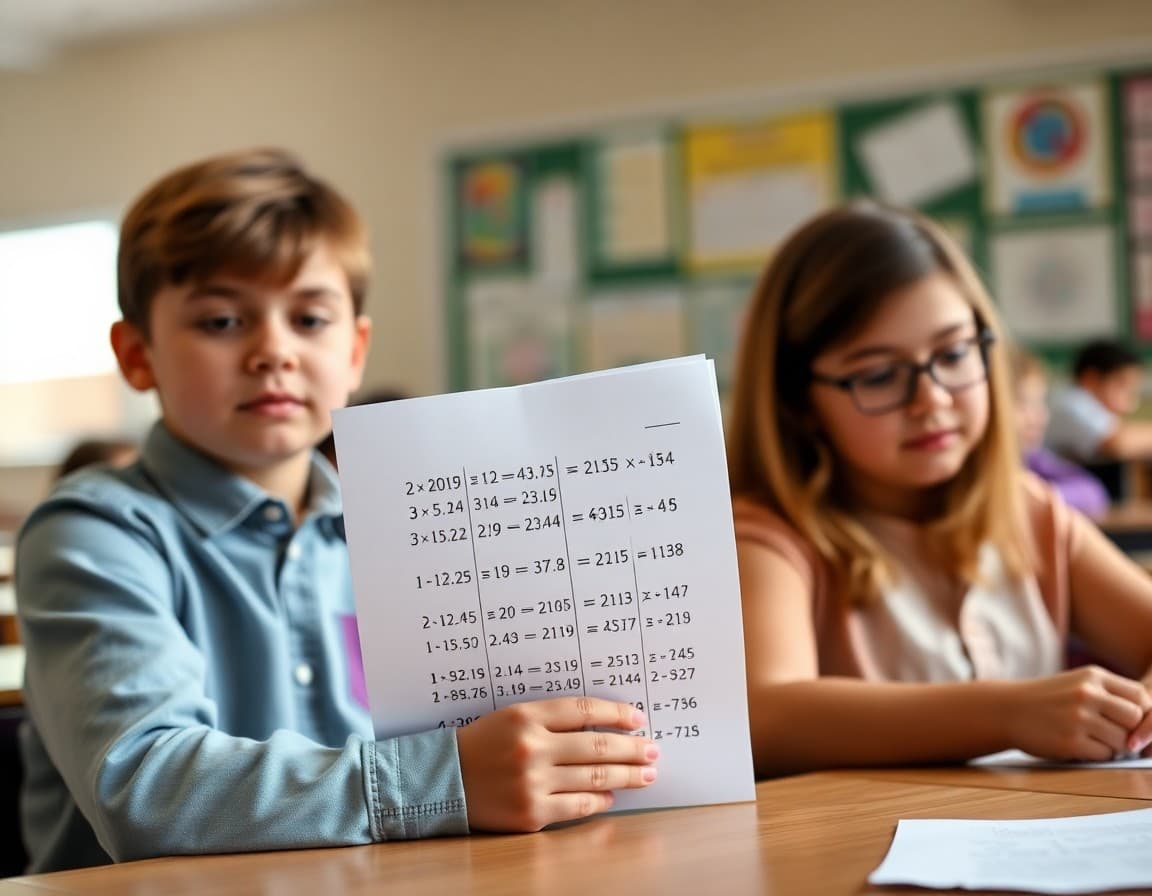
Seventh grade math is where arithmetic gives way to algebraic thinking, and that transition is much smoother for students who have their number facts locked in. A student who has to calculate 7 times 8 during a proportional reasoning problem is splitting their attention in a way that makes the harder concept harder to learn. A focused math facts newsletter helps families understand exactly what to reinforce and why it still matters at this level.
Name the Critical Facts for 7th Grade
Be specific in your newsletter. The facts that matter most in 7th grade are: multiplication through 12x12, division facts in those same families, fraction-decimal conversions for common fractions (halves, thirds, quarters, fifths, eighths, tenths), and percent-fraction equivalents for common benchmarks like 25%, 50%, 75%, and 33%. List them. Families who know exactly what to practice will practice it.
Connect Practice to Upcoming Units
Tell families which units are coming up and which facts are most relevant. "We are entering our ratios and proportions unit in three weeks. Students who are fluent with fraction-decimal conversions will move through this unit significantly faster." Connecting practice to real upcoming content makes the request feel purposeful rather than rote.
Recommend a Daily Practice Format
Give families a concrete five to eight minute format they can use any night:
"Two minutes: student calls out answers to multiplication facts parent reads aloud, random order. Two minutes: student solves 20 written division problems. Two minutes: fraction-to-decimal conversion practice with flashcards. Optional: one-minute mixed review of any fact family the student finds hardest."
That structure requires no preparation and no special materials beyond a piece of paper and a pencil.
Address the Calculator Question
Seventh graders will ask whether they can just use a calculator. Your newsletter can explain your policy, typically that calculators are allowed for multi-step problems but students are expected to know basic facts without them. The reason is not arbitrary: a student who reaches for a calculator for 6 times 7 is signaling that the fact is not yet automatic, which matters when the calculator is not permitted on an assessment.
Recommend Specific Practice Tools
Name two or three specific resources: a free app you have tested, a printable fact drill from your class page, or a website you know works at this grade level. Generic advice to "look for resources online" leads to no action. A specific recommendation leads to most families trying at least one of them.
Acknowledge Students Who Have Already Mastered This
Some students have solid fluency and do not need nightly drill. Your newsletter can acknowledge this group and redirect them toward the extension version of the practice: more complex fraction operations, mental math strategies for larger numbers, or estimation. Students who have mastered the basics benefit from challenge rather than repetition.
Set a Midpoint Check
Suggest that families run the 30-fact timed test in week four to see whether practice is working. If it is, maintain the current schedule. If there are still gaps in specific fact families, increase focus there. This builds a feedback loop into the practice rather than making it purely habitual without measurement.
Keep the Tone Practical
A newsletter that frames fact practice as a quick, daily habit rather than a remediation exercise will be received better by families. Five minutes before bed. On the car ride to school. During a commercial break. When you normalize the practice as a small routine rather than a big intervention, families are more likely to maintain it consistently.
Get one newsletter idea every week.
Free. For teachers. No spam.
Frequently asked questions
What math facts are most important for 7th graders to have mastered?
By 7th grade, students should have automatic recall of multiplication through 12x12, corresponding division facts, and common fraction-decimal-percent equivalents. Students entering the proportional reasoning and algebraic thinking units of 7th grade math will hit these constantly. Gaps in any of these areas slow progress on the concepts that define 7th grade math.
How much time should a 7th grader spend on math fact practice at home?
Five to eight minutes per night is enough if it is deliberate practice rather than passive review. Timed drills, flashcard apps, or oral quizzes from a parent all work. The key is active retrieval, not copying facts from a chart. Regular short sessions build fluency faster than occasional long ones.
My 7th grader says they already know the facts. How do I check?
Ask them to do 30 random mixed multiplication and division facts in under 60 seconds without a calculator. If they can do it cleanly, they are fluent. If they hesitate on specific families like the 7s or 8s, those are worth extra practice. A parent-administered timed test takes five minutes and gives clear information.
How do fraction-decimal-percent conversions connect to 7th grade math?
Seventh grade math includes unit rates, proportions, scale factors, and percent problems. Students who instantly know that 75 percent equals three-quarters equals 0.75 can focus on the problem structure. Students who have to derive these conversions during a test are using cognitive load they need for the actual reasoning.
What tool can I use to send math practice newsletters to 7th grade families?
Daystage lets you send a targeted math practice newsletter with skill lists, a suggested weekly schedule, and links to practice tools. You can update it each quarter as students move into new units where different facts become critical.

Adi Ackerman
Author
Adi Ackerman is a former classroom teacher and curriculum writer with 8 years in K-8 schools. She writes about school communication, parent engagement, and what actually works in real classrooms.
More for Middle School
Ready to send your first newsletter?
3 newsletters free. No credit card. First one ready in under 5 minutes.
Get started free