
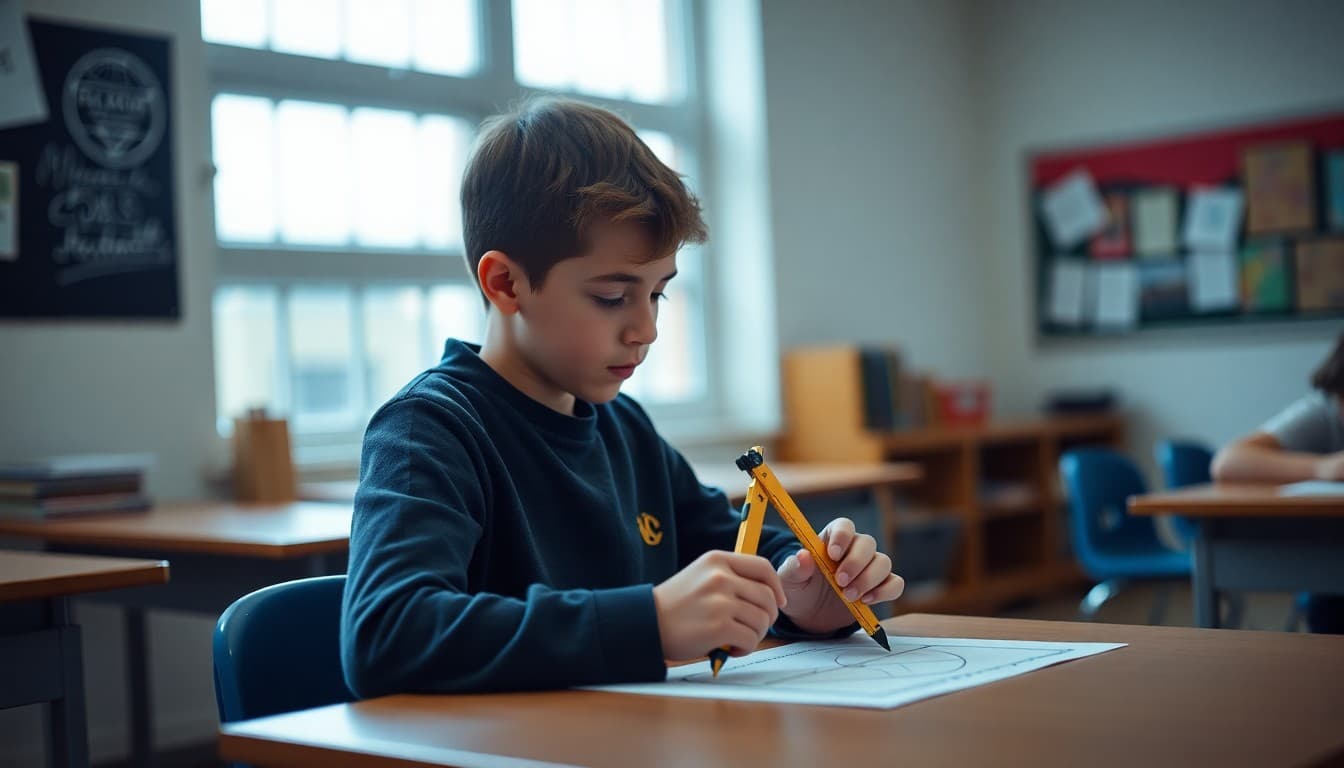
Geometry Middle School Newsletter: Learning Updates for Parents
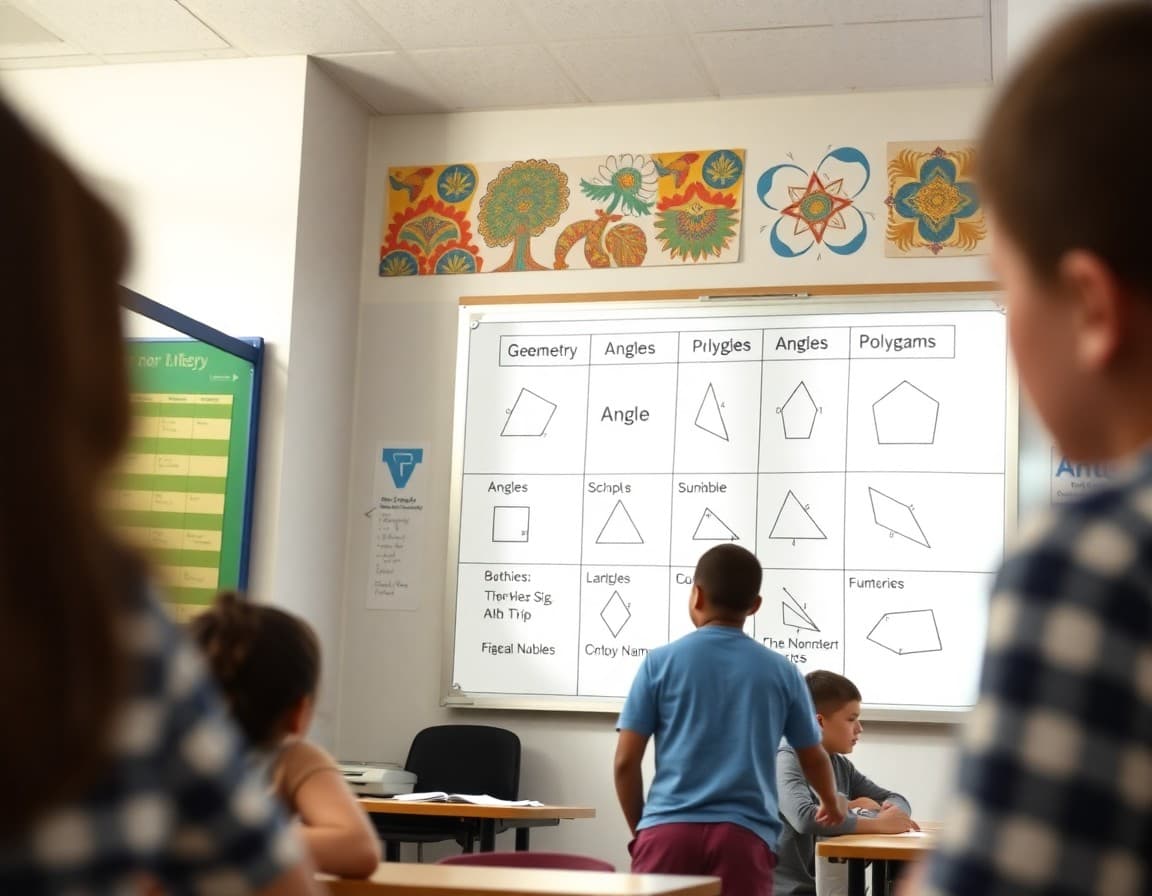
Geometry is one of those math areas that students either love or dread, and families often feel unprepared to help because the visual and spatial nature of the work is different from the arithmetic they are used to. A newsletter that explains the current unit, names what conceptual understanding looks like at this level, and gives families a real-world connection strategy changes that dynamic and makes geometry homework more productive for everyone.
Name the Current Unit and Its Concepts
Every geometry newsletter should open with the specific concepts students are working on. If it is area and perimeter, tell families whether students are working with regular polygons, composite figures, or both. If it is the Pythagorean theorem, explain what it is used for. If it is transformations, describe what each type of transformation does. Specificity makes the newsletter actionable.
Explain Why Conceptual Understanding Matters Here
Geometry formulas are famously easy to misapply. A student who memorizes pi times r squared without understanding that r is the radius and it must be squared before multiplying by pi will make consistent errors in problems where the radius is not given directly. Your newsletter can explain that the goal is not formula recall but the ability to set up and solve problems where students identify which formula applies and why.
Provide a Real-World Connection
Geometry is the most real-world-accessible of all math areas. Here is a section that works well:
"This week's real-world geometry challenge: look at one room in your home and ask your child to calculate the square footage of the floor. Then ask them to figure out how many square feet of tile would be needed to cover it if each tile is one square foot, and how many if each tile is two square feet by two square feet. That problem involves area calculation and unit conversion, exactly what we are working on this week."
Address Formula Confusion
Be direct about where students get confused. Area versus perimeter is the most common early confusion: area is the space inside a figure (square units), perimeter is the distance around it (linear units). Surface area versus volume is the second: surface area measures the outside, volume measures the inside. Many students mix these up even after instruction. Naming the confusion in the newsletter gives families a checklist question: when your child gets a geometry answer, ask them whether they found area or perimeter and how they know.
Explain the Pythagorean Theorem Simply
If students are working on the Pythagorean theorem, explain it in one accessible sentence: in a right triangle, the square of the hypotenuse equals the sum of the squares of the other two sides. The practical meaning: if you know two sides of a right triangle, you can always find the third. That is used in construction, navigation, and virtually every applied math context. Families who understand the concept can ask better questions when their child works on these problems.
Talk About Precision in Measurement
Geometry requires precision. A student who measures carelessly or rounds in the wrong place gets incorrect answers even with the right method. Your newsletter can suggest that families reinforce precision habits: read the ruler to the nearest millimeter, carry decimal places through the calculation, and round only at the final step. That habit matters in science and real-world applications as well as in the geometry classroom.
Connect to Future Math
The Pythagorean theorem is foundational for high school geometry proofs and trigonometry. Coordinate geometry connects to algebra functions. Surface area and volume appear in chemistry and physics. Letting families know where this unit leads is motivating and helps them see the current work as part of a longer learning arc, not an isolated topic.
End With a Hands-On Suggestion
Close with one specific hands-on activity: measure the walls of a room to find total surface area, build a scale model of a room on graph paper, or use a tape measure to verify the Pythagorean theorem by measuring a corner of the house. Hands-on geometry practice is more memorable than worksheet practice and does not require any special materials. Daystage makes it easy to include a clear, engaging activity suggestion at the bottom of every geometry newsletter.
Get one newsletter idea every week.
Free. For teachers. No spam.
Frequently asked questions
What geometry concepts do middle school students typically study?
Middle school geometry covers properties of angles and triangles, area and perimeter of polygons, surface area and volume of three-dimensional figures, the Pythagorean theorem, transformations (translations, rotations, reflections, and dilations), and coordinate geometry. Students at this level also begin developing informal proof and logical reasoning skills.
How is middle school geometry different from what parents remember?
Modern middle school geometry places more emphasis on conceptual reasoning and less on memorizing formulas in isolation. Students are expected to understand why a formula works, not just apply it. The connection between geometry and algebra, particularly through coordinate geometry and the Pythagorean theorem, is also more prominent than in traditional programs.
How can families support geometry learning at home?
Real-world application is unusually accessible in geometry. Ask your child to explain how to find the area of your living room floor, or figure out how much paint you would need for the walls of a bedroom. Cooking with volume measurements, measuring furniture for placement, and looking for geometric patterns in architecture all reinforce what students are learning.
What geometry errors are most common in middle school?
Students most commonly confuse area and perimeter formulas, apply area formulas to three-dimensional problems, forget to square the radius when calculating circle area, and make sign errors in coordinate geometry. Naming these in your newsletter gives families something specific to check when reviewing homework.
What tool helps communicate geometry unit updates to middle school families?
Daystage makes it easy to send a geometry newsletter with the current unit focus, a real-world connection example, and a brief practice suggestion that families can apply at home without special materials.

Adi Ackerman
Author
Adi Ackerman is a former classroom teacher and curriculum writer with 8 years in K-8 schools. She writes about school communication, parent engagement, and what actually works in real classrooms.
More for Middle School
Ready to send your first newsletter?
3 newsletters free. No credit card. First one ready in under 5 minutes.
Get started free