
Life Science Middle School Newsletter: Learning Updates for Parents

Life science is the biology of everything students will encounter in their own bodies, in nature, and in the news for the rest of their lives. Climate change, disease outbreak, genetic testing, conservation: all of these draw on concepts students are learning in middle school life science. A newsletter that helps families understand what their child is studying creates a generation of students who see the news through a biological lens and have the vocabulary to discuss it.
Name the Current Unit
Start your newsletter with the specific unit underway. Cell biology. Genetics. Ecosystems. Natural selection. Human body systems. Name it and give a one-paragraph overview of what it covers. Families who know the unit can ask their child specific questions and connect it to real-world examples they encounter during the week.
Describe the Lab Work
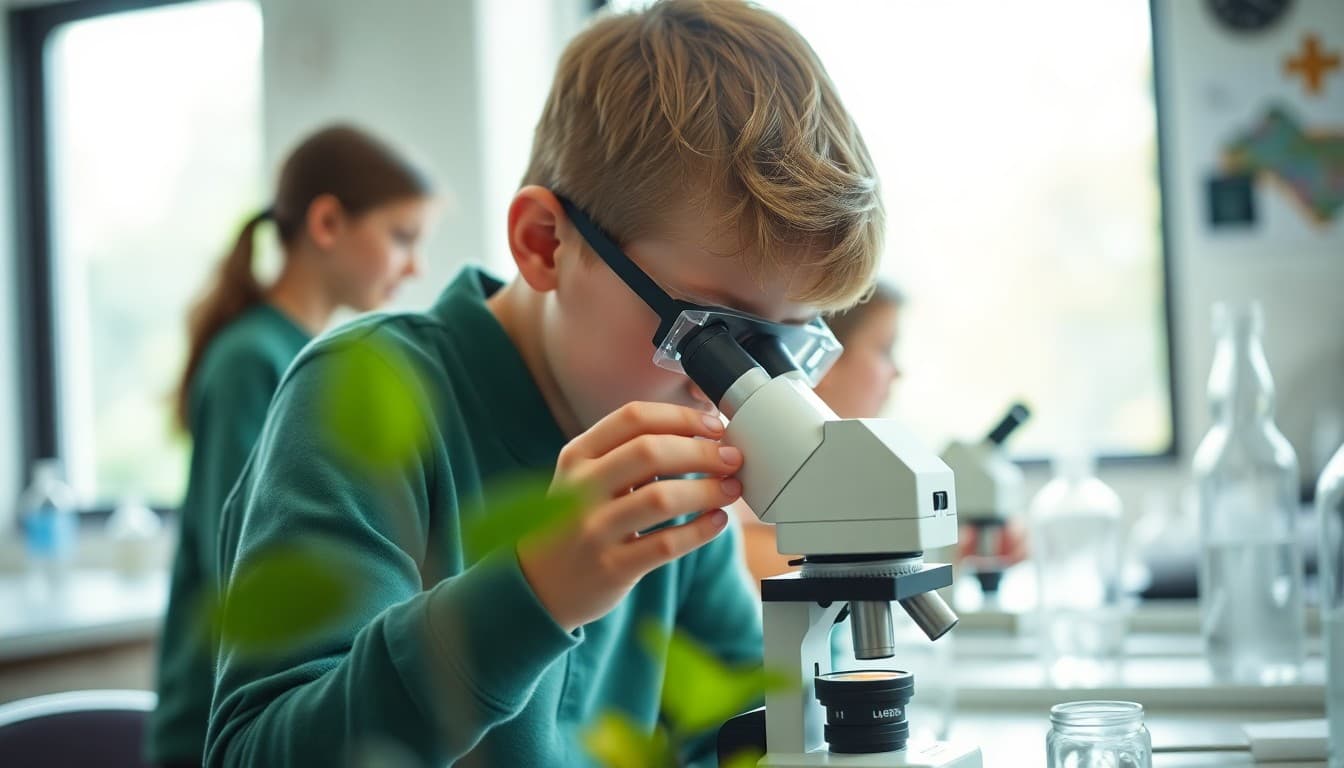
Life science labs are often the most memorable parts of the class. Share what students are doing. "This week students used microscopes to observe plant and animal cells and identify the differences in cell structure. They are learning to distinguish the cell wall and chloroplasts in plant cells from the structures found only in animal cells." That description turns a vague "we did microscope stuff" into a specific conversation topic at home.
Address a Common Misconception
Every life science unit has persistent misconceptions worth addressing. Natural selection is the most important one to handle correctly in 7th or 8th grade:
"This week we are working on a misconception that many people hold: that individual animals change during their lifetime to adapt to their environment. That is not how evolution works. What actually happens is that organisms with traits that help them survive in their environment are more likely to reproduce. Over many generations, those helpful traits become more common in the population. Individual animals do not evolve. Populations do, over time. Ask your child to explain this distinction with an example."
Make the Personal Connection Explicit
Life science is uniquely personal for middle school students who are actively living through puberty and body change. When you study the human body, connect it directly to what students are experiencing. When you study genetics, invite students to think about where their own traits came from. When you study ecosystems, connect it to food choices and environmental decisions families make. These personal connections move life science from abstract to relevant.
Offer a Home Extension Activity
Every life science unit has a home extension that requires no special materials. Growing beans from seed to observe germination and cell growth. Looking for five different types of insects in the yard. Tracing a family trait through photographs of three generations. Watching a documentary on ecosystems and identifying food web relationships in it. Name a specific activity that connects to the current unit and takes less than 30 minutes.
Share Key Vocabulary
Life science introduces enormous amounts of vocabulary that students need to use accurately. Your newsletter can list the three to five most important terms from the current unit with brief, plain-language definitions. When families have the vocabulary, they can engage with their child's learning more specifically. A parent who knows the difference between mitosis and meiosis can ask a more useful question than a parent who just asks "how was science today."
Connect to Current Biology in the News
Biology appears in the news every week. A new virus strain. A conservation success story. A genetic testing advance. A climate-related species change. Your newsletter can note any current event that connects to the unit underway. Students who see their classroom science in the real world develop a very different relationship with the subject than students who see it only in a textbook.
Preview Upcoming Assessments and Labs
Tell families what is coming in the next two weeks: a lab practical, a unit test, a model-building project, or a research presentation. Families who know what is coming can help their child prepare without waiting to be asked. Daystage makes it easy to include an upcoming events section at the bottom of every science newsletter so families are never caught off guard by a major assignment.
Get one newsletter idea every week.
Free. For teachers. No spam.
Frequently asked questions
What does middle school life science cover?
Middle school life science typically covers cell biology, genetics and heredity, evolution and natural selection, ecosystems and food webs, human body systems, and sometimes microbiology. These units build on each other from the smallest scale (cells) to the largest (ecosystems), developing a coherent understanding of how living systems work.
How can families extend life science learning at home?
Life science is happening in every backyard, kitchen, and neighborhood. Growing plants from seed, observing insects, discussing family traits and genetics, watching nature documentaries connected to the current unit, and reading about recent biology research all extend classroom learning. A newsletter that names what the current unit is makes these connections possible.
What life science concepts are particularly difficult for middle schoolers?
Natural selection is consistently misunderstood: students often think individual organisms evolve intentionally rather than that populations change over generations through differential reproduction. Mitosis versus meiosis is another persistent confusion. DNA structure and protein synthesis involve abstract molecular concepts that benefit from model-building or visual representation.
How does life science connect to health and human development topics students care about?
The genetics unit directly addresses why students have traits from their parents and how heredity works. The human body systems unit connects to decisions about nutrition, exercise, sleep, and substance use. The cells unit explains why cancer happens and why vaccines work. These personal connections make life science unusually relevant to adolescent students.
What tool makes life science unit newsletters easier to send consistently?
Daystage works well for science newsletters because it supports unit summaries, lab descriptions, extension activity suggestions, and vocabulary lists in a clean, readable format that families can reference throughout the unit.

Adi Ackerman
Author
Adi Ackerman is a former classroom teacher and curriculum writer with 8 years in K-8 schools. She writes about school communication, parent engagement, and what actually works in real classrooms.
More for Middle School
Ready to send your first newsletter?
3 newsletters free. No credit card. First one ready in under 5 minutes.
Get started free