

Kindergarten Cutting Skills Newsletter: Scissor Practice at Home
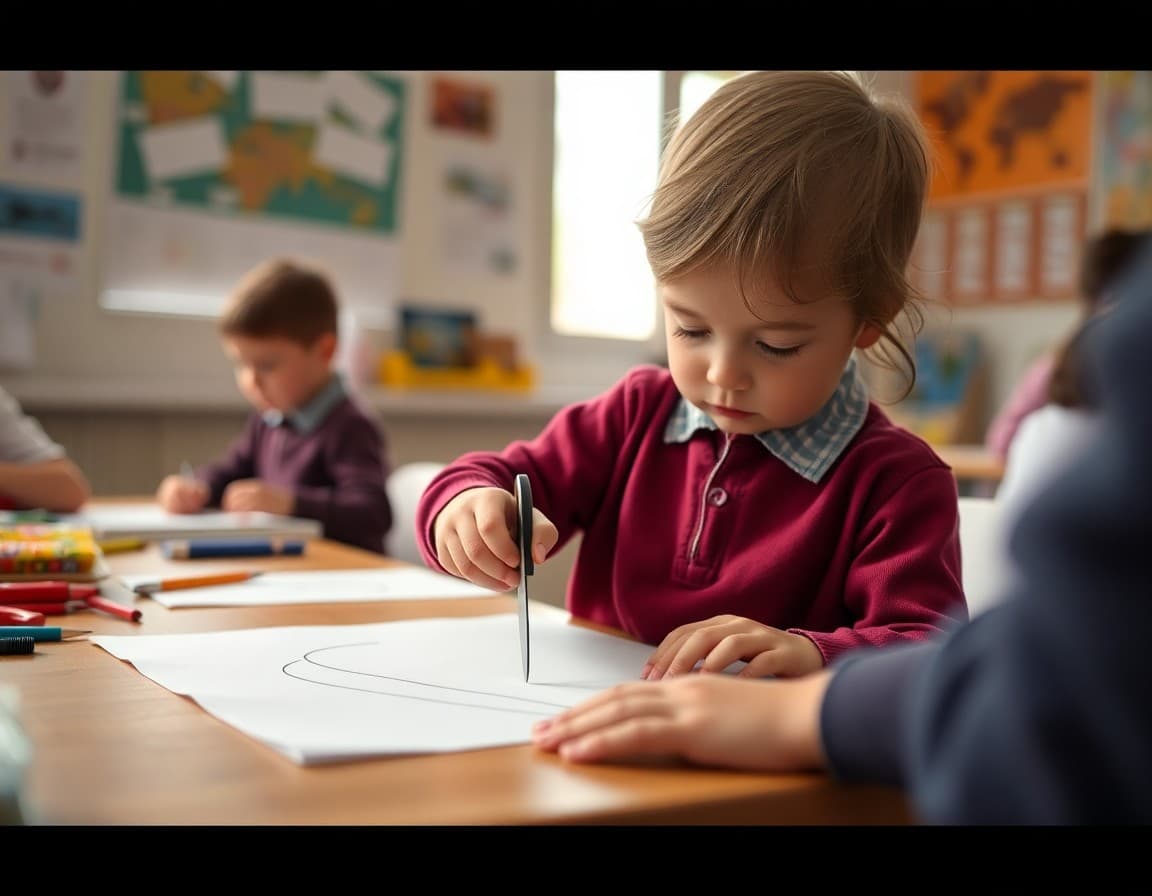
Scissor skills are one of the fine motor benchmarks that kindergarten art and writing activities depend on. A child who arrives at kindergarten unable to snip paper will struggle with the cutting components of projects throughout the year. A child who has practiced cutting at home for a few weeks before school starts has a meaningful advantage. Here is how to help families build this skill safely and engagingly.
Start With Random Snipping, Not Line Following
The first cutting skill to develop is the basic open-close motion of the scissors while maintaining control. Random snipping across small pieces of paper requires no directional tracking and builds hand strength through repetition. Families can practice this with no materials except child-safe scissors and paper scraps.
Suggest a simple first activity: cut a piece of paper into as many tiny pieces as possible without any lines to follow. The result is a pile of confetti. Make a collage with the confetti. This gives the cutting a purpose, makes the activity feel creative rather than academic, and allows multiple repetitions of the cut motion in a single session.
Teach Correct Grip Before Anything Else
The scissor grip is easier to establish correctly at the beginning than to correct after a habit has formed. In your newsletter, describe the correct grip clearly: thumb through the top loop, middle finger through the bottom loop, index finger along the outside of the bottom loop for stability, thumb pointing up toward the ceiling.
Common incorrect grips families may see: multiple fingers in each loop (reduces control), thumb down rather than up (inhibits the natural cutting motion), or whole-hand squeezing rather than thumb-only opening and closing. None of these grips are emergencies. But correcting them early, during the setup of the activity rather than mid-cut, is worth the brief attention.
Progress From Snipping to Straight Lines
After 5-10 sessions of random snipping, children are ready to cut along a line. Start with thick lines (1 cm or wider) drawn with a marker on paper strips. Paper strips about 1 inch wide are ideal because they cross the whole width of the paper in one or two cuts, providing quick success and multiple repetitions per page.
A practical home activity: draw a series of horizontal lines on a piece of paper and ask the child to cut along each one. When all lines are cut, the paper becomes a fringe that can be decorated or used in a collage. This frames the cutting practice as a purposeful craft project rather than a drill.
Left-Handed Children Need Left-Handed Scissors
This point deserves its own section because it is frequently overlooked. Standard scissors are designed for right-handed users. When a left-handed child uses them, the blade positioning works against them, making it difficult to see the cutting line and requiring extra force. Left-handed children who struggle with scissors should have true left-handed scissors before concluding that they have a fine motor problem.
Recommend families identify their child's dominant hand early and purchase left-handed scissors if needed. Left-handed children who switch to appropriate scissors often show immediate improvement in cutting accuracy, which is motivating and builds confidence for the rest of the school year's cutting activities.
Safe Cutting Habits at Home
Children who learn safety habits around scissors early carry those habits into classroom independence. Include a brief safety section in your newsletter with the rules that match your classroom expectations: always carry scissors with the blades pointing down, hand scissors to another person handle-first (not blade-first), use scissors only for paper or approved materials (not hair, clothing, or furniture), and put scissors away when not cutting.
These rules are best taught through brief demonstration and then reinforced consistently, not through repeated verbal reminders. A family that demonstrates scissors-down carrying once and then reinforces it every time is more effective than one that explains the safety rule repeatedly.
Build Toward Simple Shape Cutting
Once a child can cut along a straight line with reasonable accuracy, introduce simple shape cutting: a large square, a simple triangle, a circle drawn with a clear outline. Cutting around curves is harder than cutting straight lines and requires the child to rotate the paper while cutting, which requires bilateral coordination.
Suggest a shape book project: the child cuts out simple shapes, glues them onto construction paper, and draws or dictates a sentence about each shape. This integrates fine motor, geometry, and early literacy into one project that takes about 20 minutes and produces something the child feels proud of. Projects with visible outcomes keep motivation high for skill-building activities that require sustained effort.
Get one newsletter idea every week.
Free. For teachers. No spam.
Frequently asked questions
At what age should children be able to use scissors?
Most children develop the hand strength and coordination needed for basic scissor use between ages 4 and 6. At 4-5, most children can make random cuts across paper. By age 5-6 (kindergarten age), children are typically developing the ability to cut along straight and simple curved lines, though with varying degrees of accuracy. By end of kindergarten, most children can cut along a straight line, cut out simple shapes, and cut with purposeful direction control.
What type of scissors should kindergartners use?
Age-appropriate scissors designed for children ages 4-7 are safest and most developmentally appropriate. Look for scissors with rounded tips, spring action (which open automatically after each snip), and a blade length of 5-6 inches. Avoid adult-style scissors which are too large for small hands and have sharp tips. Left-handed scissors are specifically designed for left-handed children and significantly improve cutting success for left-dominant children.
How should scissors be held?
The correct scissor grip places the thumb through the upper loop and the middle finger through the lower loop, with the index finger resting along the outside of the lower loop for stability. The thumb should point upward. Many children initially grip scissors with multiple fingers in both loops, which reduces control. Gentle correction of the grip before bad habits solidify is appropriate, but forceful correction during cutting creates frustration. Correct the grip during setup, not mid-cut.
What should children cut first?
Start with random snipping: cut across small pieces of paper without following a line. This builds hand strength and the basic open-close motion before adding directional demands. Progress to cutting along thick straight lines, then to simple L-shapes and curves. Paper strips (1 inch wide) are excellent starter materials because they allow snipping without needing to track a line. Thicker materials like construction paper are easier to cut than thin printer paper.
Can Daystage help send scissor practice newsletters to kindergarten families?
Yes. Daystage lets teachers include photos demonstrating correct grip and starting activities, attach downloadable cutting practice sheets, and send the newsletter timed to the beginning of the school year when fine motor skills are a class focus. Families who practice cutting at home before school starts arrive with noticeably stronger cutting foundations.

Adi Ackerman
Author
Adi Ackerman is a former classroom teacher and curriculum writer with 8 years in K-8 schools. She writes about school communication, parent engagement, and what actually works in real classrooms.
More for Kindergarten Transition
Kindergarten Writing Newsletter: Early Writing Skills at Home
Kindergarten Transition · 6 min read
Kindergarten Coloring Newsletter: How Art Builds Readiness
Kindergarten Transition · 6 min read
Kindergarten Arts and Music Newsletter: How to Communicate the Value of Creative Learning to Families
Kindergarten Transition · 5 min read
Ready to send your first newsletter?
3 newsletters free. No credit card. First one ready in under 5 minutes.
Get started free