
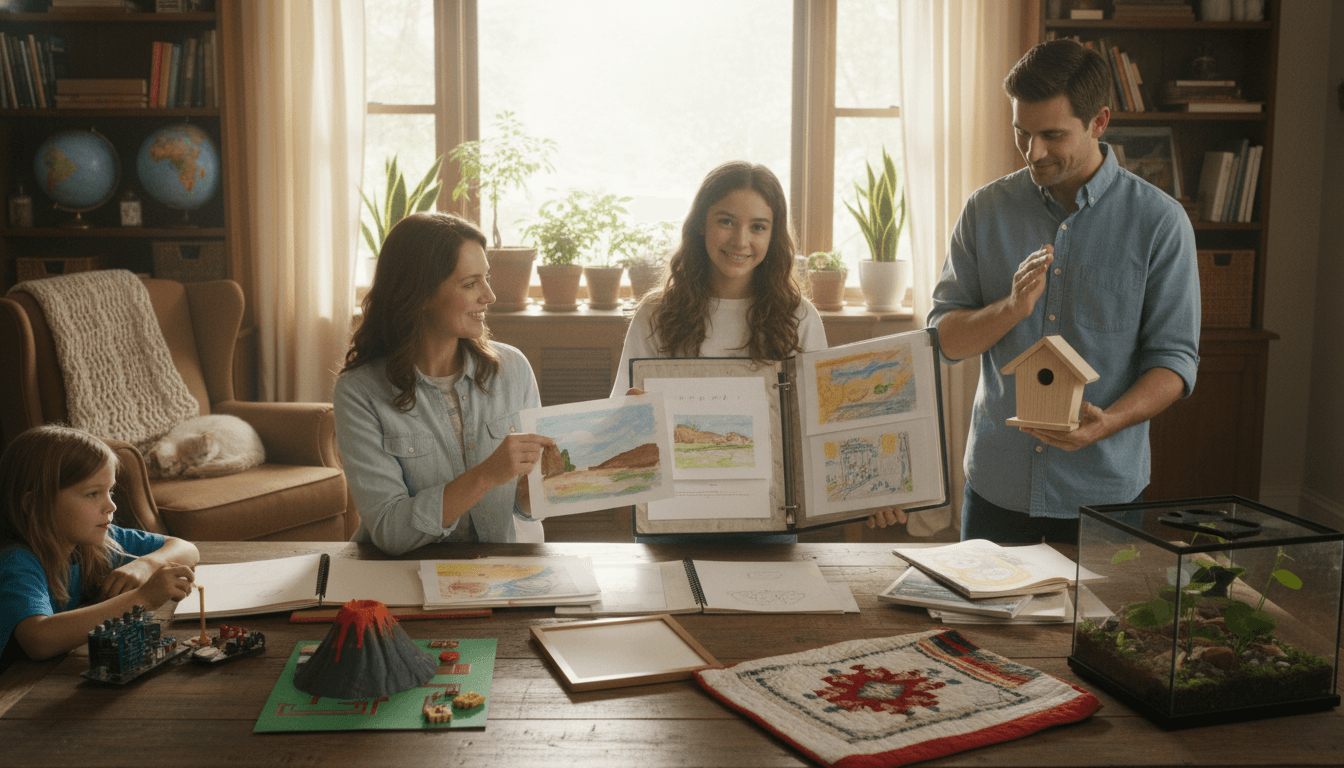
Homeschool End of Year Portfolio Newsletter: What to Include

A homeschool end-of-year portfolio does two things at once: it serves as a legal record of your student's education and it tells the story of a year of learning. When you share highlights from that portfolio as a newsletter, it becomes a third thing: a celebration that brings the people who supported your student into the moment.
Here is how to structure a portfolio that works for all three purposes.
Start collecting throughout the year, not at the end
The most common portfolio mistake is trying to reconstruct a year of work from whatever can be found in June. Portfolios assembled this way are thin in the early months and overrepresent whatever is most recent. Set up a simple collection system at the start of the year: a folder for each subject, a habit of scanning or photographing completed work monthly.
Families who collect as they go arrive at the end of the year with more material than they need. That is a good problem. Families who collect at the end of the year often cannot find early-year work at all.
What to include in each subject section
For language arts, include writing samples from different points in the year, grammar or spelling work, a reading list, and if your student did any formal writing instruction, samples from early and late in that instruction. The contrast between a September and a May writing sample often shows dramatic growth.
For math, include completed worksheets or problem sets from different levels of difficulty, any test results if you used assessments, and a brief note about where the student started and where they finished. "Entered the year working through multi-digit multiplication, ended the year working fluently through fractions and introduced to pre-algebra concepts" is exactly the kind of documentation an evaluator needs.
For science and history, include project documentation, written reports, lab sheets, reading notes, or photos of hands-on experiments and projects. These subjects are often the richest for visual documentation.
Document learning that does not fit on paper
Some of the best homeschool learning is not document-friendly. A student who spent the year learning woodworking, caring for animals, building a computer, performing in community theater, or completing a service project has done significant educational work that does not produce worksheets.
Document these experiences with photos, a written description of the project and what was learned, and any recognition or completion certificates the student received. This section of the portfolio is often what makes evaluators genuinely appreciate homeschool education.
Write a cover letter for the portfolio
Every portfolio should begin with a one-page cover letter from the parent describing the overall educational approach used, the student's strengths and areas of growth, the curriculum and resources used across the year, and a brief statement about the student's learning trajectory heading into the next year.
This cover letter frames everything that follows. An evaluator who reads it first understands the context for the work samples they are about to review. A family member who reads it in a newsletter format understands the year before they look at any specific sample.
Know what your evaluator or state specifically requires
If your state requires portfolio evaluation, contact your evaluator before building the portfolio to confirm their specific requirements. Some evaluators want to see particular subject areas covered in specific depth. Some prefer certain documentation formats. Some use a checklist against which they evaluate the portfolio. Getting that information before you assemble the portfolio saves significant work.
If your state does not require formal evaluation, your portfolio organization is entirely up to you. Design it to serve your own record-keeping purposes and to tell your student's learning story in the way that feels truest.
Turn your portfolio highlights into a newsletter
Your full portfolio is a private record. But a highlights version, the cover letter, a sample from each subject, a photo of a significant project, and a note about what is coming next year, is something you can share with everyone who has been part of your student's education.
Grandparents, co-op teachers, tutors, mentors, and friends who have watched your student grow want to see this. Most of them will never see the full portfolio. A newsletter that captures the year in five or six well-chosen examples gives them the sense of being included in the celebration.
Use Daystage to send your end-of-year portfolio newsletter to everyone on your list. It arrives as a beautifully formatted email in their inbox, not as a Google Drive link they have to remember to click. The year deserves a proper send-off. Daystage gives you one.
Get one newsletter idea every week.
Free. For teachers. No spam.
Frequently asked questions
What is the difference between a homeschool portfolio and a year-end report?
A portfolio is a collection of actual student work: writing samples, math worksheets, art projects, test results, photos of hands-on projects, reading lists. A year-end report is a narrative description of what the student learned. Many homeschool families create both, using the report to tell the story and the portfolio to provide the evidence. Some states that require evaluation specify one format over the other.
How should a homeschool portfolio be organized?
By subject is the most common and most evaluator-friendly organization. Within each subject, arrange work chronologically from the start of the year to the end. This shows growth and makes it easy for an evaluator to see progress over time. Add a brief cover sheet for each subject section describing what curriculum was used and what skills or content the section covers.
What work samples should be included in a homeschool portfolio?
For each core subject, include at least three to five samples from different points in the year: early work, mid-year work, and end-of-year work. Choose samples that show range and growth rather than only best work. An evaluator who sees only perfect work may question whether the portfolio represents typical performance. Mix strong samples with work that shows the learning process.
Does a digital homeschool portfolio meet state requirements?
It depends on the state and the evaluator. Some evaluators are comfortable reviewing a well-organized digital portfolio, especially one that can be viewed on a laptop during the evaluation meeting. Others prefer physical materials. If your state has a formal evaluation requirement, contact your evaluator before the end of the year to confirm their format preference. Surprises on evaluation day are avoidable.
What is the best tool for sharing a homeschool end-of-year portfolio newsletter with family and community?
Daystage is the tool homeschool families use to turn their end-of-year portfolio highlights into a newsletter that reaches grandparents, mentors, co-op members, and anyone else who has been part of the year. It is simple to use, looks professional in every inbox, and handles your full recipient list without any technical setup. Families who share their portfolio highlights through Daystage get far more engagement than those who send attachments or share folders.

Adi Ackerman
Author
Adi Ackerman is a former classroom teacher and curriculum writer with 8 years in K-8 schools. She writes about school communication, parent engagement, and what actually works in real classrooms.
More for Homeschool
Ready to send your first newsletter?
3 newsletters free. No credit card. First one ready in under 5 minutes.
Get started free