

Teacher Newsletter for Argumentative Essay Units: What Families Need to Know
Why Argumentative Writing Is a Core Academic Skill
The ability to construct an argument, support it with evidence, and address opposing views appears in every college course, in standardized testing, and in professional communication across every field. A high school argumentative essay unit is not just an English class assignment. It is preparation for how thinking is communicated in every serious academic and professional context.
The Essay Structure Families Should Understand
Cover the basic structure of an argumentative essay: a clear, debatable claim in the introduction, body paragraphs that each support the claim with specific evidence and analysis, an acknowledgment and rebuttal of the strongest counterargument, and a conclusion that extends beyond simply restating the thesis. Families who understand this structure can have more specific conversations with their student about where the essay is working and where it is not.
The Difference Between Opinion and Argument
High school students often confuse an opinion with an argumentative claim. An opinion ("social media is bad") is not an argument because it cannot be specifically proven with evidence. An argument ("mandatory phone-free periods during school improve academic performance") is testable with specific evidence. A newsletter that names this distinction helps parents reinforce it at home.
How to Support Revision Without Taking Over
The revision process is where argumentative skill develops. Parents who ask their student to explain each body paragraph's connection to the main claim, or who ask what the strongest objection to the argument is, support the revision process productively. Parents who rewrite sentences or restructure the essay for their student are doing the learning that belongs to the student.
What the Assessment Looks Like
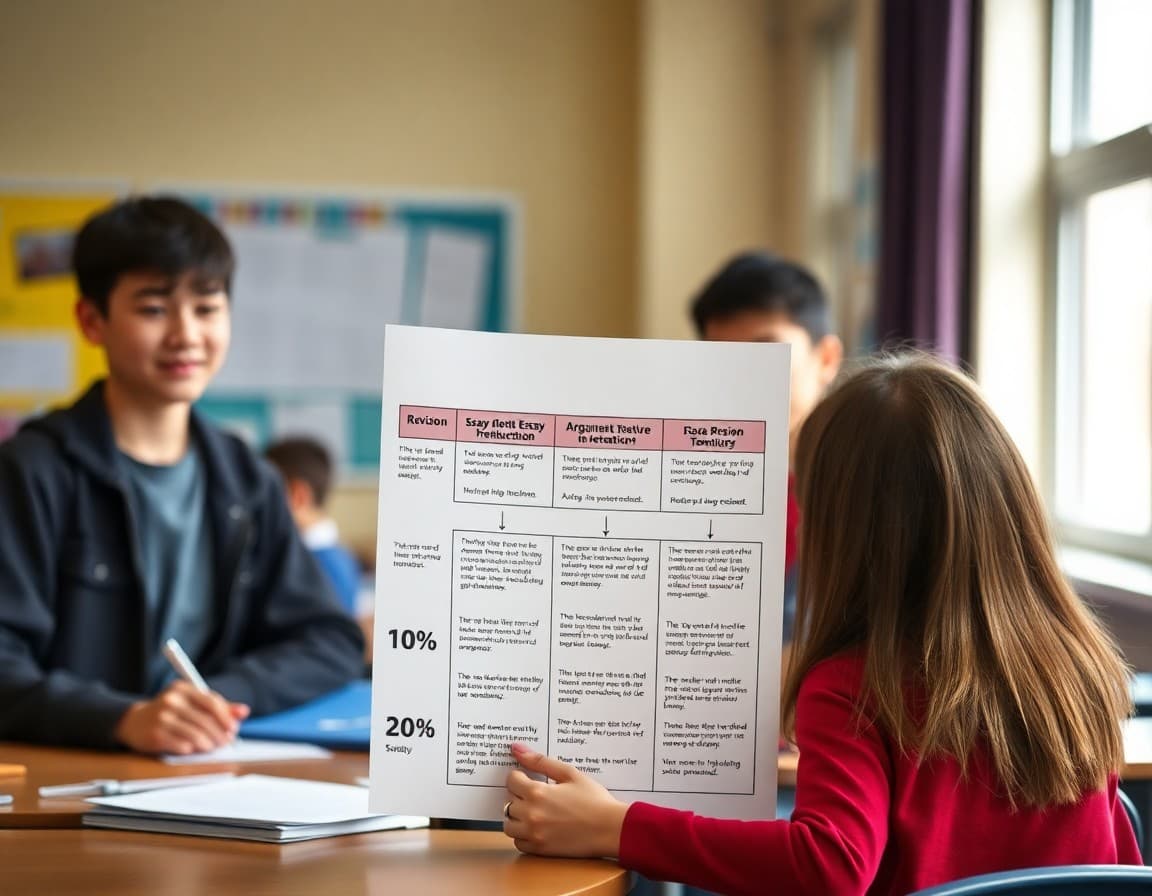
Explain your rubric criteria in plain language: what a strong claim looks like, how evidence should be used and analyzed, what addressing the counterargument requires, and how mechanics and organization factor in. Families who understand what is being assessed can help their student self-assess against those criteria before submitting.
Connecting Argumentative Writing to Standardized Tests
The AP Lang exam, ACT essay, and SAT reading and writing sections all assess argumentative reasoning and evidence use. A newsletter that connects the argumentative essay unit to these high-stakes assessments motivates students who might otherwise treat the essay as just another English assignment.
Maintaining Consistent Communication Through a Writing Unit
A newsletter at the launch of the argumentative essay unit explaining the prompt and timeline, a mid-unit check-in covering where students are in the process and what resources are available, and a post-unit reflection on what the class produced together creates a complete communication arc for the writing process.
Get one newsletter idea every week.
Free. For teachers. No spam.
Frequently asked questions
What is argumentative essay writing in high school?
Argumentative essay writing teaches students to construct a clear, evidence-based claim, support it with specific evidence from credible sources, address counterarguments, and draw conclusions that extend beyond restating the original claim. It is one of the most directly transferable academic skills, appearing in college courses, standardized tests, and professional writing across almost every field.
How can parents support argumentative essay writing without doing the work?
Parents can ask their student to explain their argument out loud, point out when a reason or piece of evidence seems weak and ask their student to respond, help track revision suggestions from the teacher, and read the final essay out of genuine interest. The argument must come from the student. A parent who rewrites the essay for their student is undermining the exact skill the assignment is designed to build.
What is the revision process for high school argumentative essays?
Strong argumentative essays go through multiple revisions. A first draft establishes the argument structure. Subsequent drafts refine the evidence, tighten the reasoning, address counterarguments more effectively, and improve sentence-level clarity. A newsletter that explains this process helps families understand why first drafts are rough, why revision feedback is positive, and why the teacher asking for multiple revisions is a sign that the assignment is working as intended.
What common mistakes do high school students make in argumentative essays?
Common mistakes include confusing opinion with argument (a claim must be debatable and provable with evidence, not just an opinion), using sources without analyzing them, ignoring the counterargument, writing a summary of different views rather than arguing for a specific one, and failing to connect evidence to the claim explicitly. A newsletter that names these pitfalls helps families prompt their student to avoid them.
What tool helps high school teachers send newsletters about argumentative essay?
Daystage is built for school communication. High school teachers use it to create formatted newsletters about argumentative essay, then send them directly to parent and student email lists without extra design work or app management.

Adi Ackerman
Author
Adi Ackerman is a former classroom teacher and curriculum writer with 8 years in K-8 schools. She writes about school communication, parent engagement, and what actually works in real classrooms.
More for High School
Ready to send your first newsletter?
3 newsletters free. No credit card. First one ready in under 5 minutes.
Get started free