
Ideal School Newsletter Length: Short or Long?
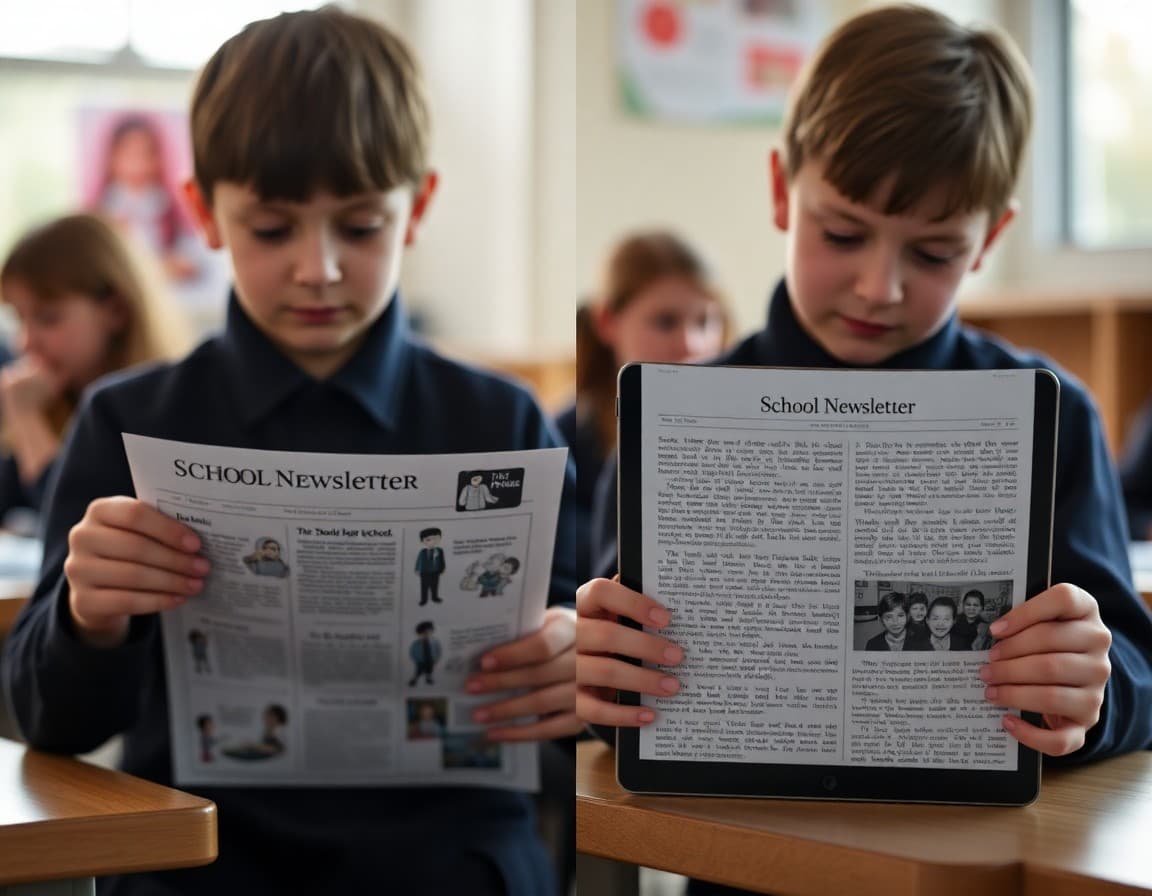
A teacher writes a thorough newsletter every week: 800 words covering everything the class did, everything coming up, all the policies, and a curriculum deep-dive. The open rate is decent. The read-through rate is terrible. Another teacher writes 200 words covering three essential things and gets questions from parents about the details, which tells her they read to the end. Newsletter length is not a measure of effort. It is a communication design decision.
How People Actually Read School Newsletters
Most school newsletters are read on a phone, often in under two minutes. Eye-tracking research on email reading shows that most readers follow an F-pattern: reading across the top, scanning down the left side, and occasionally moving right when something catches their attention. Long paragraphs in the lower half of the newsletter are largely unread. The practical implication is that information placed below 300 words reaches a significantly smaller portion of your audience than information placed in the first 150 words.
The 150-300 Word Target for Weekly Classroom Newsletters
For a weekly classroom newsletter, 150 to 300 words is the target. This is roughly: one paragraph about what the class worked on, a list of two or three upcoming dates, and a specific action item if there is one. Parents who read this will read the whole thing in 90 seconds. Parents who scan it will find the dates and the action item immediately. Both reading styles are served well.
When to Go Longer
Longer newsletters are appropriate in specific circumstances: the back-to-school newsletter that orients new families, the newsletter before a major event that requires detailed logistics, and the post-incident newsletter that needs to acknowledge something, explain what the school is doing, and provide resources. These newsletters can reasonably run 400 to 600 words. They are not the weekly standard. They are the exceptions that justify their length.
What Gets Cut When You Enforce a Word Limit
When you set a 250-word limit on a weekly newsletter, the first things that go are the things that least needed to be there: the lengthy preamble before the actual content, the explanation of why the field trip was educational rather than just the field trip date, the full policy restatement instead of a single-line reminder. Cutting these elements does not reduce the value of the newsletter. It reveals the value that was already there under the padding.
The Relationship Between Length and Trust
Parents who read a newsletter and find it useful and appropriately sized are more likely to open the next one. Parents who regularly receive a newsletter that takes five minutes to read and contains two useful facts amid hundreds of words of filler develop a habit of skimming or ignoring it. Newsletter length affects not just the current communication but the parent's expectation of future newsletters. A track record of concise, high-value newsletters is worth building.
Calibrating Length to Your Specific Audience
Some parent communities have a genuinely high tolerance for longer newsletters and appreciate detailed curriculum descriptions and context. You can test this directly: send two consecutive newsletters, one at 200 words and one at 500 words, covering the same basic information. Compare open times and engagement in your analytics. The data tells you whether your specific community reads past 300 words or stops there. Use the result to calibrate, not someone else's benchmark.
Get one newsletter idea every week.
Free. For teachers. No spam.
Frequently asked questions
How long should a school newsletter be?
For a weekly classroom newsletter, 150 to 300 words is the target. For a school-wide newsletter, 300 to 500 words. For a special circumstances newsletter covering an event or a sensitive situation, up to 600 words may be appropriate. Beyond 600 words, the evidence is consistent: read-through rates drop significantly. The information is still technically in the newsletter, but many families never reach it.
Does a longer newsletter communicate more value?
No. A longer newsletter often communicates less value per word. When newsletter writers try to be comprehensive rather than selective, they include content of marginal relevance that dilutes the high-value content families actually need. A 200-word newsletter that contains three things a parent needs to know is more valuable than a 600-word newsletter where those three things are buried.
What should be cut when a newsletter is too long?
Cut in this order: content that is available elsewhere and does not require action, repetition of information already shared in a previous newsletter, explanations for events that have already passed, and historical context that families did not ask for. What remains should be: what is happening now, what is coming up, and what families need to do.
Should a monthly newsletter be longer than a weekly newsletter?
Somewhat, but not dramatically. A monthly newsletter covering four weeks of activity might run 400 to 600 words versus a weekly at 150 to 300, but the expansion should be proportional, not unbounded. Monthly newsletters that try to recap everything from the past month become long reading projects. A monthly newsletter that covers the highlights of the period and focuses on what comes next in the month ahead is the right format.
Does Daystage have guidance or limits on newsletter length?
Daystage does not impose a word limit, but the block-based structure encourages natural sections that make length easy to assess. When you have filled three or four content blocks with useful information, the newsletter is usually the right length. Adding more blocks beyond the first useful set is often where newsletters get too long. The visual structure of the Daystage editor makes it easy to see when you have crossed from useful to verbose.

Adi Ackerman
Author
Adi Ackerman is a former classroom teacher and curriculum writer with 8 years in K-8 schools. She writes about school communication, parent engagement, and what actually works in real classrooms.
More for Guides
Ready to send your first newsletter?
3 newsletters free. No credit card. First one ready in under 5 minutes.
Get started free