
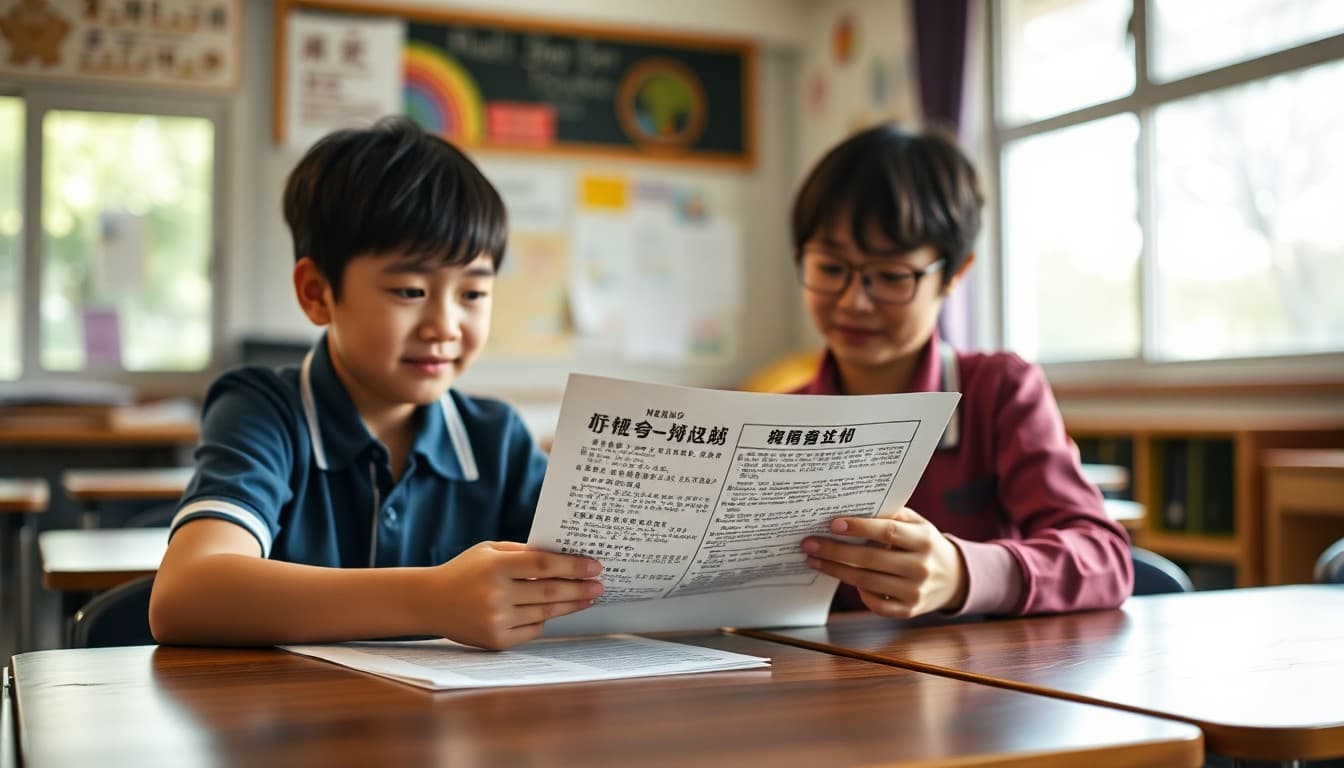
Mandarin School Newsletter Guide for Chinese Families

Chinese-speaking families are one of the largest non-English-speaking communities in U.S. public schools, concentrated in cities like New York, San Francisco, Los Angeles, Houston, and Chicago but present in communities nationwide. A Mandarin school newsletter is not just a courtesy for these families -- it is often the only way to communicate effectively with parents who speak limited or no English.
Simplified vs. Traditional: Get It Right from the Start
Sending a newsletter in the wrong Chinese script is a visible error that signals to families that the school does not know its own community. Mainland Chinese families read Simplified characters. Taiwanese families use Traditional. Hong Kong families traditionally use Traditional but often read Simplified. Singapore families use Simplified.
The fastest way to get this right is to ask at enrollment. Include a question on your enrollment form or home language survey: "Do you prefer Simplified or Traditional Chinese?" Most families will answer, and the answer removes uncertainty for the rest of the year. If you cannot ask, and your Chinese-speaking population is primarily from mainland China as it is in most U.S. districts, Simplified Chinese is the safe default.
What Mandarin Translation Requires Beyond Google Translate
Machine translation for Mandarin has improved significantly in recent years, and Google Translate produces readable Mandarin for simple informational content. The problems arise with education-specific concepts, formal register, and cultural framing. A concept like "parent-teacher conference" becomes "jia zhang jiao shi hui yi" in Mandarin, which is a reasonable translation, but the context around it -- what to expect, how long it lasts, whether an interpreter will be there -- needs to be explained explicitly because the concept itself may be unfamiliar.
Similarly, the informal, first-name-basis communication style common in American school newsletters can come across as unprofessionally casual in Mandarin. Chinese school communication conventionally uses formal address, respectful language, and a slightly more structured format than American newsletters typically employ.
A Template Opening for a Mandarin School Newsletter
Here is a sample opening that works for Mandarin-speaking families using Simplified characters:
"尊敬的家长们,您好!感谢您关注[学校名称]的近况。本期通讯为您带来本周学校的重要信息。如有任何疑问,请致电[电话号码]联系我们。我们有工作人员会讲普通话,欢迎您随时与我们沟通。"
This translates to: "Dear parents, hello! Thank you for following the news at [School Name]. This newsletter brings you important school information for this week. If you have any questions, please call us at [phone number]. We have staff who speak Mandarin and welcome you to communicate with us at any time." The formal register and explicit mention of Mandarin-speaking staff both matter for making families feel the newsletter was written for them.
Key Content Chinese Families Need Early in the Year
Chinese families who are relatively new to the American school system often need clear explanations of processes that American families take for granted. How does grading work? What is a GPA and when does it start to matter? What is the difference between honors and standard courses? Who is the school counselor and what do they do? What support services are available at no cost?
A Mandarin newsletter that walks through these concepts early in the year -- not all at once, but one or two per newsletter over the first six weeks -- builds a foundation of understanding that prevents confusion later. Families who understand the system can support their child through it. Families who do not understand it often become anxious and disengaged.
Academic Pressure and Supporting Families' Expectations
Many Chinese families have high academic expectations for their children and may push for accelerated courses, gifted programs, or additional academic support. Your newsletter can address this productively by explaining what the school's academic pathways look like, when and how gifted or advanced program testing happens, and what support is available for students who need extra challenge or extra help.
Providing this information proactively prevents the frustration some Chinese families feel when they do not know how to navigate the system and miss opportunities for their child. A newsletter that covers the academic pathway in Mandarin once per year -- ideally in the spring before enrollment windows open -- serves families who would otherwise simply not know these options existed.
Reaching Families Through WeChat and Digital Channels
For mainland Chinese families, WeChat is the dominant digital communication platform. Many Chinese parent communities in U.S. schools have existing WeChat groups -- organized by school, by grade level, or by language community -- where information spreads rapidly. If you can get your newsletter link into these groups, reach among Chinese-speaking families will be significantly higher than email alone provides.
Some schools have found success by identifying a trusted bilingual Chinese parent who is already a connector in these community networks and asking them to share official school newsletters in relevant groups. This approach respects the communication infrastructure that already exists rather than trying to compete with it.
Lunar New Year and Cultural Recognition
Acknowledging the Lunar New Year -- which falls in January or February depending on the year -- in your school newsletter sends a clear signal to Chinese families that their cultural calendar is recognized. A brief mention, a photo from a classroom activity, or a note about how the school is celebrating is enough. Families who see their cultural holidays reflected in school communication feel more connected to the institution.
Consistency That Builds Engagement
Chinese-speaking families who receive consistent, well-translated, professional Mandarin newsletters over time develop trust in the school's communication. That trust translates into higher conference attendance, more follow-through on school requests, and greater willingness to raise concerns before they become problems. The investment in good Mandarin newsletters is an investment in the kind of partnership with Chinese-speaking families that benefits students directly.
Get one newsletter idea every week.
Free. For teachers. No spam.
Frequently asked questions
Should a Mandarin school newsletter use Simplified or Traditional Chinese characters?
This depends entirely on your community. Families from mainland China and Singapore use Simplified Chinese characters. Families from Taiwan and Hong Kong traditionally use Traditional Chinese characters, though many Hong Kong families also read Simplified. If your Chinese-speaking population is primarily from mainland China -- which is the case for most U.S. school districts -- Simplified Chinese is the right choice. If you have a significant Taiwanese community, Traditional Chinese is appropriate. When in doubt, ask families at enrollment which script they prefer.
What are the most common challenges in Mandarin school newsletter translation?
The biggest challenges are education-specific terminology that does not translate directly (concepts like IEP, homeroom, or parent-teacher conference have no direct Mandarin equivalents and need explanation), formal register differences (Mandarin school communication uses formal honorifics that casual translation tools often miss), and the Simplified vs. Traditional character question. Machine translation quality for Mandarin is better than for many languages but still requires a native Chinese speaker review for anything beyond basic logistics.
What cultural communication patterns should schools understand for Chinese families?
Many Chinese families come from educational cultures with high respect for teacher authority and an expectation that parents support the school rather than question it. This means Chinese parents may not voice concerns directly even when they have them, may interpret a newsletter invitation to 'share feedback' skeptically, and may be less likely to attend informal events like coffee chats with teachers. Building in formal structures for feedback -- surveys, scheduled conferences, a clear process for raising concerns -- tends to get better results than open-ended invitations.
How do you reach Chinese families through digital communication?
WeChat is the primary digital communication platform for most mainland Chinese families. It functions as email, text message, social media, and news reader all in one. Many Chinese-speaking school communities in the U.S. have parent WeChat groups organized by school or grade level. If your school can send newsletter links through WeChat or have a trusted parent volunteer share them in a parent group, reach rates are dramatically higher than email alone.
Can Daystage help schools reach Mandarin-speaking families more effectively?
Yes. Daystage lets you send a Mandarin version of your newsletter to your Chinese-speaking family segment simultaneously with your English version. You can include photos, event details, and links to RSVP forms in one clean newsletter. Schools that have formalized their Mandarin newsletter using Daystage report that Chinese-speaking families show up for conferences at significantly higher rates because they actually know the conference is happening and what to expect when they arrive.

Adi Ackerman
Author
Adi Ackerman is a former classroom teacher and curriculum writer with 8 years in K-8 schools. She writes about school communication, parent engagement, and what actually works in real classrooms.
More for ELL & ESL
Ready to send your first newsletter?
3 newsletters free. No credit card. First one ready in under 5 minutes.
Get started free