
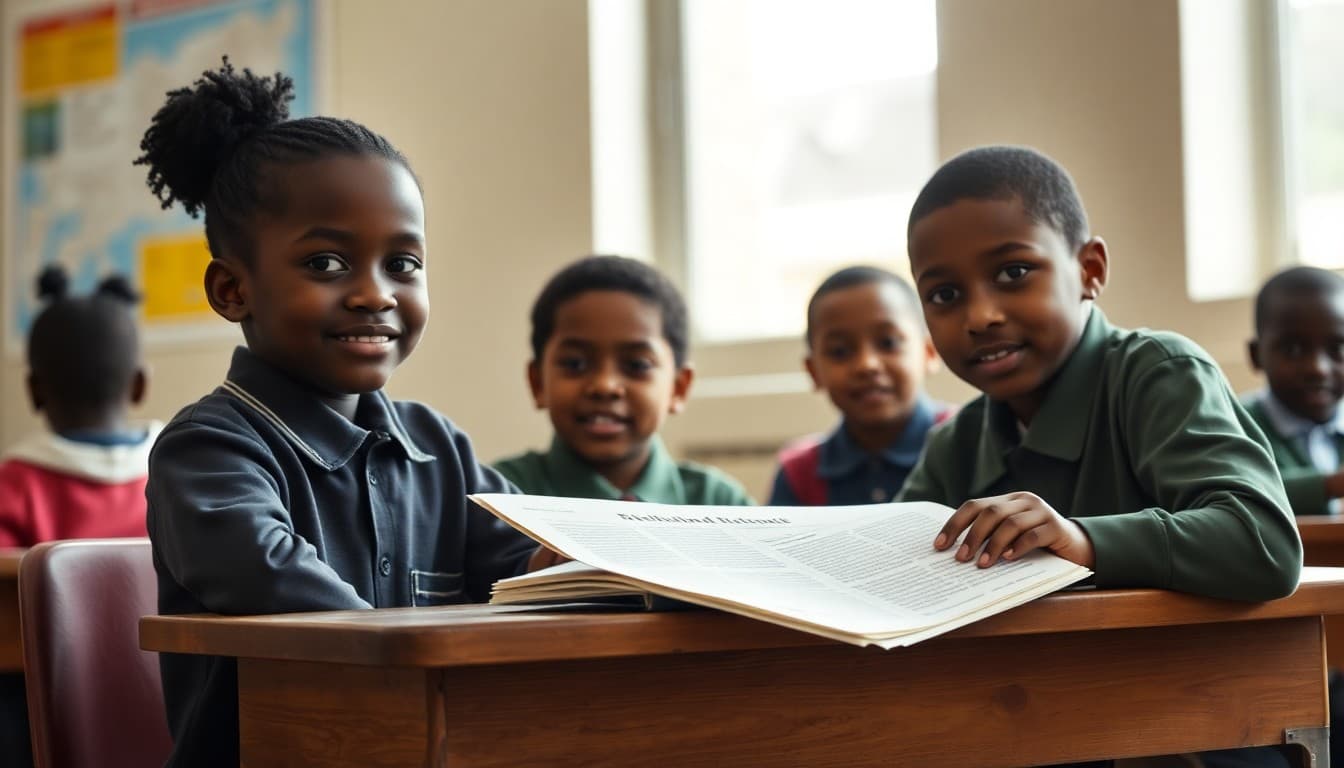
Haitian Creole School Newsletter for Families

In Miami-Dade County, over 40,000 students speak Haitian Creole at home. In Brockton, Massachusetts, Haitian Creole-speaking students make up the largest ELL population in the district. For schools in these communities, a Haitian Creole school newsletter is not a bonus feature. It is the baseline for reaching a significant portion of their families.
Haitian Creole Is Not French: Why This Matters
A school that sends French-language newsletters to Haitian families is not sending Haitian Creole newsletters. These are different languages with different grammar, different vocabulary in many cases, and different scripts in practice. A Haitian parent who received basic French education in Haiti may have some French literacy, but many Haitian families are more comfortable reading Haitian Creole than French, and some have limited formal education in either language.
Getting this distinction right is a matter of both efficacy and respect. Sending French when the family speaks Creole signals that the school has not bothered to distinguish between two distinct linguistic communities. Sending Haitian Creole signals that the school sees the community it actually serves.
Understanding Haitian Creole Literacy Levels in Your Community
Haitian Creole has a standardized written form, but access to formal schooling in Haiti varies enormously by region, economic status, and generation. Some Haitian parents have university degrees and full literacy in Haitian Creole and French. Others have limited formal schooling and may read more slowly or prefer simple, short texts.
For school newsletters, this means writing in plain Haitian Creole -- short sentences, common vocabulary, avoiding complex grammatical constructions -- benefits the broadest range of readers without being condescending to more educated families. When in doubt, shorter and simpler reaches more people.
A Template Opening in Haitian Creole
Here is a sample newsletter opening in standard Haitian Creole that works for a school with a Haitian community:
"Bonjou fanmi yo, Nou kontan voye nouvèl lekòl la ban nou. Silvouplè li mesaj sa a pou jwenn enfòmasyon enpòtan sou sa k ap pase nan lekòl la. Si ou gen kesyon, rele nou nan [phone number]. Nou gen moun ki pale kreyòl ki ka ede ou."
This translates to: "Hello families, We are pleased to send you school news. Please read this message to find important information about what is happening at school. If you have questions, call us at [phone number]. We have Creole-speaking staff who can help you." Direct, respectful, and immediately informative about the fact that language support exists.
Building a Haitian Creole Translation Resource
The practical challenge for most schools is finding someone to produce or review Haitian Creole content. Start with your own staff -- bilingual paraprofessionals, community liaisons, or teachers from the Haitian community are often willing to help with translation review if the workload is reasonable. Parent volunteers are another resource; a small Haitian parent advisory group that reviews translations monthly builds both translation capacity and community relationships.
Some Florida and Massachusetts districts have developed centralized translation services that individual schools can draw on. If your district has a language services coordinator or a Title III-funded translation program, that is the fastest path to getting professional Haitian Creole translations.
Cultural Touchpoints Worth Including
Haitian Heritage Month is celebrated in May, coinciding with Haitian Flag Day on May 18. A newsletter that acknowledges this -- even briefly, even just a sentence noting the school's recognition of the occasion -- signals that Haitian culture is not invisible in your school community. Haitian families who feel their culture is recognized in school communication are more likely to engage with that communication throughout the year.
Other touchpoints include recognizing Haitian students' academic achievements by name when families give permission, featuring Haitian family participation in school events, and occasionally including information about Haitian community resources like cultural organizations, Creole-language health clinics, or community legal services that many Haitian families need.
Reaching Families Who Are Not Reading Newsletters
Some Haitian families are not checking school email or following school social media. They are working multiple jobs, managing households with limited childcare, and navigating their own English language learning alongside their children. For families with limited digital access or literacy challenges, a newsletter sent by email is not sufficient on its own.
Complement written newsletters with phone calls from Haitian-speaking staff for key communications. Use WhatsApp or text message links to digital newsletters, as these have higher open rates than email for many Haitian families. And send paper copies home through students for families who are not reliably connected digitally.
Partnering With the Haitian Community Beyond the Newsletter
The most effective Haitian family engagement programs pair strong newsletter communication with human connection. A Haitian family liaison who attends parent events, calls families before report cards go out, and can answer questions in Creole transforms the newsletter from a one-way broadcast into the starting point for an ongoing relationship. Schools that invest in this role consistently report higher Haitian family engagement and fewer communication breakdowns.
What to Include in a First-of-Year Haitian Creole Newsletter
Beyond the standard welcome content, a first-of-year newsletter for Haitian families should include: the name and contact information for any Haitian-speaking staff member who can serve as a point of contact, information about interpreter services for parent meetings, an explanation of how the American grading system works (the 0-100 or A-F system differs from educational systems in Haiti), and a clear statement that all students are welcome regardless of immigration status. Cover these basics once clearly, and you prevent many of the most common communication failures schools experience with Haitian families throughout the year.
Get one newsletter idea every week.
Free. For teachers. No spam.
Frequently asked questions
How widely is Haitian Creole spoken in U.S. schools?
Haitian Creole is one of the top 10 languages spoken by English learners in U.S. public schools, with large concentrations in Florida (particularly Miami-Dade County), Massachusetts (Boston, Brockton, Cambridge), New York, New Jersey, and Georgia. In some Florida districts, Haitian Creole-speaking students make up 5 to 15 percent of the ELL population. For schools with significant Haitian communities, Haitian Creole newsletters are as essential as Spanish translations are in other districts.
Is Haitian Creole a dialect of French or a separate language?
Haitian Creole is a distinct language, not a dialect of French. While it has significant French vocabulary influence, its grammar structure, phonology, and vocabulary are sufficiently different that a French speaker cannot read or understand Haitian Creole without learning it separately. Schools that send French translations to Haitian families are not reaching those families effectively. Haitian Creole has a standardized written form with its own spelling conventions, and newsletters should use that standard form.
How reliable is automated translation for Haitian Creole?
Machine translation quality for Haitian Creole is significantly lower than for Spanish or French because there is less digital training data for the language. Google Translate can handle basic Haitian Creole but makes frequent vocabulary and grammar errors that native speakers notice immediately. For school newsletters, a human reviewer with native Haitian Creole literacy is essential. Many Haitian communities have bilingual educators, community liaisons, or parent volunteers who can serve this role.
What cultural considerations should inform Haitian school newsletters?
Haitian families often place extremely high value on education and view teacher authority with great respect. However, experiences with poverty, political instability, and in some cases trauma from natural disasters may make families cautious about formal institutional communication. A newsletter that is warm, specific, and clearly from a school that welcomes Haitian families helps overcome hesitation. Including recognition of Haitian Heritage Month in May and acknowledging Haitian culture and history signals genuine inclusion rather than token accommodation.
Can Daystage help format Haitian Creole newsletters professionally?
Yes. Daystage supports multilingual newsletter creation and lets you send different language versions to segmented family lists simultaneously. You can design a professional newsletter with photos and clear layout, paste in your Haitian Creole content, and send it to Haitian families at the same time the English version goes to the broader community. Schools with Haitian communities that have adopted this approach report measurably higher parent conference attendance from Haitian families.

Adi Ackerman
Author
Adi Ackerman is a former classroom teacher and curriculum writer with 8 years in K-8 schools. She writes about school communication, parent engagement, and what actually works in real classrooms.
More for ELL & ESL
Ready to send your first newsletter?
3 newsletters free. No credit card. First one ready in under 5 minutes.
Get started free