

Physical Science Elementary Newsletter: Learning Updates for Parents
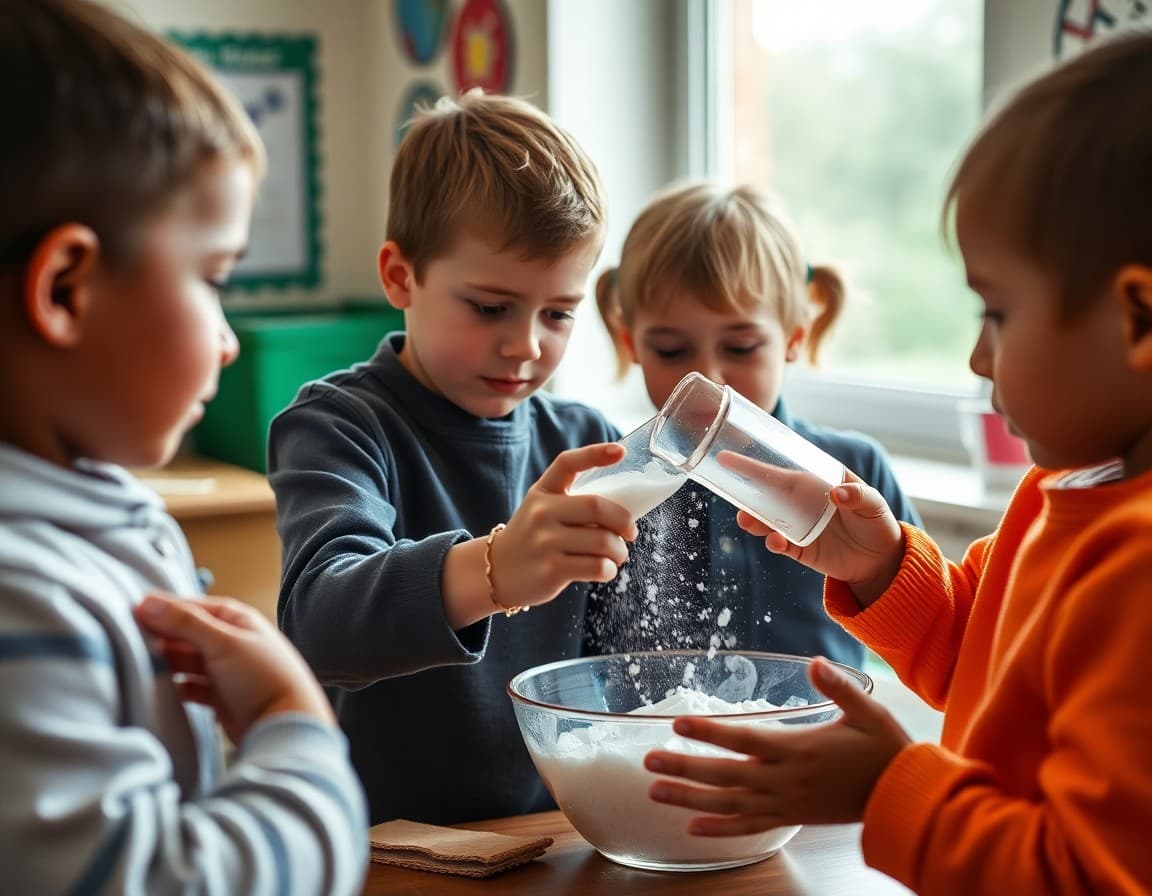
Physical science is the subject with the most dramatic at-home demonstration potential. Forces, motion, matter, and energy all show up in kitchens, backyards, and driveways every day. A physical science newsletter that points families toward these everyday phenomena turns routine household activities into genuine science conversations.
Name the Concept and the Central Question
Start with a specific concept and frame it as a question students are investigating. "This month, third graders are studying friction: the force that slows objects down when they slide across a surface. Our guiding question is: how does the texture of a surface affect how far an object slides?" That question is one families can explore immediately with any toy car, book, and kitchen floor at home.
Describe the Classroom Experiments
Physical science lessons should be mostly hands-on. Let parents know what students are actually doing: "Students built ramps from cardboard and tested how far a toy car traveled on three surfaces: sandpaper, carpet, and smooth tile. They recorded results in their science notebooks and compared data with their lab partners. Most groups discovered that smoother surfaces produce less friction and longer distances." Parents who can picture the experiment are more likely to extend it at home.
Share a Safe Kitchen Experiment
One kitchen experiment recommendation is the most actionable element of a physical science newsletter. Choose something with materials every family has, clear safety parameters, and a direct connection to the classroom concept: "Try the Slippery Surfaces experiment at home. Collect four surfaces: a wooden cutting board, a tile floor, carpet, and a piece of aluminum foil. Roll the same toy car down a book propped at an angle onto each surface. Measure how far it travels. Which surface created the most friction? Which the least? Your child will recognize this experiment immediately from class."
A Reusable Template Section
Here is a physical science newsletter template you can adapt for any unit:
"This month in physical science, we are investigating [CONCEPT]. Our central question is [QUESTION]. In class, students are [EXPERIMENT DESCRIPTION]. To try something similar at home, you need [MATERIALS LIST] and about 10 minutes. Here is what to do: [3-4 STEP INSTRUCTIONS]. Ask your child to predict what will happen before you start. That prediction is the first step of the scientific method."
The prediction prompt is an important detail. It activates prior knowledge and makes the activity feel like real science.
Explain How Concepts Build on Each Other
Physical science concepts connect in clear sequences. Help parents understand the progression: "Understanding friction this month prepares students for next month's unit on gravity and how both forces affect the motion of objects. When students watch a ball roll down a ramp and slow to a stop, they will need to explain both gravity pulling it down and friction slowing it down. These concepts work together, and building the foundation now makes the combined understanding much easier."
Address the Scientific Method Explicitly
Elementary parents often wonder how science experiments connect to learning standards. Explain the process: "Every experiment students conduct follows the same structure: question, prediction, procedure, observation, and conclusion. The content changes every unit, but the thinking process stays the same. By fifth grade, students have practiced this process dozens of times and apply it automatically." That explanation shows parents the deeper purpose behind classroom experiments.
Connect Physical Science to Engineering
Physical science and engineering are closely linked in current elementary standards. A brief connection builds context: "Understanding forces and motion connects directly to engineering design. When students investigate how friction affects a car on a ramp, they are thinking like engineers who need to design safer roads, faster vehicles, or more effective brakes. This kind of thinking, not just memorizing facts, is what the science standards are built around." Parents who understand this connection are less likely to see hands-on experiments as play and more likely to see them as substantive learning.
Invite Observations From Home
A brief call to action at the end of the newsletter creates engagement: "If your family tries the Slippery Surfaces experiment at home, we would love to hear your results. Your child can share their findings at school and we will add them to our class data set. Different surfaces at different homes give us more data to analyze together." Inviting families to contribute to classroom data builds a genuine sense of partnership.
Get one newsletter idea every week.
Free. For teachers. No spam.
Frequently asked questions
What should an elementary physical science newsletter include?
A physical science newsletter should explain the concept in focus (forces, matter, energy, motion, or sound), describe the experiments students are conducting in class, and offer one or two safe, simple kitchen or backyard experiments families can try. Physical science has an enormous advantage: most concepts can be demonstrated with household materials, making at-home extension very accessible.
What physical science topics do elementary students study?
Kindergarteners investigate pushes and pulls and how they affect object motion. First and second graders explore sound, light, and material properties. Third graders study forces and motion in depth. Fourth graders investigate electricity, magnetism, and energy transfer. Fifth graders work with chemical reactions, matter states, and energy conservation. A newsletter that identifies the specific concept and grade-level context helps parents understand where their child is in the learning sequence.
How can families safely experiment with physical science at home?
Kitchen experiments cover most elementary physical science concepts. Mixing baking soda and vinegar explores chemical reactions. Ramps with different surfaces investigate friction. Magnets sorting metal objects demonstrate magnetic force. A paper cup telephone shows sound transmission. These experiments use materials most families already have and involve no hazardous chemicals. The newsletter should emphasize safety (adult supervision, no chemicals, no electrical experiments) and focus on observation and questions, not just getting a cool effect.
How do I explain scientific vocabulary from physical science to parents?
Keep definitions concrete and tied to real examples. Instead of defining force as a push or pull that causes acceleration, say that a force is any push or pull, like the push that starts a swing moving or the pull of a magnet attracting a paperclip. Attaching the definition to a specific, familiar example makes it stick and gives parents vocabulary they can use naturally in conversation with their child.
What tool makes physical science newsletters easy to send to elementary parents?
Daystage lets you send a science newsletter with photos from classroom experiments, step-by-step home experiment instructions, and vocabulary lists in a single clean message. You can save a physical science template and update the experiment and vocabulary each unit, making it faster to send consistent updates throughout the year.

Adi Ackerman
Author
Adi Ackerman is a former classroom teacher and curriculum writer with 8 years in K-8 schools. She writes about school communication, parent engagement, and what actually works in real classrooms.
More for Elementary
Ready to send your first newsletter?
3 newsletters free. No credit card. First one ready in under 5 minutes.
Get started free