
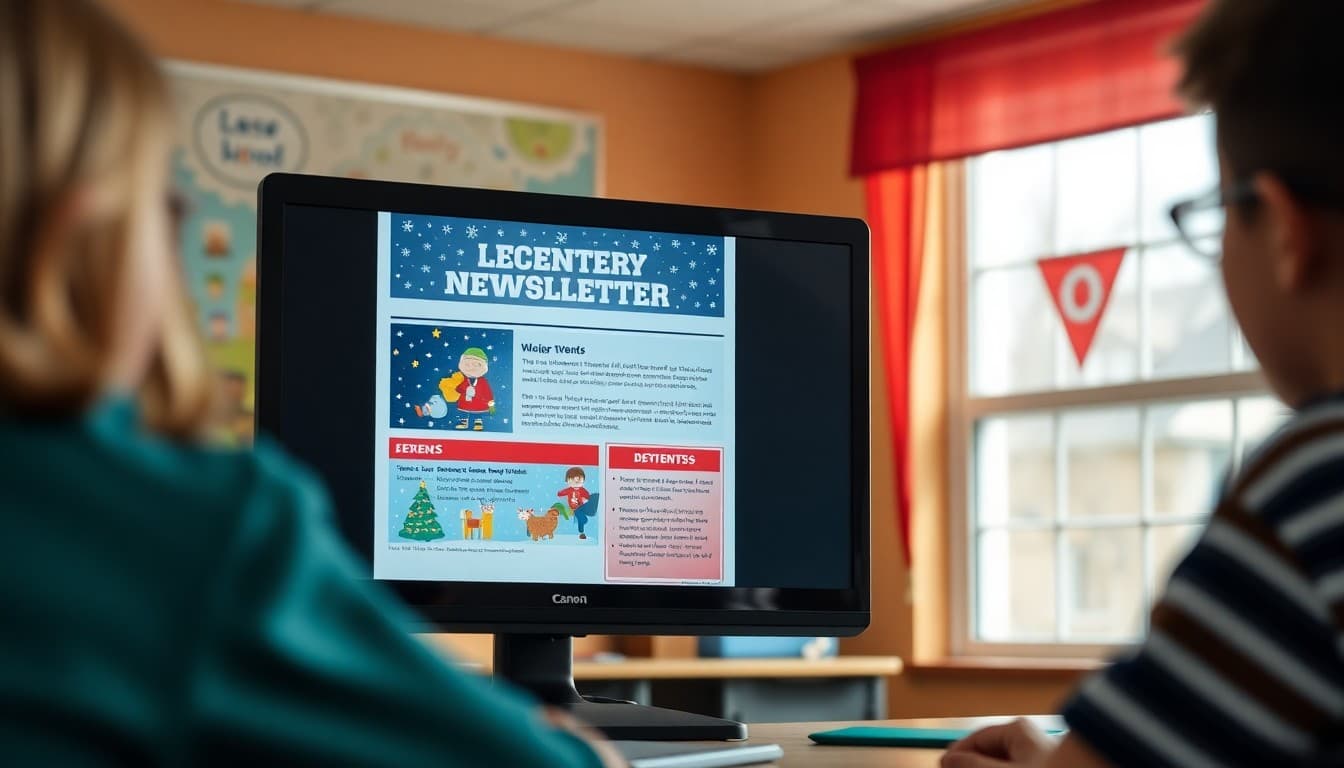
December Newsletter Template for Elementary School Parents

December newsletters for elementary schools have one challenge that no other month has: the content is entirely time-sensitive and families need it all at once. Winter concert dates, party logistics, break dates, and classroom celebrations all require advance planning. A December newsletter that gets this information to families clearly and early prevents the cascade of individual inquiries and last-minute confusion that characterizes December in every elementary school office.
Opening: Celebrate the Semester Before Looking Ahead
The December newsletter should open by naming one specific thing students have accomplished this semester. Not a general "what a wonderful fall semester" but a concrete example: "Our second graders started September reading an average of 120 words per minute. They are ending it at 185. That growth happened in your living rooms and in our classroom, together." This specific framing makes the opening worth reading and sets a tone of genuine pride that carries families into the holiday section with good feeling toward the school.
Section: Winter Concert or Performance Details
The winter concert is the most anticipated school event of the fall semester for elementary families. Give families everything they need in one clear section:
Date and time: Thursday, December 18 at 6:30 PM
Location: School gymnasium (doors open at 6:00 PM)
What to wear: [Dress code or costume details for students]
What students perform: [Grade level programs or song titles if appropriate to share]
Parking: [Overflow parking location]
Video/photo: [School photography policy for the event]
Accessibility: [Wheelchair access location, hearing loop availability]
Section: Classroom Holiday Celebration Details
Classroom parties or celebrations generate the most parent questions in December. Address them all preemptively:
When the classroom celebration is happening (date and time), what students will do during the celebration (activity-based description), whether families are invited to attend, whether treats are provided by the school (yes, and all treats are allergy-safe) or whether parents should bring items (and if so, exactly what), and whether students should bring cards or gifts for classmates and teachers. A section that answers all six of these questions prevents the individual teacher emails that accumulate in early December.
Template: December Elementary Newsletter Break Dates Section
Here is a ready-to-adapt break dates section:
"Winter Break Dates
Last day of school before winter break: Friday, December 19
Dismissal on December 19: [Regular time / Early dismissal at X PM]
School reopens: Monday, January 5
First full day of instruction: Monday, January 5 (regular schedule)
January lunch menu will be sent home the week of January 5.
Have a restful break. We look forward to seeing your children in January ready for a strong second semester."
Section: What Students Are Learning in December
Parents of elementary students want to know what their children are doing in the final weeks before break. A brief classroom update covering two or three subjects gives families conversation starters for the dinner table and helps parents understand the learning their children are describing. Examples: "In reading, we are finishing our author study of Patricia Polacco with one more book this week. In math, we are consolidating our understanding of multiplication with real-world problem scenarios. In science, we are exploring how animals adapt to winter weather, which connects to what students may notice in your neighborhood over break."
Section: Winter Break Learning Suggestions
Elementary teachers consistently get the question "what should my child do over break to not lose ground?" A brief, low-pressure response in the December newsletter prevents both the question and the anxiety behind it. Frame it as options, not obligations: "Reading for 20 minutes on most break days is the single most helpful thing elementary students can do for their learning. Our library allows students to check out books this week for over-break reading. Beyond that, family games that involve counting, math skills, or storytelling are genuinely educational and genuinely fun."
Section: January Preview
Families returning from winter break appreciate knowing what January holds before they come back. A brief January preview reduces first-week-back uncertainty and helps families who need to plan around school events prepare in advance. Include: the first major event of January, any testing or assessment windows coming in late January or February, the date of the next school newsletter, and one sentence about what students will be working on academically to build anticipation for the new semester.
Get one newsletter idea every week.
Free. For teachers. No spam.
Frequently asked questions
What are the most important things an elementary school December newsletter must cover?
December newsletters for elementary parents consistently need to cover four things: the exact date and time of any school performance or winter concert (parents plan around these), the last day of school before winter break with dismissal time clearly stated, the first day back in January, and any gift-giving or celebration logistics for classroom holiday parties. These four items generate the most parent questions in December. A newsletter that answers all four prevents most of the individual inquiries that flood front offices in early December.
How should elementary newsletters handle holiday content for diverse families?
Use inclusive language that acknowledges multiple winter celebrations without requiring any family to opt in or out: 'the holiday season' rather than specific holiday names, 'winter celebration' rather than 'Christmas party.' If the school has classrooms doing celebration activities, describe them as end-of-semester celebrations tied to learning activities (making cards, winter-themed science experiments, reading activities) rather than as religious holiday parties. The classroom party section should also specify that treats are only school-provided to address allergy management, which also reduces pressure on families to bring cultural or religious holiday food.
What classroom learning content works in a December elementary newsletter?
December classroom content that resonates with parents: a specific book or author the class has read this semester (parents can check it out for holiday reading), a math or science concept students have mastered recently, any art project they will bring home, and a preview of what students will be learning in January. The semester end is a natural moment to highlight growth. Comparing where students started in September to where they are in December gives parents a meaningful picture of their child's progress.
Should the December elementary newsletter include a message from the principal?
Yes, brief and warm. The principal's December message should acknowledge what the school community has built in the first semester, thank families for their partnership, and look forward to January with one or two specifics about what is coming in the new year. December is a high-emotion month for many families; a warm, specific message from the principal reinforces the sense of school community that carries families through the often-difficult return from winter break.
How can Daystage help elementary teachers publish December newsletters quickly during a busy month?
Daystage's block-based newsletter builder lets teachers and principals drop in content into a pre-built December template without starting from scratch. During one of the busiest weeks of the school year, being able to open a template, update dates and classroom specifics, and send in under 30 minutes is the difference between a December newsletter that goes out on time and one that gets pushed until January. Daystage saves previous newsletters so the December issue can be built directly from November's template with updates.

Adi Ackerman
Author
Adi Ackerman is a former classroom teacher and curriculum writer with 8 years in K-8 schools. She writes about school communication, parent engagement, and what actually works in real classrooms.
More for Elementary
Ready to send your first newsletter?
3 newsletters free. No credit card. First one ready in under 5 minutes.
Get started free