
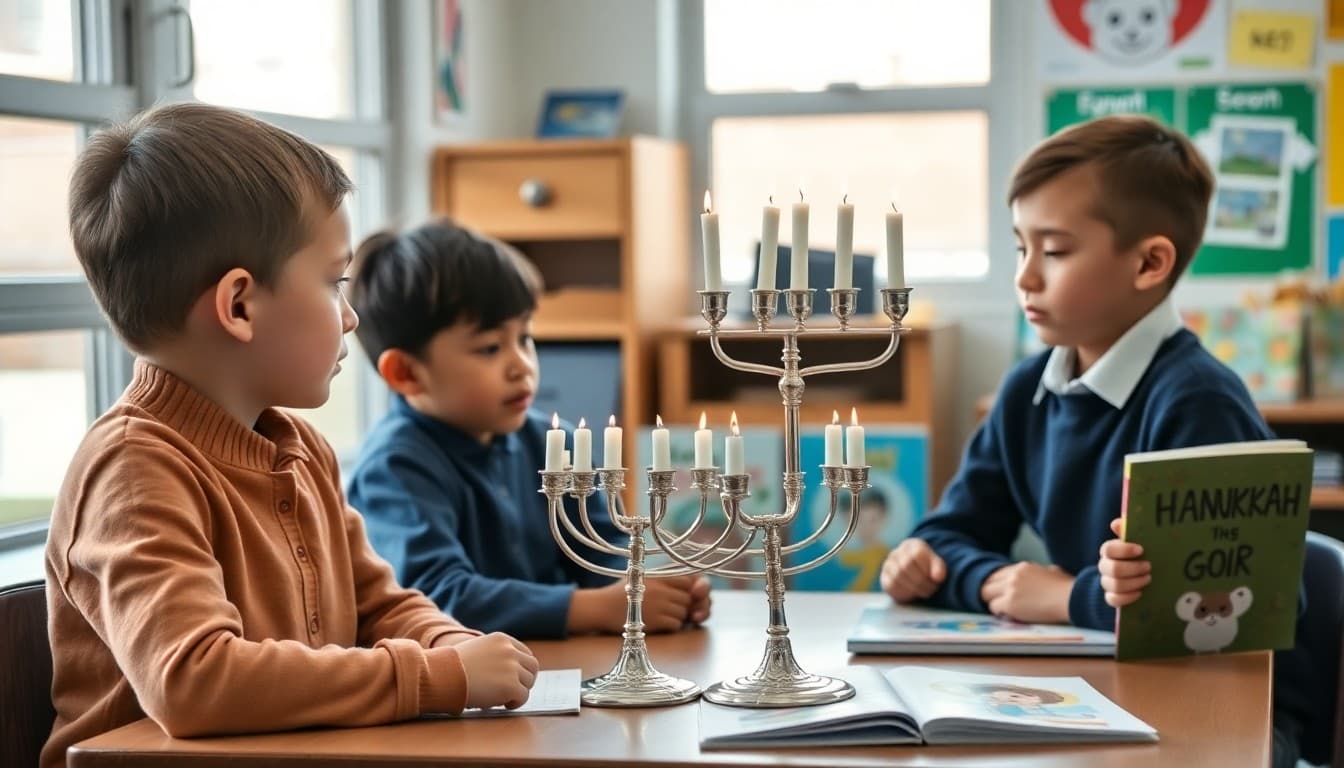
School Newsletter for Hanukkah: Ideas and Template

Hanukkah is often called the Jewish Christmas, which is historically inaccurate and undersells what the holiday actually commemorates. For school newsletters, this mischaracterization is worth avoiding. A Hanukkah newsletter that explains the holiday correctly, acknowledges Jewish families in your community, and gives non-Jewish families genuine cultural learning is far more valuable than one that treats Hanukkah as a decorative holiday that happens to use blue and silver instead of red and green.
What Hanukkah Actually Commemorates
Hanukkah, also spelled Chanukah, is an eight-day Jewish festival that commemorates the rededication of the Temple in Jerusalem in the second century BCE, following its desecration by the Seleucid Empire. The central story involves the Maccabean revolt and a miracle in which a small amount of oil -- enough for one day -- burned for eight days. The menorah, or Hanukkiah, is lit each night of the holiday to commemorate this miracle. Hanukkah is considered a minor holiday in the Jewish calendar but has become culturally prominent in the United States due to its proximity to Christmas.
Why the Newsletter Matters for Jewish Families
Jewish students in many American schools spend December surrounded by Christmas music, Christmas crafts, and Christmas classroom parties. A school newsletter that explicitly acknowledges Hanukkah -- by name, with accurate information, and with visible respect -- signals to Jewish families that the school sees them. This matters more than it might appear to non-Jewish educators. Research on religious minority students consistently shows that feeling recognized by the school institution improves belonging and academic engagement.
Template Section: Hanukkah Explained for All Families
Here is a brief, factual Hanukkah explanation section for a winter holidays newsletter:
"Hanukkah 2026 begins at sundown on December 14 and continues through December 22. Hanukkah commemorates the Maccabean revolt and the miracle of the Temple oil that burned for eight nights. Each night, families light one additional candle on the Hanukkiah (menorah), say blessings, and often exchange small gifts, play dreidel, and eat foods fried in oil like latkes and sufganiyot (jelly doughnuts). We are glad to have families in our school who observe this holiday."
That section is 96 words, historically accurate, and respectful without being performative.
Classroom Learning Connections
If your classroom is studying winter holidays, connect the Hanukkah content to curriculum. For social studies, the Maccabean revolt is a story about religious freedom and resistance to oppression -- themes that appear in standards from elementary through high school. For language arts, there are excellent picture books about Hanukkah for K-3 (Eight Candles, Lots of Latkes) and chapter books for older students. For art, the decorative traditions of the menorah connect to world art history. Note in the newsletter what students will be exploring in class.
Family Activity Suggestions
For Jewish families, the newsletter can acknowledge that school knows and respects their observance without needing to explain the holiday to them. For non-Jewish families, suggest two or three ways to learn more: visiting a local Jewish community center's public Hanukkah event, reading a library book about Jewish holidays, or watching a short documentary about Jewish American history. The goal is cultural education, not participation in a holiday that families do not observe.
What to Avoid in the Newsletter
Avoid equating Hanukkah with Christmas in magnitude or meaning. Avoid the phrase "the Jewish Christmas." Avoid implying that Hanukkah is primarily about gift-giving -- gift-giving is a relatively recent American addition to the holiday, not its religious center. Avoid decorating the newsletter with generic blue-and-silver imagery that does not connect to the holiday's actual symbolism. Use a menorah image rather than snowflakes with blue coloring. These distinctions signal genuine knowledge versus surface-level acknowledgment.
Coordinating with Other Winter Holiday Coverage
If you are covering multiple winter holidays in December, be consistent in the depth and quality of each section. A 200-word explanation of Christmas and a one-sentence mention of Hanukkah is not equitable coverage. Aim for comparable sections for each holiday your student community observes. If families in your building observe Christmas, Hanukkah, Kwanzaa, and Diwali, each deserves a thoughtful paragraph. This is not about equal screen time for its own sake -- it is about making every family feel that the school knows and respects their tradition.
Get one newsletter idea every week.
Free. For teachers. No spam.
Frequently asked questions
When does Hanukkah fall and how should the newsletter timing account for it?
Hanukkah follows the Hebrew calendar and falls on different dates each year, typically anywhere from late November to late December. In 2026 it runs December 14 through December 22. Send the newsletter at least one week before Hanukkah begins so families with Jewish students feel recognized, and so other families have time to learn something about the holiday before it passes.
Should a public school newsletter explain Hanukkah to non-Jewish families?
Yes, briefly and factually. A one-paragraph explanation of what Hanukkah commemorates and how it is observed is educationally appropriate and helps build cultural awareness across your school community. Keep it factual and respectful, not performatively enthusiastic. The goal is understanding, not celebration by families who do not observe the holiday.
How do I acknowledge Hanukkah without privileging it over other winter holidays?
Include Hanukkah as one of several December holidays in a broader winter holidays newsletter, or send a dedicated Hanukkah newsletter on the same schedule you would send for Christmas or Diwali. Consistency in how you treat each holiday is what matters. If you send a detailed Christmas newsletter, send a comparably detailed Hanukkah newsletter.
What classroom activities connect to Hanukkah?
Age-appropriate Hanukkah activities include reading the story of the Maccabees at a grade-appropriate level, learning about the menorah and the significance of light in multiple religious traditions, exploring dreidel games and the Hebrew letters on the dreidel, and studying Jewish art and music traditions. Check with your school's curriculum guidance on religious holiday classroom activities.
Can Daystage help me send a Hanukkah newsletter alongside other winter holiday newsletters?
Yes. Daystage lets you build and schedule separate newsletters for different holidays and send them to relevant parent groups or your full parent list. Teachers in diverse school communities use it to send dedicated newsletters for Hanukkah, Christmas, Kwanzaa, and Diwali that each receive equal attention and quality of presentation.

Adi Ackerman
Author
Adi Ackerman is a former classroom teacher and curriculum writer with 8 years in K-8 schools. She writes about school communication, parent engagement, and what actually works in real classrooms.
More for Diversity & Equity
Ready to send your first newsletter?
3 newsletters free. No credit card. First one ready in under 5 minutes.
Get started free