

School Newsletter for Eid al-Adha: Ideas and Template
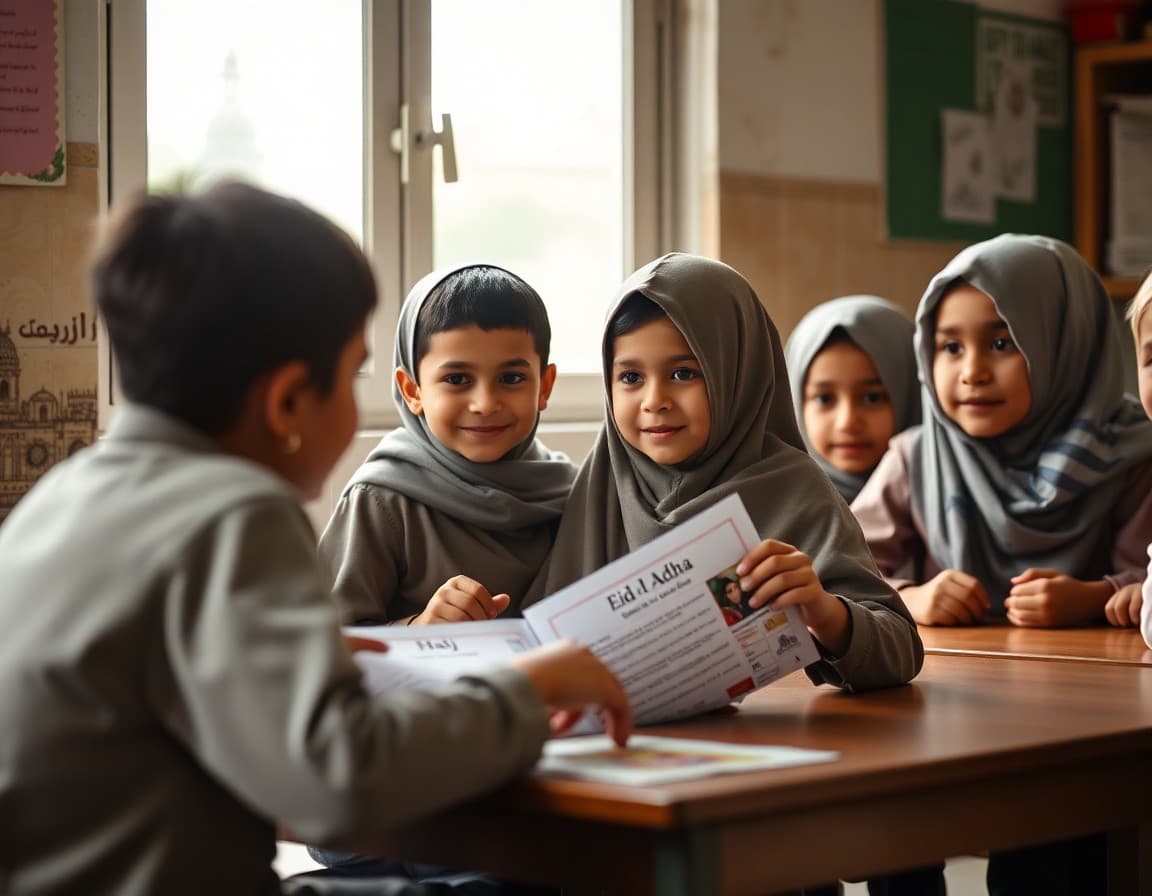
Eid al-Adha is the larger of the two major Islamic holidays -- larger in religious significance, larger in global observation, and in many parts of the world, larger in celebration. In the United States, it is less visible than Eid al-Fitr because it often falls in summer when school is not in session. But for Muslim students and families, it is among the most important dates of the year, and a school newsletter that acknowledges it -- even during summer -- is a meaningful gesture of inclusion.
What Eid al-Adha Commemorates
Eid al-Adha commemorates the story of the prophet Ibrahim (Abraham in the Jewish and Christian traditions), who was commanded by God to sacrifice his son as a test of faith. As Ibrahim prepared to follow through, God provided a ram to sacrifice instead. The story appears in the Quran, the Bible, and the Torah and is understood across all three Abrahamic faiths as a story of obedience, trust, and divine mercy. For Muslims, Eid al-Adha is both a commemoration of this story and a celebration aligned with the Hajj pilgrimage -- the annual gathering of millions of Muslims in Mecca, Saudi Arabia.
The Hajj: Context Worth Including
The Hajj pilgrimage is the fifth pillar of Islam. Every Muslim who is physically and financially able is expected to make the pilgrimage to Mecca at least once in their lifetime. During Eid al-Adha weekend, approximately 2 to 3 million Muslims from every country in the world gather in Mecca for a series of rituals that include circling the Kaaba, walking between the hills of Safa and Marwa, and gathering at the plain of Arafat. It is the largest annual peaceful human gathering on Earth. For students studying world geography, population movements, or world religions, this context is curriculum-connected and genuinely remarkable.
The Tradition of Sacrifice and Charity
On Eid al-Adha, Muslim families traditionally sacrifice a sheep, goat, or cow to honor Ibrahim's obedience. The meat is divided into three portions: one for the family, one for neighbors and friends, and one for people in need. This three-way division reflects Islamic principles of community and charity. In the United States, many families fulfill this obligation through halal butchers or by donating to organizations that perform the sacrifice on their behalf. Explaining this tradition factually and in context -- as an act of charity with deep religious significance -- is the appropriate approach for a school newsletter.
Template Section: Eid al-Adha Overview
Here is a newsletter section that covers the holiday accurately and respectfully:
"Eid al-Adha (expected around June this year): Eid al-Adha is one of the two major Islamic holidays, commemorating the prophet Ibrahim's willingness to sacrifice his son and God's provision of a ram as a substitute. It coincides with the annual Hajj pilgrimage to Mecca -- the world's largest annual gathering. Families observe Eid al-Adha with prayers, family celebrations, and the tradition of animal sacrifice, with meat shared with family, neighbors, and those in need. Eid Mubarak to all Muslim families celebrating this holiday."
Attendance and School Policy
Eid al-Adha is a significant religious holiday and absences should be treated as excused religious observances, consistent with the school's obligations under the First Amendment and most state education codes. Include this explicitly in the newsletter if Eid al-Adha falls during the school year. "Absences on Eid al-Adha will be treated as excused religious observances. Students who are absent should see their teachers upon return for any missed work." This statement costs nothing and means a great deal to Muslim families who have historically had to fight for this basic accommodation.
Summer Context for Eid al-Adha Newsletters
When Eid al-Adha falls during summer, a newsletter covering it represents genuinely optional but meaningful outreach. Teachers and schools that send summer newsletters covering major holidays -- including both Eid and Christmas/Hanukkah/Kwanzaa when applicable -- build a year-round reputation for inclusive communication that pays off in family trust when school resumes in fall. Even a short summer email that says "Wishing all of our Muslim families Eid Mubarak" with one paragraph of context is better than silence during one of the most important days of the Islamic year.
Educational Resources for Non-Muslim Families
For families who want to learn more, the Council on American-Islamic Relations (CAIR) and the Islamic Society of North America (ISNA) both have educational resources online. The Smithsonian's National Museum of Asian Art has a free virtual exhibit on Islamic art and culture. For children, "Eid al-Adha" by Melissa Nichols and "The Proudest Blue" by Ibtihaj Muhammad are recommended reading. Including two or three concrete resource links in the newsletter is far more useful than a generic "learn more about Islam" instruction without guidance.
Get one newsletter idea every week.
Free. For teachers. No spam.
Frequently asked questions
What is Eid al-Adha and how is it different from Eid al-Fitr?
Eid al-Adha, the 'festival of sacrifice,' commemorates the prophet Ibrahim's (Abraham's) willingness to sacrifice his son in obedience to God, and God's provision of a ram as a substitute. It occurs on the 10th day of Dhul Hijjah, the last month of the Islamic lunar calendar, coinciding with the Hajj pilgrimage to Mecca. Eid al-Fitr marks the end of Ramadan; Eid al-Adha marks the culmination of the Hajj. Both are major Islamic holidays, but Eid al-Adha is considered the greater of the two.
When does Eid al-Adha fall and how should the newsletter account for it?
Eid al-Adha follows the Islamic lunar calendar and shifts approximately 10 days earlier each Gregorian year. It typically falls in the summer for the next several years. In 2027 it is expected around June. The date is confirmed by lunar sighting and may vary by a day. Note in the newsletter that the exact date is approximate and that the school welcomes and respects students who observe the holiday.
How should school newsletters address the animal sacrifice tradition of Eid al-Adha?
In Muslim communities around the world, families traditionally slaughter a sheep, goat, or cow on Eid al-Adha, dividing the meat among family, neighbors, and those in need. In the United States, many Muslim families purchase a sacrificial animal through a local halal butcher or donate money to an organization that performs the sacrifice on their behalf. This tradition is directly analogous to the kosher slaughter tradition in Judaism and meat processing in general. Explain it factually and without dramatization for an audience that may be unfamiliar with it.
What classroom connections are appropriate for Eid al-Adha?
For social studies: the story of Ibrahim/Abraham is shared across Islam, Judaism, and Christianity, making Eid al-Adha an opportunity to discuss the Abrahamic faiths and their shared roots. For world geography: the Hajj pilgrimage to Mecca in Saudi Arabia is the largest annual human gathering on Earth, drawing 2 to 3 million pilgrims. These connections are curriculum-relevant and educationally rich without requiring students to practice any religious observance.
Can Daystage help send an Eid al-Adha newsletter in summer when teachers are less active?
Yes. Daystage supports scheduled newsletter sends, so teachers can write and schedule an Eid al-Adha newsletter before summer begins and have it deliver automatically when the holiday arrives. This allows year-round family communication without requiring active newsletter writing during summer months.

Adi Ackerman
Author
Adi Ackerman is a former classroom teacher and curriculum writer with 8 years in K-8 schools. She writes about school communication, parent engagement, and what actually works in real classrooms.
More for Diversity & Equity
Ready to send your first newsletter?
3 newsletters free. No credit card. First one ready in under 5 minutes.
Get started free