
School Newsletter for Diwali: Ideas and Template

Diwali is one of the most widely celebrated festivals in the world, observed by over a billion people across South Asia and South Asian diaspora communities globally. In the United States, the South Asian student population in schools has grown significantly, and for many of those families, Diwali is the most significant celebration of the year. A school newsletter that covers Diwali with the same accuracy and care as Christmas signals to those families that the school sees and values them.
What Diwali Is and Who Celebrates It
Diwali, also spelled Deepawali, is a five-day festival typically falling in October or November. In Hinduism, the most widely practiced version of Diwali celebrates the return of the god Rama to his kingdom of Ayodhya after 14 years of exile and his defeat of the demon king Ravana. The people of Ayodhya lit oil lamps to guide Rama home, which is why Diwali is called the festival of lights. Sikhs observe Diwali on a different basis: the Bandi Chhor Divas, commemorating the release of the Sikh Guru Hargobind from captivity. Jains celebrate Diwali as the day of the enlightenment of the Mahavira, the last Jain Tirthankara. Note in the newsletter that the holiday has different meanings across these communities.
The Five Days of Diwali
Diwali spans five days, each with its own significance: Dhanteras (worship of wealth and prosperity, buying of gold or silver), Naraka Chaturdashi (also called Chhoti Diwali, a day of cleansing), the main Diwali day (lighting of diyas, fireworks, family celebrations, puja prayer ceremonies), Govardhan Puja (gratitude to nature), and Bhai Dooj (celebration of the bond between brothers and sisters). For the newsletter, the main Diwali day is the most significant to highlight, though knowing the holiday spans five days gives families a more complete picture.
Diwali Traditions Worth Explaining
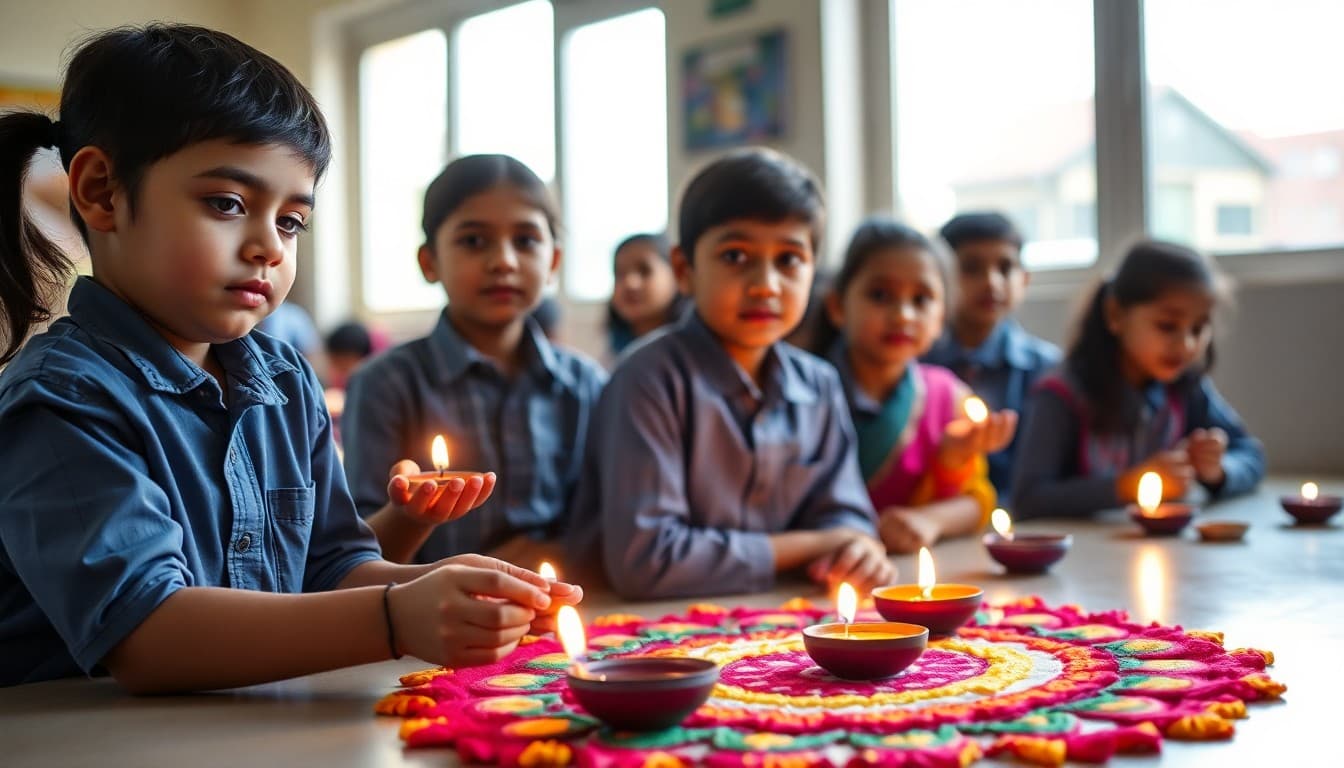
Three Diwali traditions are particularly vivid and easy to explain in a school newsletter. First, diyas: small clay oil lamps lit throughout homes, doorways, and public spaces. Second, rangoli: intricate, colorful designs made on floors using colored powders, flower petals, or rice flour, created to welcome Lakshmi, the goddess of prosperity. Third: sweets. Diwali is one of the great Indian sweet-eating occasions -- families exchange boxes of mithai (sweets) including gulab jamun, barfi, and laddoo. These three traditions are sensory and specific, which makes them far more engaging for newsletter readers than generic descriptions of "light and celebration."
Template Section: Diwali Overview for All Families
Here is a newsletter section that is accurate, warm, and appropriate for all grades:
"Diwali, the festival of lights, begins October 20 this year and continues for five days. Celebrated by Hindus, Sikhs, Jains, and others, Diwali marks the triumph of light over darkness and good over evil. Families light diyas (oil lamps), set off fireworks, create colorful rangoli designs, share sweets with neighbors, and gather for prayer and celebration. It is one of the most joyful and visually stunning festivals in the world. Happy Diwali to all families celebrating -- may your homes be filled with light and prosperity."
Connecting Diwali to Classroom Learning
Rangoli designs are mathematically interesting -- they typically exhibit rotational and reflective symmetry, which connects directly to geometry standards in grades 3-8. Art classes can explore rangoli design as both cultural tradition and mathematical pattern. Science classes can use Diwali as a context for discussing light, combustion, and optics. Social studies can use the diversity of Diwali observances across Hindu, Sikh, and Jain communities to discuss how a single festival can hold multiple meanings. Each of these connections deserves a mention in the newsletter if the classroom is exploring them.
Student Absences and School Sensitivity
The main day of Diwali involves family gatherings, puja ceremonies, and evening fireworks. Some South Asian families keep children home the day of Diwali or the day after, particularly if celebrations run late into the evening. Treating these absences as excused religious observances and noting that policy in the newsletter is both legally appropriate and genuinely appreciated by South Asian families. The newsletter can also suggest that classrooms avoid scheduling major assessments on the day of or day after Diwali out of respect for observing students.
Get one newsletter idea every week.
Free. For teachers. No spam.
Frequently asked questions
When is Diwali and how does the date change each year?
Diwali follows the Hindu lunar calendar and falls on the new moon of the month of Kartik, typically in October or November. In 2027 it falls in mid-October. Because the date shifts annually, check the current year's date and confirm it in the newsletter. Sending the newsletter one to two weeks before Diwali gives families time to engage with any suggested activities.
What is Diwali and who celebrates it?
Diwali is the Hindu festival of lights, typically celebrated over five days. It is also observed, with different stories and traditions, by Sikhs, Jains, and some Buddhists. In Hinduism, Diwali celebrates the return of the god Rama to Ayodhya after defeating the demon king Ravana, symbolizing the triumph of light over darkness and good over evil. The holiday involves lighting diyas (oil lamps) and fireworks, creating rangoli (colorful floor designs), exchanging sweets, and celebrating with family.
How do I acknowledge Diwali without conflating the different communities that celebrate it?
Note in the newsletter that Diwali is celebrated by Hindus, Sikhs, Jains, and others, but that the specific stories and traditions vary by community and religious tradition. Avoid presenting any single version of Diwali as the definitive one. If you have South Asian families in your school who celebrate, consider asking them to share a tradition or story they would be comfortable having included.
What classroom activities connect to Diwali?
For art: rangoli designs are visually striking and connect to symmetry and pattern recognition in math. For social studies: Diwali as practiced across Hindu, Sikh, and Jain communities illustrates how a single date can hold different stories for different communities. For science: the chemistry of diyas and fireworks connects to a combustion unit. For literature: reading a picture book about Diwali from a South Asian author provides an insider perspective.
Can Daystage help teachers send a Diwali newsletter that feels as complete as a Christmas newsletter?
Yes. Daystage supports newsletters with multiple content sections, embedded links, and custom formatting that makes holiday newsletters feel cohesive and professional. Teachers use Daystage to send Diwali newsletters that match the quality of their December holiday communications -- which signals to South Asian families that their celebration matters to the school.

Adi Ackerman
Author
Adi Ackerman is a former classroom teacher and curriculum writer with 8 years in K-8 schools. She writes about school communication, parent engagement, and what actually works in real classrooms.
More for Diversity & Equity
Ready to send your first newsletter?
3 newsletters free. No credit card. First one ready in under 5 minutes.
Get started free