
Hanukkah School Newsletter: Inclusive Holiday Communication

December school newsletters often try to acknowledge multiple holidays simultaneously, and Hanukkah is frequently the one that is handled with the least accuracy. Schools default to placing a menorah next to a Christmas tree in a graphic, treating it as an equivalent holiday when the two have very different religious and cultural weight. A newsletter that describes Hanukkah on its own terms, accurately and specifically, does more for your Jewish students and families than a cheerful visual equivalent ever could.
Get the History Right
Hanukkah commemorates a specific historical event: the victory of the Maccabees, a group of Jewish fighters led by Judas Maccabaeus, against the Seleucid Greek forces who had desecrated the Temple in Jerusalem. When the Maccabees reclaimed and rededicated the Temple, the story goes, they found only enough ritually pure olive oil to light the Temple's menorah for one day, but the oil burned for eight days. The eight-day festival and the tradition of lighting candles each night commemorate this miracle. That story is more interesting than "a Jewish holiday in December," and telling it accurately honors the tradition.
Correct Common Misconceptions
The most common misconception about Hanukkah is that it is equivalent in significance to Christmas. In the Jewish religious calendar, it is not. High Holy Days like Rosh Hashanah (the Jewish New Year) and Yom Kippur (the Day of Atonement), as well as Passover and Shavuot, are far more significant religiously. Hanukkah gained cultural prominence in the United States partly because of its proximity to Christmas, not because of its religious importance. Stating this in your newsletter is honest and helps families understand what they are learning about.
The Rituals of Hanukkah
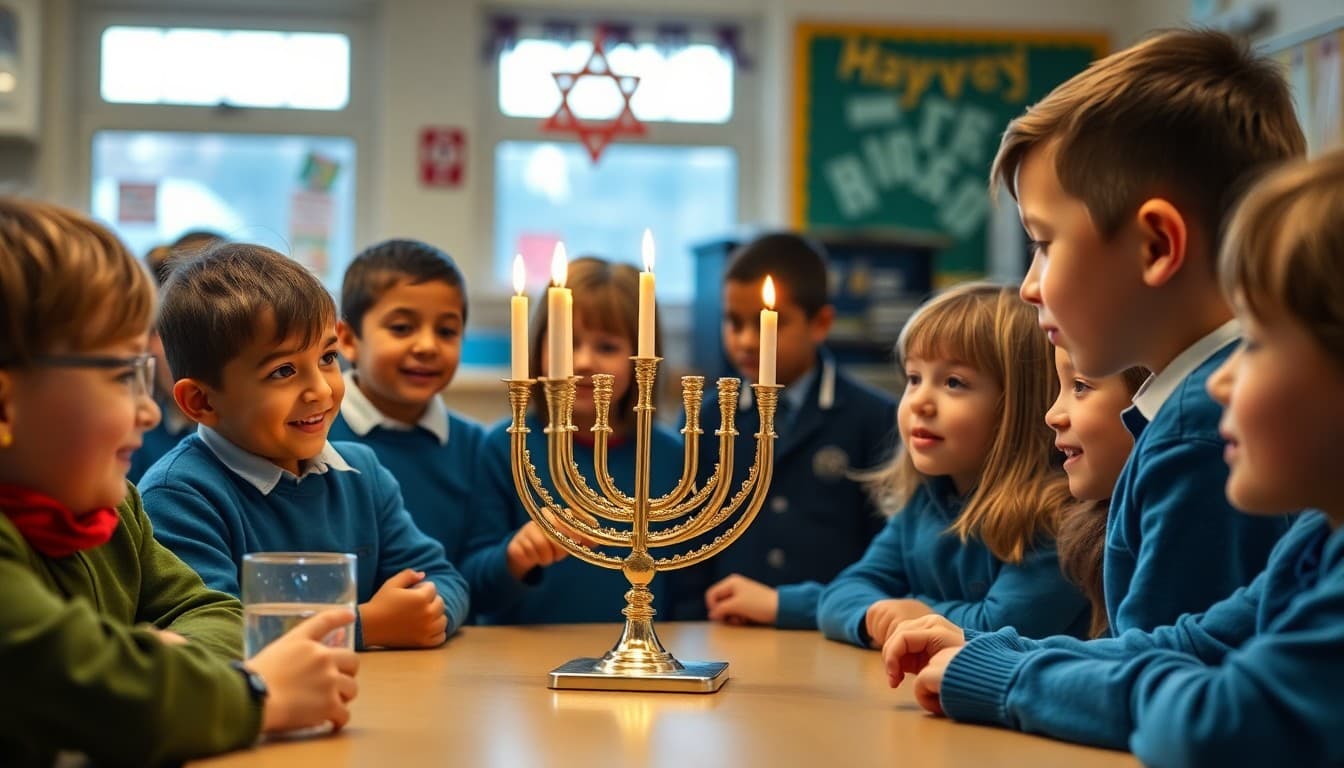
Each night of Hanukkah, families light the hanukkiah, placing it in a window or doorway so it is visible from outside. The hanukkiah holds nine candles: one for each of the eight nights plus the shamash, the helper candle used to light the others. Special blessings are recited. Traditional foods fried in oil, latkes (potato pancakes) and sufganiyot (jelly doughnuts), commemorate the miracle of the oil. Children play with a dreidel, a spinning top with Hebrew letters. Songs, games, and gifts are part of many families' celebrations.
Educational Connections
Hanukkah connects to multiple areas of curriculum. The Maccabean revolt fits into ancient history units. The story of religious and cultural resistance against a dominant empire connects to broader social studies themes. The Hebrew letters on the dreidel connect to language studies. The physics of spinning tops and optics of candlelight connect to science. Naming these connections in your newsletter shows families that learning about Hanukkah serves educational goals, not just an obligation to include every December holiday.
Handling Gifts Thoughtfully
Gift-giving at Hanukkah is a relatively recent tradition in American Jewish practice, influenced partly by proximity to Christmas. It is not the central meaning of the holiday. If your school is doing a holiday gift exchange or talking about gift-giving traditions, your newsletter can note this distinction: "While gifts have become part of many families' Hanukkah traditions, the heart of the holiday is the story of religious freedom and the miracle of the lights." That sentence preserves accuracy without dismissing families who do give gifts.
Acknowledging Antisemitism in Context
Hanukkah is a story of Jewish survival and resistance against cultural erasure. If your school has experienced any antisemitic incidents, or if there is a broader community conversation about antisemitism, your December newsletter can acknowledge that context directly. "Hanukkah reminds us that Jewish communities have been targeted for persecution throughout history. Our school is committed to being a place where every student is safe, including our Jewish students and families." That acknowledgment is appropriate and important.
Inviting Jewish Families to Share
An open, low-pressure invitation for Jewish families to share their Hanukkah traditions is appropriate. Make it clear that participation is voluntary and that no single family speaks for all Jewish families. Different Jewish families celebrate Hanukkah very differently, from highly traditional observance to secular celebration to something in between. Acknowledging that variation prevents the pressure of singular representation.
Get one newsletter idea every week.
Free. For teachers. No spam.
Frequently asked questions
What is Hanukkah and how should a school newsletter describe it accurately?
Hanukkah, also spelled Chanukah, is an eight-day Jewish festival that commemorates the rededication of the Temple in Jerusalem following the Maccabean revolt against the Seleucid Empire, around 165 BCE. The central ritual is the lighting of the hanukkiah (the Hanukkah menorah), adding one candle each night. Hanukkah falls at different dates each year based on the Hebrew calendar, typically in November or December. It is a minor holiday in the Jewish religious calendar, not the Jewish equivalent of Christmas, even though its timing often places it near the Christmas holiday season.
How do I avoid the common mistake of treating Hanukkah as the Jewish Christmas?
Be direct in your newsletter about what Hanukkah is and is not. 'Hanukkah is an eight-day Jewish festival with its own history and traditions. It is not the Jewish equivalent of Christmas, and while it often falls near Christmas on the calendar, the two holidays are completely separate and have different religious and cultural significance.' That clarification is respectful to Jewish families and educationally accurate for all families.
How do I acknowledge Hanukkah in a newsletter without requiring Jewish students to represent their faith?
Focus on the educational content rather than personal testimony. Describe the history of the holiday, its rituals, and its significance. Invite (but do not require) Jewish families to share something if they want to. Do not call on Jewish students to explain Hanukkah to their classmates unless they have actively chosen to do so. An opt-in approach that centers educational content rather than personal performance respects students' autonomy.
Should a public school acknowledge Hanukkah in a newsletter?
Yes. Public schools can and should acknowledge major holidays observed by students in their community. Teaching about holidays from a cultural and historical perspective is appropriate and legally permissible. Leading worship or requiring religious observance is not. A newsletter that explains the history and traditions of Hanukkah from an educational standpoint is appropriate in any public school.
What newsletter tool works well for inclusive holiday communication?
Daystage lets you format a newsletter that balances multiple holiday acknowledgments cleanly. If you are sending a December newsletter that acknowledges Hanukkah, Christmas, Kwanzaa, and other traditions, Daystage's formatting tools help you present each respectfully without making the newsletter look cluttered or tokenizing.

Adi Ackerman
Author
Adi Ackerman is a former classroom teacher and curriculum writer with 8 years in K-8 schools. She writes about school communication, parent engagement, and what actually works in real classrooms.
More for Diversity & Equity
Inclusive Holiday Communication Newsletter: Writing School Holiday Messaging That Welcomes Every Family
Diversity & Equity · 6 min read
Jewish American Heritage Month School Newsletter Templates
Diversity & Equity · 6 min read
DEI Coordinator Newsletter Guide: Communicating Equity Goals and Progress to the School Community
Diversity & Equity · 7 min read
Ready to send your first newsletter?
3 newsletters free. No credit card. First one ready in under 5 minutes.
Get started free