

College Prep Newsletter for Freshmen: Starting Strong in 9th Grade
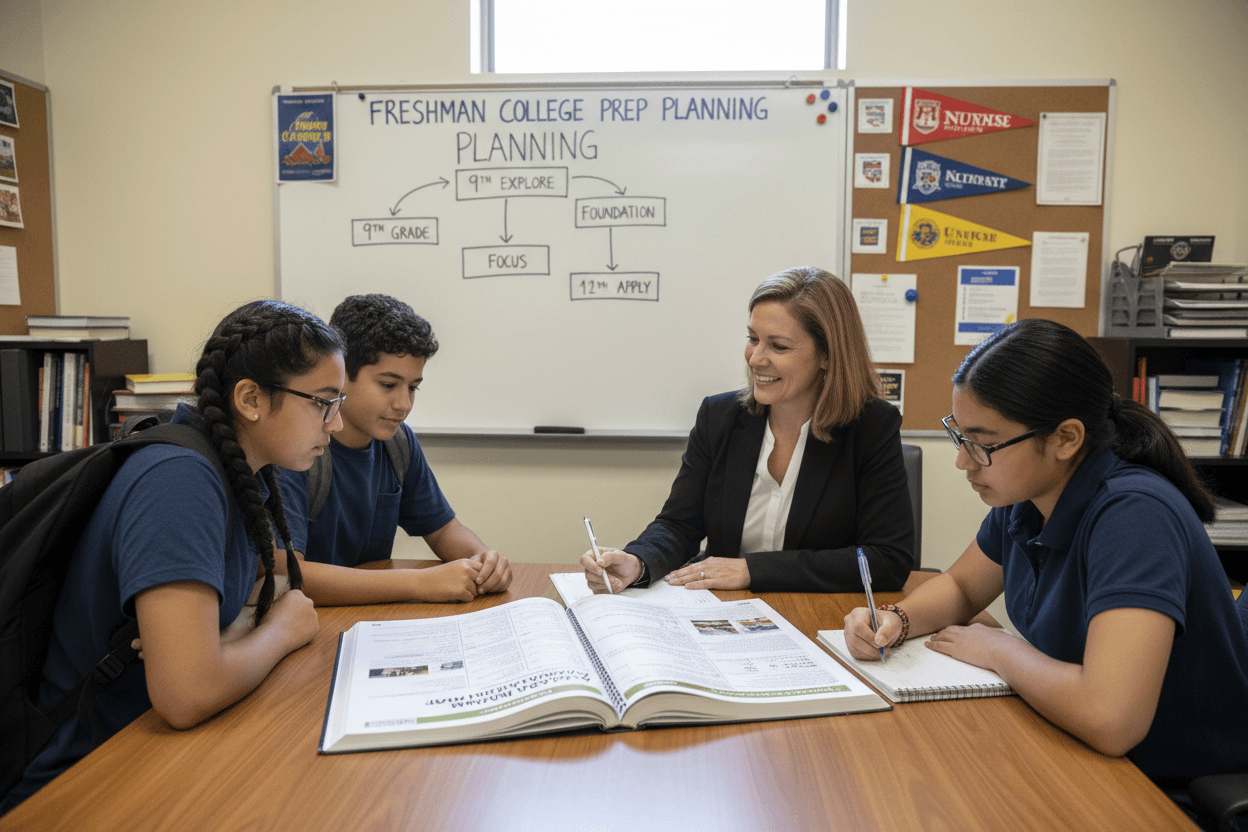
Most high school college prep communication starts in junior year. By then, students have already completed two years of a permanent academic record. Course decisions that limit their options have already been made. Habits that will either help or hurt them through the application process are already established.
A freshman college prep newsletter does not mean pressuring 14-year-olds with application anxiety. It means giving families accurate, practical information about how high school works and how it connects to what comes next, early enough to act on it.
Freshman year grades count, and families need to hear it clearly
The most persistent and damaging misconception in high school is that freshman year is a practice run. Students who believe this take their first semester as an opportunity to ease into high school at a relaxed pace, assuming they can make up for low grades later. They cannot, not fully.
Colleges see the cumulative GPA, which includes every semester from 9th grade forward. A student who earns a 2.8 GPA in 9th grade and then earns a 3.8 in 10th through 12th grade will graduate with a cumulative GPA in the 3.5 range, not the 3.8 they might expect. Name this directly in the September freshman newsletter. Do not bury it in paragraph three. It is the most actionable piece of information you can give a 9th grade family in September.
How freshman course selection shapes all four years
The courses a student takes in 9th grade create a sequence that constrains or expands their options in later years. This is true in math more than any other subject. A student who starts in Algebra I in 9th grade needs a clear four-year plan to reach Precalculus or Calculus by senior year, and that plan requires taking math every year without gaps.
It is also true in world languages. A student who starts Spanish I in 9th grade can reach Spanish IV or AP Spanish Language by senior year. A student who defers world language to 10th grade will be one level behind throughout. Colleges that expect three or four years of a world language will see that gap in the transcript.
The newsletter does not need to alarm families about every possible sequence. But it should make clear that course selection is a four-year plan, not an annual form, and encourage families to discuss their student's long-term goals with the counselor when making freshman course choices.
What GPA to aim for and what it actually means
Families of freshmen often have limited awareness of what GPA levels mean for college options. A counselor who communicates this context early gives families a clearer picture to plan around.
Broadly, a cumulative GPA of 3.5 or above (on a 4.0 unweighted scale) opens the door to a wide range of four-year colleges. A GPA between 3.0 and 3.5 opens access to many strong institutions with less competition. A GPA below 3.0 begins to narrow options significantly, though strong test scores, compelling personal essays, and other factors still matter. These are generalizations, not rules, and the newsletter should say that. But they give families a frame of reference for what strong performance in 9th grade is working toward.
Extracurriculars in freshman year: exploring, not optimizing
Freshmen should try things. That is the clearest guidance the counseling office can give, and it runs counter to the anxiety-driven advice many families encounter online, which tells them their student needs to be the president of a club by sophomore year.
Colleges value genuine commitment and growth over time. A student who joined the school newspaper in 9th grade and became editor-in-chief by senior year demonstrates something meaningful. A student who listed twelve clubs across four years without sustained involvement in any of them demonstrates nothing. Tell freshman families that the goal of 9th grade extracurricular participation is to find what their student genuinely cares about, not to build a resume.
Reading habits, study skills, and the academic transition
High school asks significantly more of students than middle school in terms of independent reading, long-form writing, and self-directed study. The transition is difficult for many students, and the difficulty shows up as lower grades in the first semester of 9th grade.
Include a brief section in the freshman newsletter on academic habits. Recommend that students establish a consistent study time each day, including days without specific assignments, as a foundation for the heavier workloads that come in later years. Point families toward tutoring resources if the school offers them. Name the signs that a student is struggling: falling behind on assignments, avoiding specific subjects, missing school on days when tests are scheduled. Early intervention in 9th grade is far more effective than intervention in 11th grade.
Standardized testing: what freshmen need to know now
Most students do not take the SAT or ACT until junior year. But the PSAT 8/9, which many schools administer in 9th grade, introduces students to the format and gives both the student and the counselor useful diagnostic information. Explain in the newsletter that this test is low-stakes in 9th grade and functions primarily as a benchmark.
Freshman year is also the time to establish whether a student may be eligible for testing accommodations due to documented learning differences. The process for obtaining College Board accommodations requires a current evaluation and a school-based approval process. Families who begin this process in 9th grade have accommodations in place well before the PSAT in 10th grade and the SAT in 11th grade. Families who begin the process in junior year often cannot complete it in time.
The counselor's door is open, specifically for this conversation
End the freshman newsletter with a direct invitation to schedule an appointment. Many families are hesitant to reach out to the counseling office in freshman year because they believe counselor meetings are only for students who are struggling or only for seniors applying to colleges. Correct that assumption explicitly. The counseling office is available to every student at every grade level, and the best time to discuss a four-year academic plan is before it is already two years underway.
Get one newsletter idea every week.
Free. For teachers. No spam.
Frequently asked questions
Is 9th grade too early to start college prep communication?
No. Ninth grade GPA counts toward the cumulative GPA that colleges evaluate. Course choices in 9th grade determine which courses students can access in 11th and 12th grade. Students who fall behind academically in freshman year often cannot recover in time for the courses and GPAs that selective colleges require. A counselor who communicates this reality to 9th grade families in September, rather than in junior year, gives those families time to act on it.
What is the most important thing to tell freshman families in the first newsletter?
That freshman year grades count. Many students and families arrive at high school believing that 9th grade is a trial period that does not affect college applications. It does. The cumulative GPA that appears on a college transcript starts in September of freshman year. A student who earns a 2.5 GPA in 9th grade must earn significantly higher grades in 10th through 12th grade to recover their cumulative average before senior fall.
What course selection guidance should the freshman newsletter include?
Explain that the courses students take in 9th grade determine which advanced courses they can access later. A student who places into Algebra I in 9th grade will need a clear math progression plan to reach Calculus or Statistics by senior year if that is their goal. A student who skips a world language in 9th grade will have fewer language options in 11th and 12th grade. The newsletter should name these dependencies so families understand that course selection is a four-year planning exercise, not an annual preference form.
How do you communicate extracurricular expectations to freshman families without overwhelming them?
Tell families that quality and commitment matter more than quantity. Colleges are not looking for students who joined every club in high school. They are looking for students who pursued a few activities with genuine interest and increasing responsibility over time. Freshman year is the right time to explore and find those areas of interest. By sophomore year, students should be starting to invest more deeply in one or two activities rather than spreading across five or six.
How does Daystage help counselors communicate with freshman families?
Daystage lets counselors build grade-level subscriber lists and send targeted newsletters to 9th grade families separately from juniors and seniors who need different content. Freshman families who receive college prep communication specific to their student's year, rather than general senior-focused college content, are more likely to engage with it because it feels relevant to them. Daystage makes that targeting straightforward without requiring a separate email system.

Adi Ackerman
Author
Adi Ackerman is a former classroom teacher and curriculum writer with 8 years in K-8 schools. She writes about school communication, parent engagement, and what actually works in real classrooms.
More for College Prep
Ready to send your first newsletter?
3 newsletters free. No credit card. First one ready in under 5 minutes.
Get started free