

College Counseling Timeline Newsletter: Month by Month Senior Guide
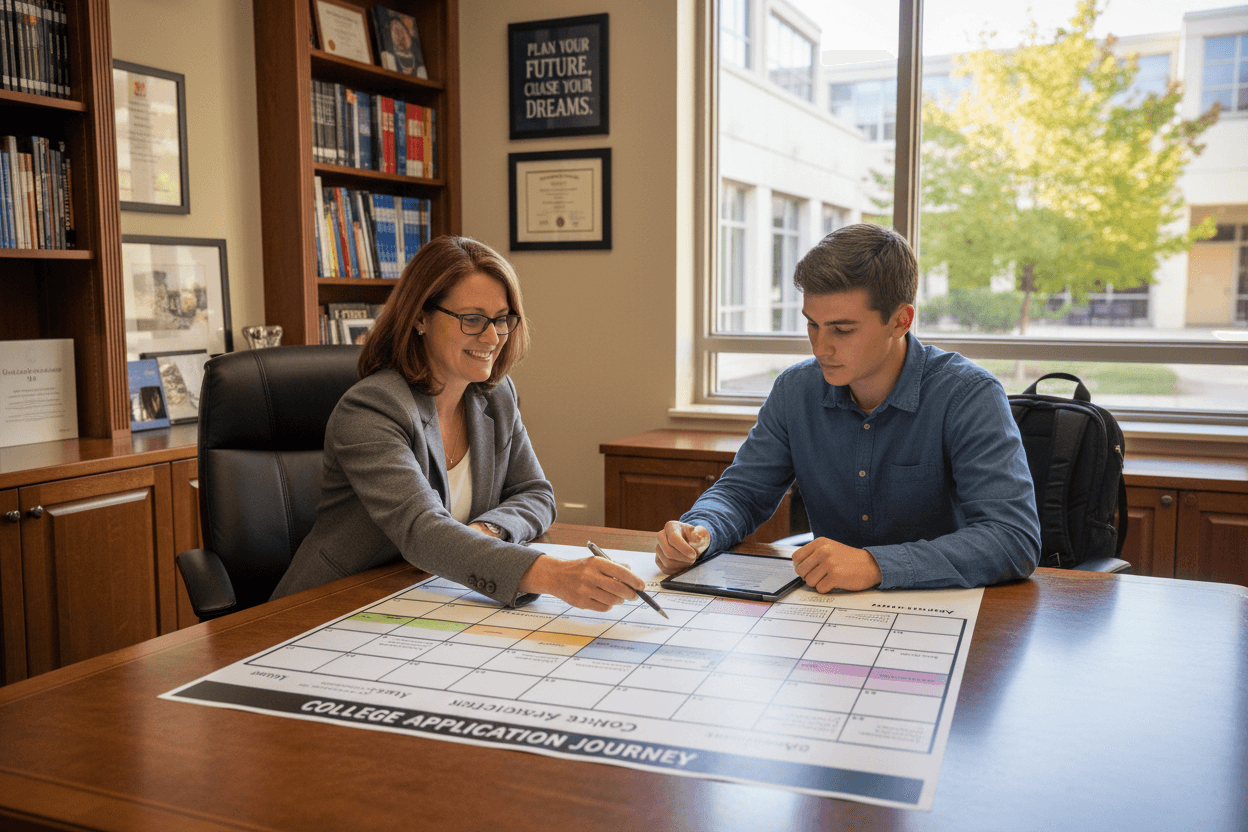
Senior year moves fast. The families who navigate it most successfully are the ones who know what is coming before it arrives. A month-by-month college counseling timeline newsletter gives senior families exactly that: a clear picture of what needs to happen each month from September through May, delivered at the moment it is most relevant.
This newsletter does not need to be long. It needs to be specific, accurate, and sent on time. A counselor who sends a monthly senior newsletter consistently throughout the year, even if each issue is only 300 words, will have fewer panicked phone calls and more students meeting their deadlines.
August: the full picture before school starts
Send the first senior newsletter in August, before school starts. This issue should provide the full academic year overview. List every major milestone: Common App opens August 1, FAFSA opens October 1, early decision and early action deadlines in November, regular decision deadlines in January, financial aid award letters in March and April, and the national Decision Day on May 1.
Include a prompt to create a Common App account, a prompt to request teacher recommendations before school starts, and a reminder to schedule a senior counseling appointment for September. The August newsletter functions as the orientation document for senior year. Families who read it have a map. Families who do not often arrive in October feeling behind.
September: applications, recommendations, and the essay
The September newsletter focuses on three things: completing the Common App profile and activities section, securing recommendation letters, and drafting the personal essay. Name your school's internal deadline for recommendation requests, which should be at least four to six weeks before any application deadline the student has. Remind seniors that teachers and counselors need adequate time to write thoughtful letters, and that last-minute requests produce last-minute quality.
Include the essay prompt reminder. Seniors who begin writing in September have time to revise. Seniors who begin in late October for November 1 deadlines do not. If your school holds a college application workshop or essay review sessions in September, include those dates in this newsletter.
October: the FAFSA opens and early applications close
October is one of the two most critical months of senior year. FAFSA opens on October 1 and many states award financial aid on a first-come, first-served basis, meaning early submission directly affects how much money a student receives. The October newsletter should communicate this clearly and include the most relevant state priority deadlines for your school's population.
October is also the month when students with November 1 early deadlines should be in final revision mode on their applications. The newsletter should name which schools in your region have November 1 early decision or early action deadlines, remind students about the Common App submission checklist, and confirm whether your school submits transcripts automatically or requires a student request.
November: early decisions, peer pressure, and what to do next
The November 1 deadline passes and some students receive early decision responses in mid-December. The November newsletter should address what happens after submission: students should continue working on regular decision applications for their full list rather than assuming they will receive an early decision acceptance. Early decision acceptance rates are higher than regular decision rates at many schools, but they are not certain.
For students not applying early anywhere, the November newsletter should reinforce regular decision deadlines and keep them on track for January submissions. Include a prompt to begin the CSS Profile if applicable. Many selective institutions require both the FAFSA and the CSS Profile, and the CSS Profile has earlier deadlines at some schools.
December: regular decision applications and financial aid follow-up
December is the month when seniors applying regular decision should finalize and submit their applications. The newsletter should name any January 1 deadlines, which are common for regular decision applications, and remind families that December 31 submissions are technically on time but create unnecessary stress. Encourage families to aim for December 20 completions so the winter break is not consumed by application anxiety.
For FAFSA, December is a check-in month. Families who have not yet submitted should do so immediately. Include a reminder that some financial aid funds are exhausted before the official deadline if the school uses rolling allocation.
January through March: waiting, mid-year transcripts, and scholarships
The period between January and March is one of the most overlooked in the senior year newsletter sequence. Most counselors stop communicating after the December application push and resume in April when decisions arrive. But January through March is when several important things happen.
Mid-year grade reports are submitted in January and February. Seniors whose grades have dropped since submission should know that colleges can and do rescind acceptances for significant academic decline. The newsletter should say this plainly. Local scholarship deadlines cluster in January and February. A newsletter that compiles local scholarship opportunities with their deadlines is one of the highest-value things a counseling office can produce during this period.
April and May: decision day and the final steps
Financial aid award letters arrive in March and April. The April newsletter should explain how to compare award letters, specifically the difference between grants and scholarships that do not require repayment and loans that do. Many families make college decisions based on the total financial aid package without distinguishing between the two types, which leads to painful realizations in sophomore year when loan repayment comes into focus.
National Decision Day is May 1. The May newsletter should celebrate students who have committed, remind any undecided students of the deadline, and provide the final checklist: submit enrollment deposit, accept or decline financial aid offers, notify any schools you are not attending, and begin housing and orientation registration. Ending the senior year newsletter sequence with a clear final checklist gives families a clean close to a long process.
Get one newsletter idea every week.
Free. For teachers. No spam.
Frequently asked questions
Should counselors send one timeline newsletter or multiple monthly newsletters?
Both approaches work. A single comprehensive timeline newsletter sent in August gives senior families the full picture at once and serves as a reference document throughout the year. Monthly newsletters that focus on the current month's priorities are more actionable because they arrive when the relevant deadlines are immediately ahead. The most effective approach is to send the full timeline in August and then reinforce the relevant section in each monthly newsletter through May.
What is the single most important deadline to feature in the senior timeline newsletter?
November 1 early decision and early action deadlines, for schools that have them. Missing an early deadline is not recoverable. Students who miss the November 1 early action deadline at their top-choice school move into a larger and more competitive regular decision pool. A counselor who features this deadline prominently in September, October, and a final reminder in late October is doing the most valuable deadline communication of the year.
How do you communicate FAFSA deadlines in the timeline newsletter without causing panic?
Be specific and calm. Name the federal FAFSA deadline, which is typically June 30 of the following year. Then name the priority deadlines for the specific states and institutions your students most commonly apply to, because those deadlines are often months earlier and are where families lose financial aid money by waiting. A newsletter that says 'file FAFSA as soon as possible after October 1' with a list of the three or four states most relevant to your school's population is more useful than a general statement about financial aid.
How should the timeline newsletter handle students who are applying to a mix of early and regular decision schools?
Acknowledge that students have different timelines based on their college lists. The timeline newsletter should name both the early application sequence and the regular decision sequence, and explicitly note that students applying to any early decision or early action school need to treat their October and November deadlines as the priority, while those applying regular decision everywhere have until January. This helps families understand which category their student is in and what that means for their fall schedule.
How does Daystage help counselors send monthly timeline newsletters to senior families?
Daystage is built for school newsletter communication with subscriber lists that let counselors reach senior families specifically. The ability to schedule newsletters in advance means counselors can write the September through December timeline newsletters in August and set them to deliver on the first of each month, without managing each send manually during the busiest period of the school year. Counselors who do this report significantly less deadline-related stress for themselves and their families.

Adi Ackerman
Author
Adi Ackerman is a former classroom teacher and curriculum writer with 8 years in K-8 schools. She writes about school communication, parent engagement, and what actually works in real classrooms.
More for College Prep
Ready to send your first newsletter?
3 newsletters free. No credit card. First one ready in under 5 minutes.
Get started free