
Third Grade ELL Support Newsletter: Keeping English Language Learner Families Connected
Third grade classrooms are often home to students from a wide range of language backgrounds. For families where English is not the primary language spoken at home, the standard classroom newsletter can feel like a wall rather than a window. With a few intentional adjustments, you can turn your newsletter into one of the most powerful tools you have for connecting ELL families to their child's education.
Understanding What ELL Families Actually Need
Families of English language learners often have the same questions as every other parent: How is my child doing? What are they learning? What can I do at home to help? The difference is that accessing those answers can require navigating language barriers, unfamiliar school systems, and communication formats that were not designed with them in mind.
A well-designed newsletter addresses this directly. It does not require a family to decode education jargon or understand complex testing language. It meets them where they are and delivers clear, useful information in a format they can actually use.
Writing in Plain, Accessible Language
Plain language matters for every family, but it matters especially for ELL households. Use short sentences. Stick to everyday vocabulary wherever possible. When you do need to use academic terms like "phonics" or "fluency," give a brief explanation alongside it.
Avoid idioms that do not translate well. Phrases like "hit the ground running" or "burning through material" are confusing even for native speakers reading quickly. Replace them with direct statements: "We started the year with a strong focus on reading" says the same thing without the confusion.
Offering Translated Versions
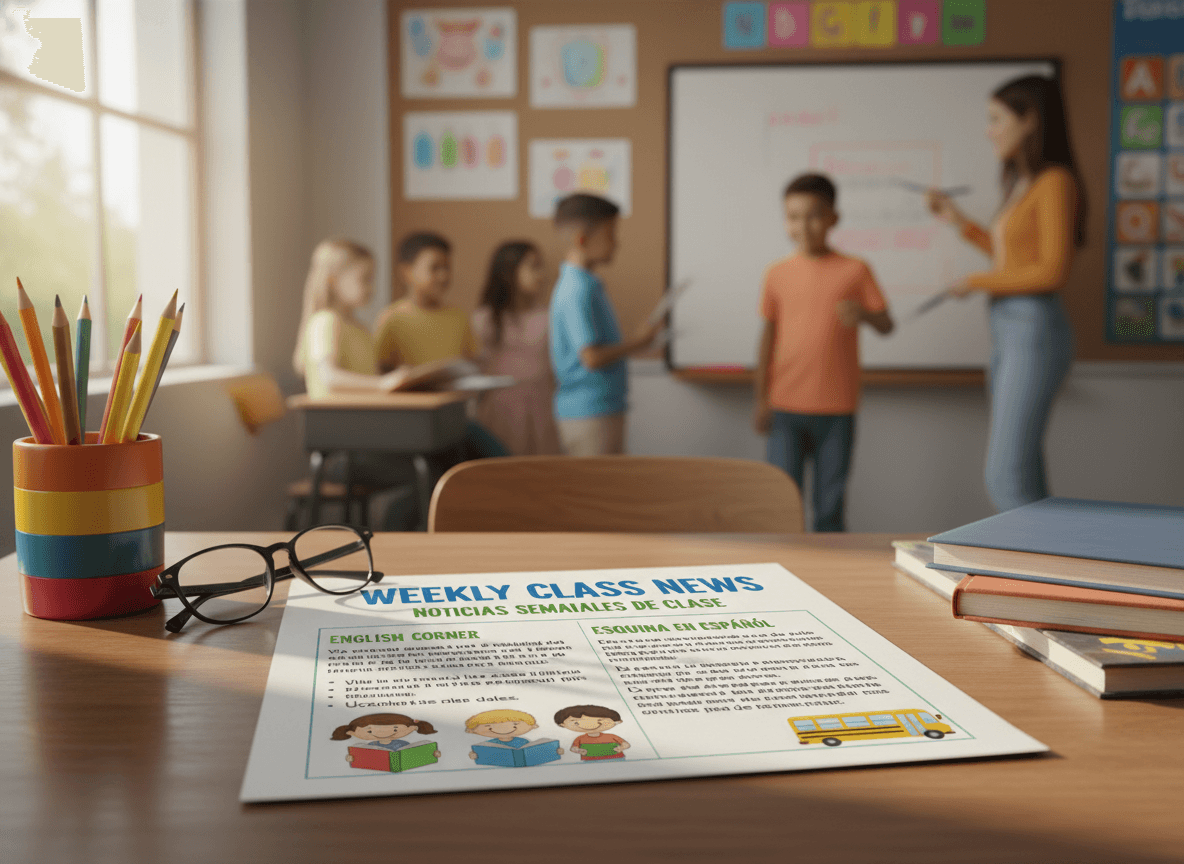
Translation does not have to be a huge undertaking. If you have families who primarily speak Spanish, Mandarin, Vietnamese, or another language common in your school community, a translated version of your newsletter shows genuine effort and significantly increases engagement.
Start with a tool like Google Translate to create a working draft, then ask a bilingual colleague, staff member, or community volunteer to review it for accuracy. Even an imperfect translation is often more useful than an English-only document for a family with limited English proficiency.
Highlighting ELL Program Supports
Families of ELL students often do not have a clear picture of the supports their child is receiving. Use your newsletter to describe what English language development looks like in your classroom. Are students receiving pull-out services with an ELL specialist? Are there in-class language supports? Is your classroom using visuals, sentence frames, or vocabulary walls?
When families understand what their child's day looks like, they feel less anxious and more equipped to have meaningful conversations with their child about school. Describe the supports in plain language, not in program jargon.
Sharing Language Development Milestones
Progress in language acquisition does not always show up in standard academic metrics right away, but there is almost always genuine growth to report. Notice and share specific milestones. "Your child is now initiating conversations with classmates in English" or "we are seeing real growth in the ability to follow multi-step oral directions" gives families something concrete to celebrate.
Tie these milestones to what they mean for learning. When a child can follow classroom instructions independently, that unlocks participation in activities that were previously harder to access. Help families see the chain from language growth to academic opportunity.
Home Language Support Strategies
Research is clear that maintaining a strong home language supports English acquisition, not the opposite. Your newsletter can reinforce this by encouraging families to continue rich conversations in their home language. Reading books, telling stories, and discussing ideas in the language a family knows best builds the foundational literacy skills that transfer to English learning.
Include one or two specific suggestions each month. "Talk with your child about what they did at school today, in any language" is simple, actionable, and removes the pressure some ELL families feel about not being able to support English homework directly.
Upcoming Events and How to Participate
School events can feel intimidating for families who are navigating a new language and culture. Use your newsletter to preview upcoming events and explain clearly what they involve, what time they start, whether translation will be available, and what families can expect.
When ELL families show up to school events and feel welcomed, the relationship between home and school strengthens in ways that directly benefit students. Your newsletter can be the first step in making participation feel accessible.
Building a Two-Way Relationship
End each newsletter with a clear invitation for families to reach out. Include your contact information and note whether you have access to translation support for meetings or phone calls. Some schools have bilingual staff or can connect families with interpretation services. Letting families know that option exists removes a significant barrier to communication.
When ELL families feel genuinely welcomed into the communication loop, students benefit directly. The connection between home and school becomes a resource rather than a source of stress, and that shift makes a real difference in the classroom every day.
Get one newsletter idea every week.
Free. For teachers. No spam.
Frequently asked questions
Should I translate my third grade newsletter for ELL families?
If you have families who are more comfortable in another language, offering a translated version shows respect and dramatically increases the chances your communication actually gets read. Free tools like Google Translate can produce a working draft, and many schools have bilingual staff who can review it for accuracy before it goes home.
What ELL program updates should go in a classroom newsletter?
Let families know what language supports their child is receiving, how English proficiency goals are progressing, and what the classroom is doing to build academic vocabulary. Also share any upcoming ELL assessments or parent meetings so families feel informed rather than surprised.
How do I communicate progress when a student is still developing English?
Focus on growth rather than comparison. Describe specific things the student can do now that they could not do at the start of the year. Use phrases like 'is now able to' and 'has started to' so progress feels concrete and positive, even when a student is still working toward grade-level benchmarks.
How can I make my newsletter more accessible for ELL families?
Use shorter sentences, common vocabulary, and clear headings. Avoid idioms and education jargon. Include visual cues like simple icons or photos where you can. When families with limited English proficiency receive a newsletter that reads clearly, they are far more likely to engage with it.
What newsletter tool works best for reaching ELL families in third grade?
Daystage is a school newsletter platform designed to make family communication simple and professional. You can build a clean, visually clear newsletter that is easy to read for families at all language levels, and send it directly to families without relying on paper that gets lost in backpacks.

Adi Ackerman
Author
Adi Ackerman is a former classroom teacher and curriculum writer with 8 years in K-8 schools. She writes about school communication, parent engagement, and what actually works in real classrooms.
More for Classroom Teachers
Third Grade Classroom Newsletter Ideas Parents Actually Read
Classroom Teachers · 6 min read
3rd Grade Special Education Newsletter: Communicating IEP Progress and Support to Families
Classroom Teachers · 7 min read
Second Grade ELL Support Newsletter: How to Communicate With and About English Language Learners
Classroom Teachers · 7 min read
Ready to send your first newsletter?
3 newsletters free. No credit card. First one ready in under 5 minutes.
Get started free