
Second Grade ELL Support Newsletter: How to Communicate With and About English Language Learners
English language learners in second grade face a compounded challenge: they are learning to read and write in a language they are still acquiring while also meeting the full academic expectations of the grade level. Their families often face a parallel challenge: navigating a school communication system that may be entirely in a language they are still learning, with cultural norms and institutional expectations that may be unfamiliar.
The newsletter you send home has a role in either closing that gap or widening it. This guide covers how to write newsletters that genuinely serve ELL students and their families, and how to communicate about ELL support in a way that builds trust rather than creating distance.
Start With Plain, Clear Language for Everyone
The single most valuable writing change you can make for ELL families is also the change that makes your newsletter better for every family: use plain, direct language. Cut jargon. Spell out acronyms. Replace idioms with literal language. "We will test students in reading and math" is clearer than "we will be administering benchmark assessments." "Your child's English teacher" is clearer than "your child's ELA instructor."
This is not dumbing down your communication. It is removing barriers that serve no one. A newsletter written in plain language is easier to translate accurately, easier to process for families still building English proficiency, and often clearer for fluent English-speaking families too.
Translate Your Most Important Newsletters
Not every newsletter needs to be translated into every language represented in your class. But the newsletters that matter most should be available in the home languages of your families: the beginning-of-year curriculum overview, the supply list, the homework policy, and any newsletter that asks families to take a specific action or attend a specific event.
Automated translation tools like Google Translate have become reliable for most common languages in everyday communication. For sensitive documents or anything that will be used in a formal context, ask a bilingual colleague or community liaison to review the translation before sending.
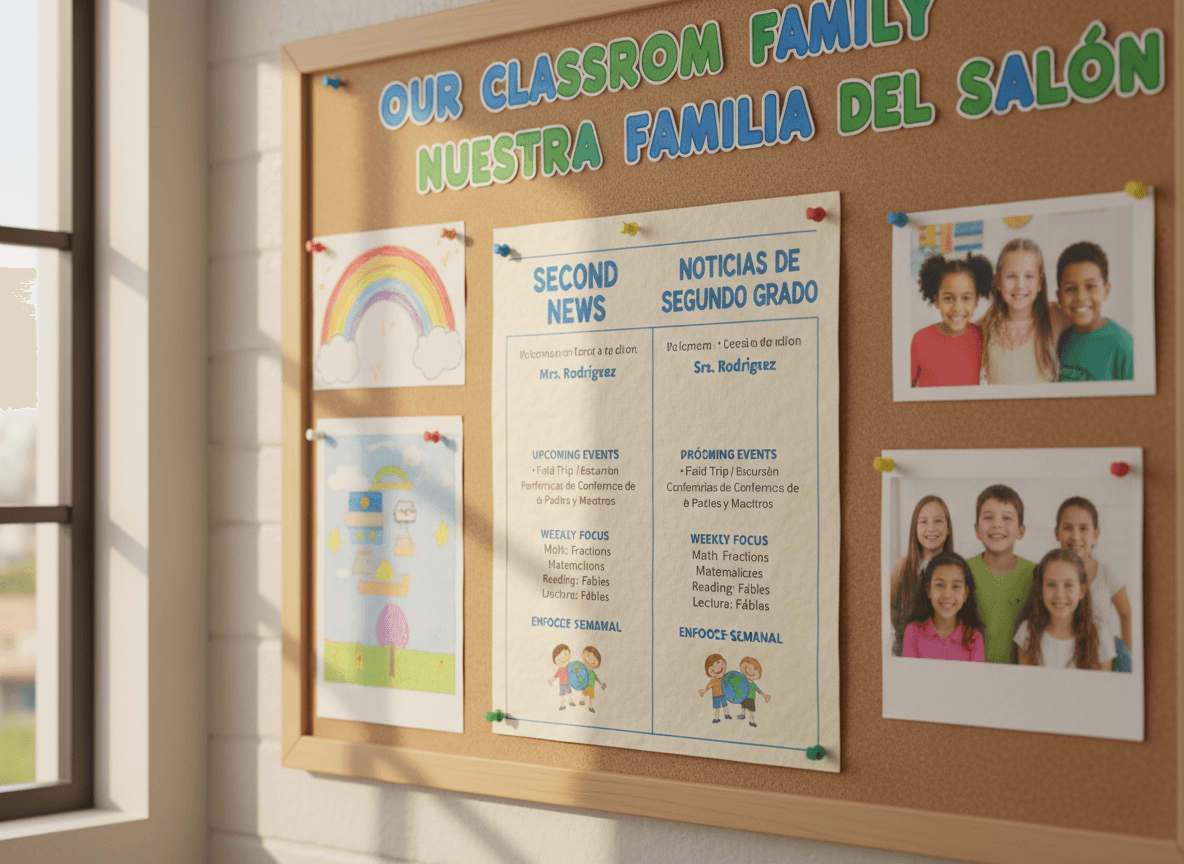
When you send a translated newsletter, include both the English version and the translated version. This helps families who are learning English by giving them a parallel text, and it signals that you see their home language as legitimate, not as a problem to be replaced.
Describe How ELL Support Works in Your Classroom
Many ELL families do not know what language support services look like in an American elementary school. They may not know the difference between a push-in and pull-out model, whether their child will be in a bilingual classroom or an English-immersion setting, or how the level designations used by the school relate to their child's actual ability. Your newsletter can provide that context.
A general description of how language support is structured in your classroom helps all families, not just ELL families, understand the learning environment. Something like: "Several students in our class receive support from our English language development specialist. This support happens both within our classroom and in small groups, and is designed to help students build academic English skills while they continue to participate fully in all classroom activities."
Acknowledge and Celebrate Multilingualism
Second graders who speak more than one language have a cognitive and cultural asset that deserves genuine recognition, not just tolerance. Your newsletter is a place to communicate that multilingualism is valued in your classroom and in your school community.
Include a brief line in your newsletter that names this explicitly. "Our classroom is richer because our students bring languages and experiences from many different backgrounds. We celebrate that diversity as part of our community." That sentence costs you nothing and communicates something real to ELL families about whether their child belongs in your room.
Give ELL Families Specific Ways to Support Learning at Home
A common mistake in newsletters to ELL families is instructing parents to practice English with their children at home, sometimes explicitly telling families to stop speaking their home language. Current research on second language acquisition strongly contradicts this advice. Children who develop strong literacy and academic language skills in their home language transfer those skills to English more readily than children who are pushed to abandon their first language.
Instead, tell families that reading together in their home language supports their child's English development. Encourage rich conversation in whatever language feels most natural. Ask families to share books, stories, and songs in their language. When you frame home-language use as an asset to English learning rather than an obstacle, you align with the evidence and build trust with ELL families simultaneously.
Remove Barriers to Conference and Event Participation
ELL families often have lower attendance at school events and parent-teacher conferences, not because they are disengaged but because the barriers to participation are higher. Language access is one barrier. Unfamiliarity with school culture is another. Work schedules, childcare, and transportation can all compound these challenges.
Your newsletter can address barriers directly by offering options: conferences available in person or by phone, translation services available on request, a family liaison available to attend meetings with families who would like support. When families see these options listed explicitly, many who would have self-excluded will participate.
Build a Communication System That Works for These Families
Some ELL families have limited access to email or do not check it consistently. Some prefer text messages or phone calls. Some rely on older children to translate written communication, which creates its own set of reliability issues. Ask ELL families at the start of the year how they prefer to receive information, and build your communication around that.
Your class newsletter is an important channel, but for ELL families, it may need to be supplemented with a phone call, a text message alert, or a meeting to review the content together. The families who need the most support from school communication are often the least reached by standard newsletter-only approaches.
Partner With Your ELL Specialist
If your school has an ELL specialist or English language development teacher, partner with them on newsletters that touch on language learning topics. They will have resources for families, more specific language about how to support ELL students at home, and insight into what questions ELL families in your school are most commonly asking.
A co-authored or endorsed newsletter from both the classroom teacher and the ELL specialist carries extra credibility with families who are still building trust with the school. It also signals that your school's communication systems are integrated rather than fragmented, which is a message worth sending.
Get one newsletter idea every week.
Free. For teachers. No spam.
Frequently asked questions
How do I send newsletters to ELL families who do not read English fluently?
Use a translation tool for written communications, but go further than automated translation for important documents. Many schools have bilingual staff or community liaisons who can review key newsletters for accuracy and cultural appropriateness. For critical communications, a translated version sent alongside the English original is the most respectful approach.
Should my classroom newsletter mention the ELL support students receive?
In general terms, yes. Describing how language support is integrated into your classroom helps all families understand the learning environment. Specific services for individual students should be communicated privately with those families rather than in a class-wide newsletter.
How do I engage ELL families who may be hesitant to connect with school?
Reduce the barriers to connection. Send communications in families' home languages when possible, offer multiple ways to respond beyond written English, and make it clear that families can bring a support person to conferences or meetings. Some ELL families have had negative or confusing experiences with school systems and will not engage until they feel genuinely welcomed.
What should I avoid when writing newsletters for ELL families?
Avoid jargon, idioms, and acronyms without explanation. 'IEP,' 'ELA,' 'SBAC,' and similar terms are meaningless to families who are also learning English and have no prior context for US school systems. Spell out terms and use concrete, simple language for every audience.
What newsletter tool works well for communicating with ELL families in second grade?
Daystage supports sending school newsletters by email, which makes it easy to attach or link translated versions alongside the English original. Teachers can send their newsletter to all families at once and then follow up individually with ELL families who need additional support. The read-receipt feature also helps identify which families have not yet opened key communications, which is especially useful for families who may need a personal outreach call.

Adi Ackerman
Author
Adi Ackerman is a former classroom teacher and curriculum writer with 8 years in K-8 schools. She writes about school communication, parent engagement, and what actually works in real classrooms.
More for Classroom Teachers
Second Grade Special Education Newsletter: How to Communicate Inclusion and Support to All Families
Classroom Teachers · 7 min read
Second Grade Curriculum Overview Newsletter: What to Share With Families at the Start of the Year
Classroom Teachers · 6 min read
Second Grade Social Studies Newsletter: Connecting Classroom Learning to Family Conversations
Classroom Teachers · 6 min read
Ready to send your first newsletter?
3 newsletters free. No credit card. First one ready in under 5 minutes.
Get started free