
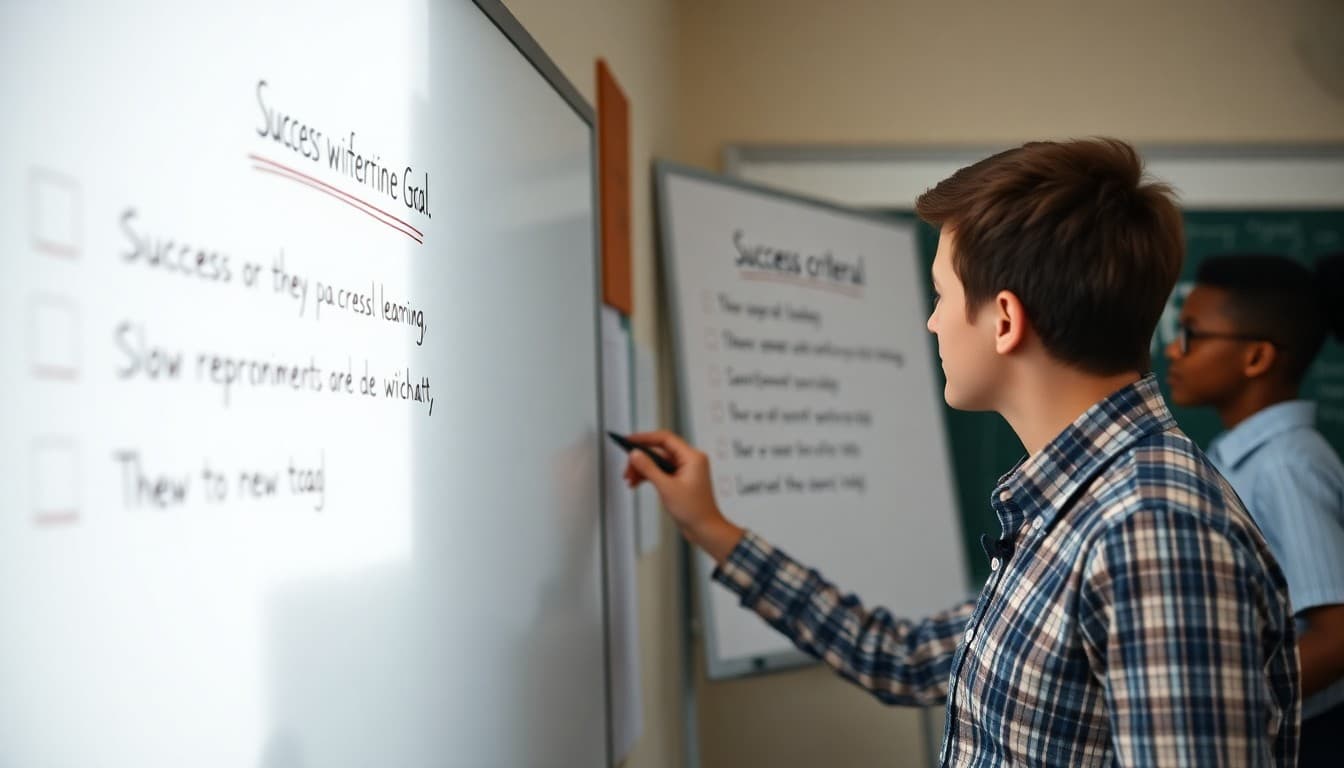
How to Share Success Criteria With Families in Your Teacher Newsletter

Success criteria are the specific, observable behaviors that show a student has met a learning goal. They answer the question students ask most often but rarely say aloud: "How do I know when I am done and it is good enough?" A newsletter that shares success criteria with families gives them the same checklist students use in class, which makes homework support more targeted and more useful.
Explain what success criteria are
"Success criteria are a checklist of what meeting the learning goal actually looks like in the work. They are not the same as the learning goal itself. The learning goal is the destination. Success criteria are the specific markers that confirm you have arrived. For a writing goal like 'I can write a strong argument,' the success criteria tell students exactly what a strong argument contains: a clear claim, evidence from the text, an explanation connecting the evidence to the claim, and a conclusion that goes beyond restating the introduction."
Share the current success criteria for your class
"This week we are working on argumentative writing. Here are the success criteria students are using to check their own drafts before submitting: I have stated my claim in the first paragraph. I have included at least two pieces of evidence from the source. I have explained how each piece of evidence supports my claim, not just restated it. I have addressed a counterargument. My conclusion adds something new rather than copying my introduction. Families who want to help with the writing assignment can use this same list to ask specific questions about the draft."
Explain how students use success criteria during work time
"Before students submit any major writing assignment, they run through the success criteria checklist independently and check off each item they have met. For any item they cannot check off, they write a revision note to themselves. The goal is for students to identify the gap before I identify it. Over time, students who self-check against criteria before submitting produce drafts that need less corrective feedback from me because they have already addressed the most common gaps."
Tell families how success criteria make feedback more specific
"When a student brings home a draft with a 'good job' comment from the teacher, families have nothing to work with. When a draft comes home with a success criteria checklist and specific items not yet checked off, families can ask: 'It says you need to explain how the evidence connects to your claim. Read me that sentence. Now explain it to me in your own words.' That conversation is only possible when the criteria are visible."
Describe how you co-create criteria with students
"For our most important assignments, we build the success criteria together as a class by looking at examples of strong and weak work and naming what makes the difference. Students who help create the criteria understand them more deeply than students who receive them. When your student can tell you what the criteria are without looking at the list, they have internalized the standard rather than just following a checklist."
Connect success criteria to what families already do
"Every parent who has ever said 'make sure you showed your work' or 'did you proofread' is using informal success criteria. What we do in class is the same instinct made more specific and consistent. The criteria do not replace judgment. They make the judgment concrete enough for a student to apply it independently."
Including success criteria in a Daystage newsletter is one of the most practical things a teacher can send home. It gives families a tool that works during the assignment, not just after it is graded.
Get one newsletter idea every week.
Free. For teachers. No spam.
Frequently asked questions
What are success criteria and how are they different from learning goals?
A learning goal describes what students will understand or be able to do. Success criteria describe the specific, observable evidence that shows a student has met the goal. A learning goal might be 'I can write an argumentative paragraph.' The success criteria are: I have a clear claim, I have at least two pieces of evidence, I have explained how each piece of evidence supports the claim, and I have used a transition between evidence and explanation.
Where do success criteria come from?
Teachers derive success criteria by unpacking what high-quality work on a given standard actually looks like. Some teachers co-create success criteria with students by analyzing exemplar work together and identifying what makes it strong. Co-created criteria tend to produce more student ownership because students helped define the target.
Are success criteria the same as a rubric?
They are related but different. A rubric describes performance at multiple quality levels (excellent, proficient, developing). Success criteria describe what proficient looks like as a checklist. Success criteria are simpler and more actionable for self-checking during the writing or problem-solving process. Rubrics are more useful for grading after completion.
How can families use success criteria at home?
Use them as a checklist before your student considers their work done. 'Read me your claim. Now show me your first piece of evidence. Now explain to me how it supports the claim.' Running through the criteria out loud is a more effective pre-submission check than reading the work silently and hoping it is done.
Can Daystage help teachers share success criteria with families in newsletters?
Yes. A Daystage newsletter that includes the current success criteria checklist gives families a practical tool for homework support. The criteria are already written , sending them home takes one minute and dramatically improves the quality of support families can provide.

Adi Ackerman
Author
Adi Ackerman is a former classroom teacher and curriculum writer with 8 years in K-8 schools. She writes about school communication, parent engagement, and what actually works in real classrooms.
More for Classroom Teachers
How to Share Visible Learning Goals With Families in Your Teacher Newsletter
Classroom Teachers · 6 min read
How to Explain Student Self-Assessment to Families in Your Teacher Newsletter
Classroom Teachers · 6 min read
How to Explain Formative Assessment to Families in Your Teacher Newsletter
Classroom Teachers · 6 min read
Ready to send your first newsletter?
3 newsletters free. No credit card. First one ready in under 5 minutes.
Get started free