

How to Explain Student Self-Assessment to Families in Your Teacher Newsletter
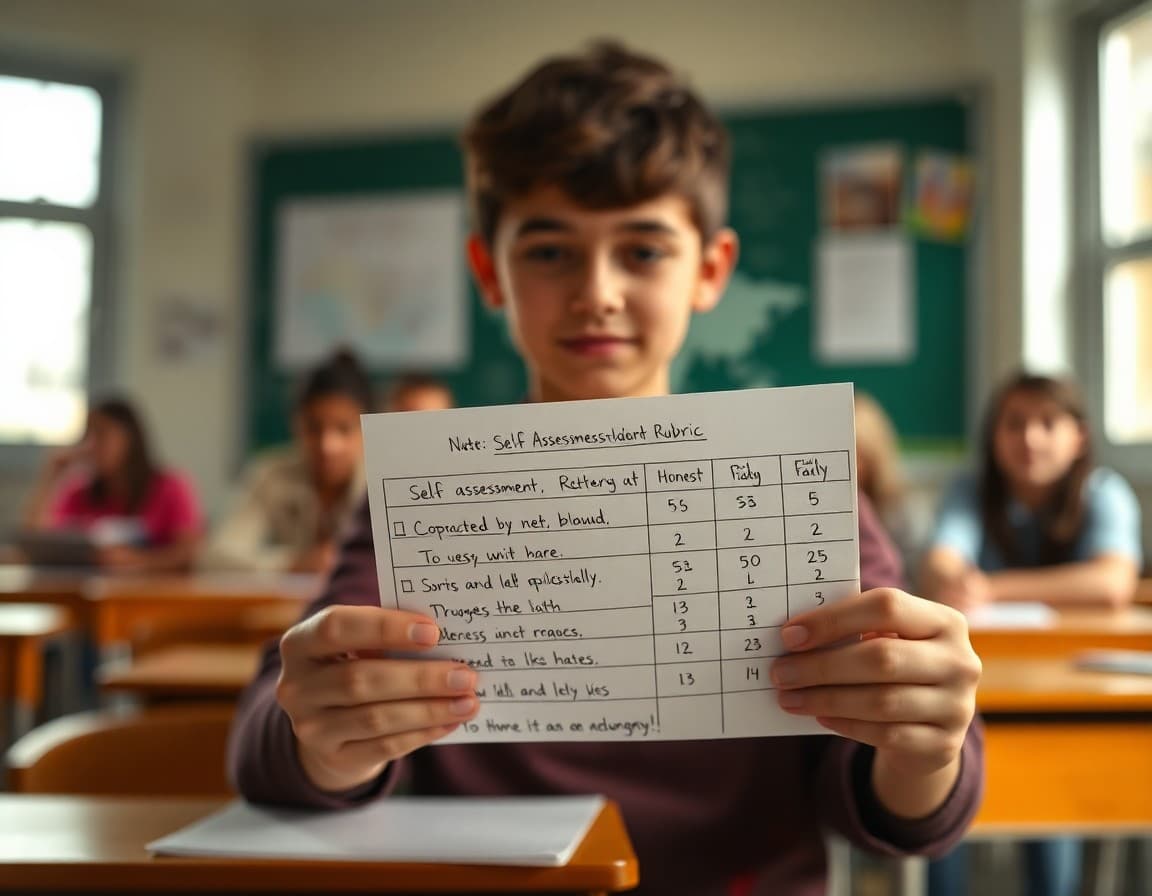
Self-assessment is one of the highest-leverage practices in learning because it transfers ownership of quality from the teacher to the student. A student who can look at their own work and say "this argument needs more evidence" or "this calculation is right but my work is not shown" is a student who is developing the monitoring skills that independent learners need. A newsletter that explains self-assessment helps families understand what they are seeing when work comes home with a student-filled rubric attached.
Explain what self-assessment is and what it is not
"Self-assessment in our classroom is a structured practice where students evaluate their own work against defined criteria before I look at it. It is not guessing what grade they will get. It is not fishing for compliments. It is looking honestly at a piece of work and asking: does this meet the standard? Where does it fall short? What would make it stronger? The criteria come from the same rubric I use, so students know exactly what they are measuring against."
Describe what self-assessment looks like in your classroom
"Before students submit a writing draft, they complete a self-assessment using our writing rubric. They rate themselves in four areas: focus, organization, evidence, and conventions. For each area they write one sentence explaining their rating. Then they choose one area to revise before submitting. I collect the self-assessment alongside the draft and compare our ratings. When they match closely, I know the student has an accurate picture of their own work. When they diverge, that gap is where the most important feedback conversation happens."
Explain why accuracy in self-assessment takes time to develop
"Students do not self-assess accurately the first time. Early in the year, most students rate themselves higher than the work warrants. This is not dishonesty. It is the normal starting point before they have internalized what quality looks like. Over the course of the year, as they see more examples of strong work and receive feedback that shows them where the gap was, their self-assessments become more accurate. The accuracy itself is a learning progression I track."
Tell families how this connects to self-directed learning
"A student who can self-assess accurately does not need to wait for a teacher to tell them their work is not done yet. They can see it. That skill is what separates students who revise from students who submit the first draft. It also transfers to every other subject and to every context outside of school where quality standards matter and feedback is not immediately available."
Give families a way to practice self-assessment at home
"When your student brings home work, ask them to rate it before you say anything. 'What score would you give this and why?' Then look at it yourself. The conversation about where your assessment and their assessment differ is exactly the kind of thinking we practice in class. It does not need rubrics or formal criteria at home. The habit of honest evaluation before asking for external feedback is the goal."
Share an observation from recent self-assessment work
"In this month's writing self-assessments, students were more accurate on organization than on evidence quality. Most students correctly identified their organizational strengths and weaknesses. Most also underestimated how much more evidence their arguments needed. That pattern tells me the next lesson should focus on what counts as sufficient evidence for a claim."
When families understand that self-assessment is a skill students are actively learning, not a checkbox before grading, the practice makes more sense and families can reinforce the same habits at home. Daystage is a practical way to send home the rubric and explanation together so both pieces arrive in context.
Get one newsletter idea every week.
Free. For teachers. No spam.
Frequently asked questions
What is student self-assessment and why do teachers use it?
Self-assessment is a practice where students evaluate their own work against defined criteria before the teacher grades it. Teachers use it to develop metacognition , the ability to think about and monitor one's own thinking. Students who can accurately assess their own work are more independent learners and more effective at directing their own revision.
Are students accurate when they self-assess?
With practice, yes. Young students initially overestimate their performance. Over time, explicit instruction in what quality looks like narrows the gap between self-assessment and teacher assessment. The process of self-assessing accurately is itself a learning goal, not just a warm-up to the real evaluation.
Does self-assessment replace teacher grading?
No. Self-assessment is a learning practice that precedes or accompanies teacher feedback. Most teachers use self-assessment as a step in the revision process rather than as a replacement for teacher evaluation. The comparison between what the student assessed and what the teacher assessed is often the most instructive part.
How can families support self-assessment habits at home?
When your student brings home work, ask them to assess it before you do. 'What do you think is the strongest part? What would you change if you could do it over?' This builds the habit of evaluating work before submitting it. Avoid telling them what you think first , let them self-assess before hearing external feedback.
Can Daystage help teachers share self-assessment examples with families in newsletters?
Yes. A Daystage newsletter can include a photo of a self-assessment rubric alongside an explanation of how it is used, which gives families a concrete model of the practice and what it looks like in student work.

Adi Ackerman
Author
Adi Ackerman is a former classroom teacher and curriculum writer with 8 years in K-8 schools. She writes about school communication, parent engagement, and what actually works in real classrooms.
More for Classroom Teachers
How to Explain Formative Assessment to Families in Your Teacher Newsletter
Classroom Teachers · 6 min read
How to Share Success Criteria With Families in Your Teacher Newsletter
Classroom Teachers · 6 min read
How to Explain Progress Monitoring to Families in Your Teacher Newsletter
Classroom Teachers · 6 min read
Ready to send your first newsletter?
3 newsletters free. No credit card. First one ready in under 5 minutes.
Get started free