
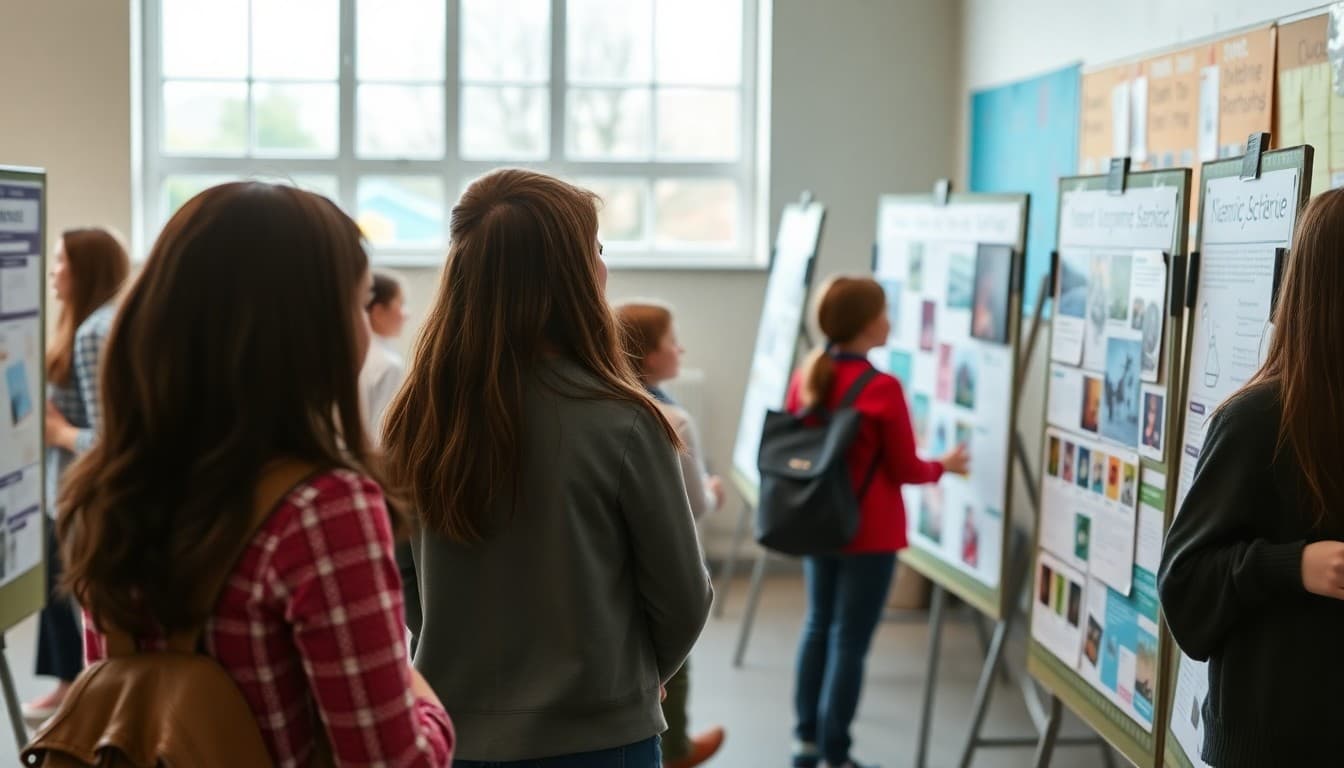
Teacher Newsletter for Science Showcase: Prepare Families for Project Night

A science showcase is a chance for students to present their thinking, not just their results. Your newsletter before the event is what helps families arrive prepared to engage, not just observe. The difference between a parent who watches their child point at a poster and one who listens to their child explain a hypothesis and a conclusion is almost entirely determined by the preparation that newsletter provides.
Name What Students Investigated
Open the newsletter by describing what students were doing over the course of the unit. They identified a question they were curious about, formed a hypothesis, designed and conducted an experiment, recorded observations, and drew conclusions. Naming that arc gives families a context for what they are about to see. A parent who understands the scientific process appreciates the work differently than one who sees a tri-fold board for the first time.
Give Families Questions to Ask Their Child
Include four questions every family member should ask their child during the showcase: What question did you try to answer? What did you think would happen? What actually happened? What did you learn? These questions work for any project, give families a natural conversation structure, and demonstrate to students that their scientific thinking matters to the people watching them.
Explain the Showcase Format
Is this a gallery walk where families roam freely? Are students assigned presentation slots? Are there judges or evaluators? Tell families exactly what to expect when they walk in the door. Families who know the format navigate the event more confidently and spend more quality time at each project.
Describe the Display Components
Every student will have a display board, a data table, or a visual summary of their experiment. If students prepared a materials demonstration or a model, mention that. Giving families a preview of what the display looks like prevents the first few minutes of the showcase from being consumed by orientation.
Connect the Work to Science Standards
One sentence connecting the showcase to the skills students developed, whether it is data collection, variable control, or scientific communication, reinforces that this is a learning event, not just a fair. Families who understand the standards context take the work more seriously.
Close with a Congratulations Before the Event
End the newsletter by acknowledging the effort students put into their projects. Students who know their teacher is proud of their work before showcase night arrive with more confidence. Using Daystage, you can design that message to feel genuinely celebratory and get it to every family before the event doors open.
Get one newsletter idea every week.
Free. For teachers. No spam.
Frequently asked questions
What should a science showcase newsletter cover?
Explain the format of the showcase, what each student prepared, the date and time, whether families need to arrive at a specific time for their child's presentation, and how families should engage with other students' projects. Preparation-focused newsletters produce better-attended and more engaged showcase audiences.
How do I explain the scientific method to parents in the newsletter?
A brief description of the inquiry process students followed, including question, hypothesis, experiment, observation, and conclusion, gives families a framework for understanding what their child is presenting. Even one sentence per step is enough to prime the audience before they walk in the door.
Should families ask their child questions during the showcase?
Yes. Encourage families in the newsletter to ask their child to explain their question, what they thought would happen, what actually happened, and what they learned. These four questions work for any project and give families a natural conversation structure that makes the experience more meaningful for the student.
Are judges involved in the classroom showcase?
Some classroom showcases are simply exhibitions while others involve peer or teacher evaluation. Your newsletter should clarify whether students are being judged, what criteria are used if so, and how students should prepare to explain their work. This prevents anxiety from families who assume their child is being graded on something they did not prepare for.
What tool helps teachers send newsletters efficiently?
Daystage is a great fit for science showcase newsletters. You can include a project preview, audience engagement tips, the event schedule, and an RSVP option in one clear message. Families who open it know exactly what to expect on showcase night.

Adi Ackerman
Author
Adi Ackerman is a former classroom teacher and curriculum writer with 8 years in K-8 schools. She writes about school communication, parent engagement, and what actually works in real classrooms.
More for Classroom Teachers
Ready to send your first newsletter?
3 newsletters free. No credit card. First one ready in under 5 minutes.
Get started free