

How to Write a Bridge Building Project Newsletter to Families
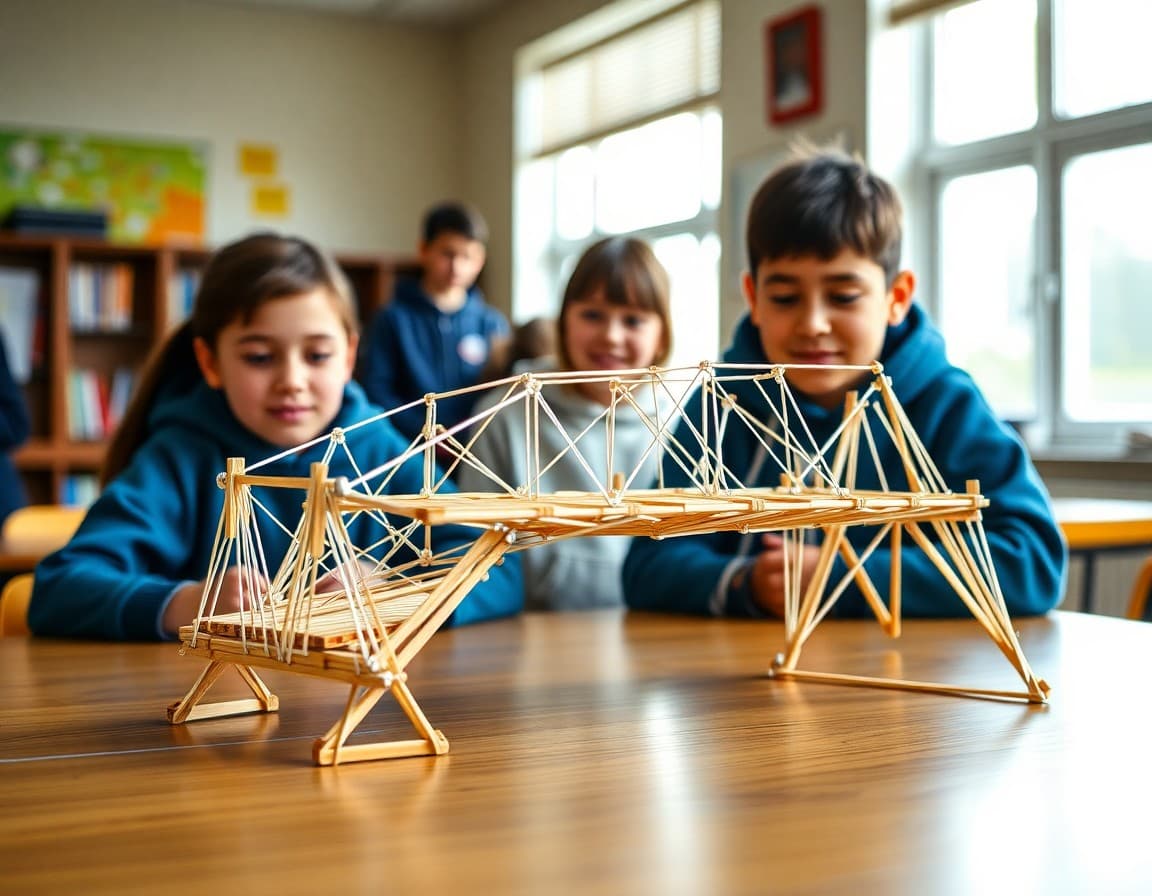
Bridge building projects are among the most memorable engineering challenges a student encounters in school. They combine visible physics, careful math, hands-on construction, and the extremely satisfying moment when a structure either holds its load or dramatically fails. A newsletter that explains what students are actually learning through the project turns an exciting activity into a meaningful academic experience families can support and celebrate.
Describe the challenge and the constraints
Tell families exactly what students are building. A bridge that must span a specific gap, support a specific minimum load, weigh no more than a certain amount, and be built with specific materials. The constraints are what make bridge building a genuine engineering challenge rather than a free build. Families who understand the constraints can ask better questions and will have a much clearer picture of what their student is describing when they come home talking about the project.
Explain the structural concepts behind the project
Bridge building teaches real structural engineering. Compression forces push inward on a structure while tension forces pull outward. Triangles are the most structurally stable shape because they cannot be deformed without changing the length of a side. Arch shapes distribute load along a curve. Trusses use triangulated frameworks to carry load efficiently. Families who have a basic vocabulary for these concepts can engage more meaningfully with what their student is learning.
Connect to the math standards
Bridge building is math in application. Measurement and precision, ratio and proportion in scale drawings, weight and load calculations, data collection during testing. Students who measure inaccurately during construction often discover the consequence directly when joints do not align or spans fall short. Math precision has a physical consequence here that no worksheet can replicate. Naming these connections helps families see the academic depth of the project.
Walk families through the design process
Students do not go straight from idea to building. They sketch designs with measurements and reasoning, choose materials based on structural logic, build a prototype, evaluate its weaknesses, and often rebuild sections before the final test. This iterative design process is the core engineering skill the project develops. Families who understand this do not expect a perfect bridge on the first try and will not interpret a redesign as a failure.
Describe the load testing event
The load test is the culminating moment of the project. Tell families how it works: what weights will be added, how the bridge will be positioned, what counts as a successful result, and whether results will be measured by weight held, weight-to-bridge-mass ratio, or another metric. Students who understand how they will be evaluated build with more intention. If families can attend the testing event, say so and give the date.
Connect to bridges in the real world
Suggest that families look at bridges they cross or drive past and notice the structural features their student has been studying. The triangle patterns in a truss bridge, the arc of an overpass, the cable stays of a suspension bridge. Asking their student to identify what structural problem each bridge design is solving turns an ordinary commute into a field investigation. This kind of observation is available to every family regardless of location.
Share what success looks like beyond load capacity
Remind families that bridge building assessment values the design process as much as the physical result. A student who documents their design reasoning, explains why they chose a truss structure over an arch, and reflects on what they changed after the first test is demonstrating the engineering design thinking the project is meant to develop. A bridge that holds 500 grams with no documentation teaches less than a bridge that holds 200 grams with careful reasoning throughout.
Daystage makes it easy to send a bridge building project newsletter with load testing details and follow-up photos from the showcase so families experience the full arc of a project that develops structural thinking and engineering persistence in equal measure.
Get one newsletter idea every week.
Free. For teachers. No spam.
Frequently asked questions
What does a bridge building project teach students?
Bridge building develops structural engineering concepts including load distribution, tension, compression, and material strength. It also builds mathematical skills through measurement and calculation, scientific skills through hypothesis and testing, and collaborative skills through design decisions made as a team. It is one of the most cross-disciplinary hands-on projects in the curriculum.
What materials do students typically use for bridge building projects?
Common classroom bridge materials include popsicle sticks and wood glue, index cards and tape, spaghetti and marshmallows, or toothpicks and glue. The material choice determines the structural principles being explored. Your newsletter should specify exactly what materials students are using and whether they need to bring anything from home.
How is a bridge building project assessed?
Assessment typically includes the engineering design document (sketch with measurements and reasoning), the construction process (documentation of decisions and changes), and the load test (how much weight the bridge holds per gram of bridge weight). Both the process and the final product matter, and students who document their decisions well often score higher than those who build a stronger bridge without the reflection.
How can families support a bridge building project?
Families can look at real bridges together and discuss what makes them structurally effective. Noticing the triangle shapes in truss bridges, the arc of arch bridges, and the cable patterns of suspension bridges builds the vocabulary students are using in class. This kind of observation walk is free, fast, and highly connected to the engineering content.
What tool helps teachers communicate about bridge building projects?
Daystage makes it easy to send a bridge building newsletter with load testing details and a showcase invitation so families can celebrate the problem-solving and structural thinking their student applied throughout the project.

Adi Ackerman
Author
Adi Ackerman is a former classroom teacher and curriculum writer with 8 years in K-8 schools. She writes about school communication, parent engagement, and what actually works in real classrooms.
More for Classroom Teachers
Ready to send your first newsletter?
3 newsletters free. No credit card. First one ready in under 5 minutes.
Get started free