
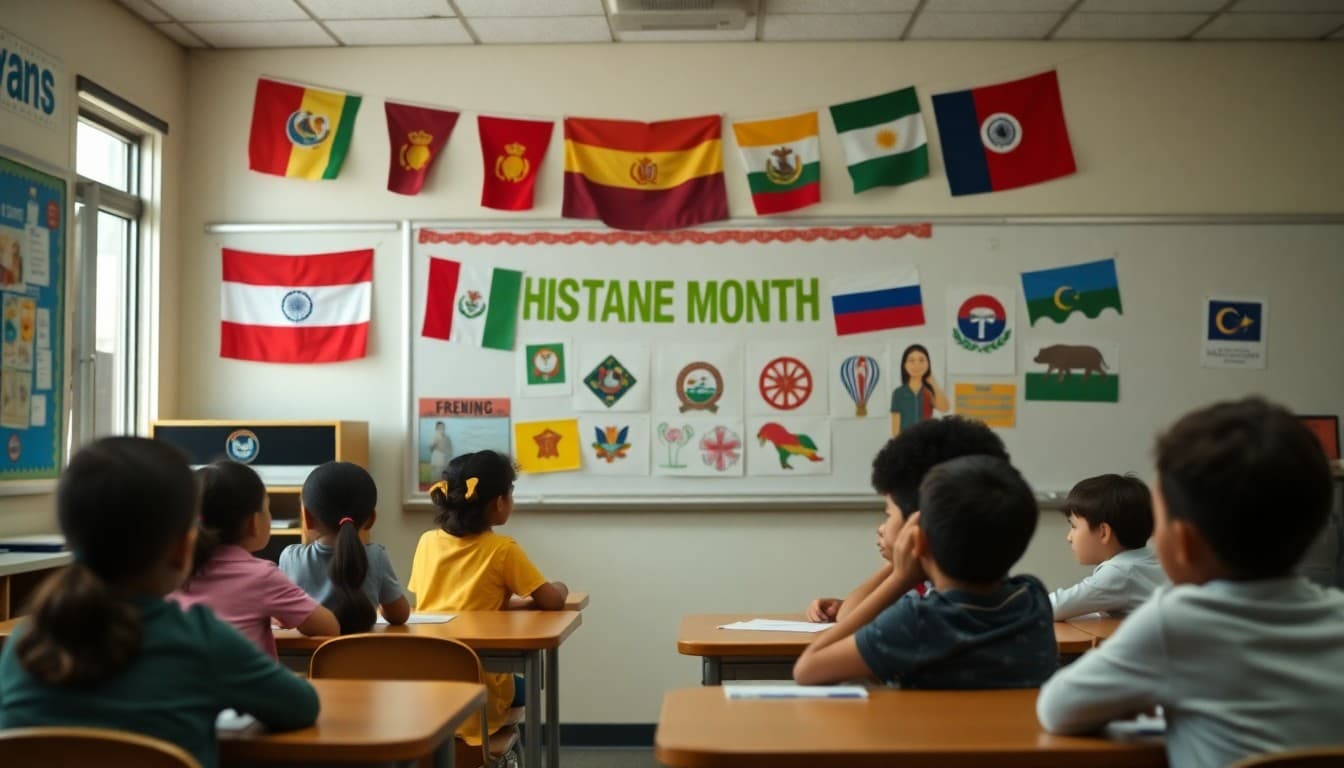
How to Write a Hispanic Heritage Month Classroom Newsletter to Parents

Hispanic Heritage Month runs from September 15 to October 15 and falls in the first weeks of the school year, when families are most tuned in to classroom communication. A newsletter that names specific individuals, cultures, and ideas tells families something real about what their student is learning. A newsletter that says "we are celebrating Hispanic Heritage Month" without detail misses the opportunity entirely.
Be specific about which cultures and individuals you are studying
The term Hispanic covers over twenty countries and enormous cultural diversity. Be specific about who and where. "This month we are studying figures from several Latin American countries and the United States. We are learning about Cesar Chavez, who organized farmworkers in California; Roberto Clemente, who used his baseball career to do humanitarian work; and Sonia Sotomayor, the first Latina Supreme Court Justice." Specific names and stories are more powerful than general heritage language.
Connect the learning to your full curriculum
Heritage month learning is most durable when it connects to what you are doing all year. "The scientists we are studying this month connect to our fall science unit. The writers connect to our study of memoir and personal narrative. The athletes and activists connect to our ongoing discussion of how individuals shape communities." This framing makes the learning feel integrated, not obligatory.
Address the diversity within the designation
One of the most important things you can communicate to families is that Hispanic Heritage Month is about many cultures, not one. "We are making sure students understand that the label Hispanic or Latino covers an enormous range of countries, languages, traditions, and histories. Mexico and Argentina are both included but they have very different cultures. Spain and Puerto Rico are both included but their histories are completely different." This level of honesty builds genuine understanding.
Frame it as belonging to every student
Heritage months should feel relevant to every student, not just students from that background. "The contributions of Hispanic and Latin American people are woven into the science, art, literature, and history of the world every student in our class lives in. This learning belongs to all of us." Families across diverse backgrounds respond well to this framing.
Invite family contributions thoughtfully
If you have Hispanic or Latin American families in your classroom who want to contribute their own cultural knowledge, a warm invitation is appropriate. "If your family has a story, tradition, or piece of history from a Hispanic or Latin American background that you would be comfortable sharing, I would be honored to include it. This is purely optional, and any contribution is welcome." Make the invitation genuine and pressure-free.
Recommend books and media for home
A curated list at grade level gives families concrete tools. One picture book, one chapter book, one family read-aloud option. "For picture books, [title] is a beautiful story about [brief description]. For chapter book readers, [title] is an engaging biography of [person]. These are the kinds of books that start conversations." Annotate your recommendations rather than just listing titles.
Give conversation prompts for dinner
"Ask your student: Who is one person we studied this month and what did they do that you admire? Is there something about Hispanic or Latin American culture that you want to learn more about? What surprised you this month?" These three questions open genuine conversations that extend classroom learning and signal to students that what they learn at school matters at home.
Daystage makes it easy to include portraits, video links, book recommendations, and family conversation prompts in a single well-organized Hispanic Heritage Month newsletter that families will engage with rather than skim.
Get one newsletter idea every week.
Free. For teachers. No spam.
Frequently asked questions
What should I include in a Hispanic Heritage Month classroom newsletter?
Which individuals, cultures, or regions you are studying, what themes or concepts students are exploring, how the learning connects to the rest of your curriculum, conversation starters for families, and book or media recommendations at grade level.
How do I write a Hispanic Heritage Month newsletter that is accurate and not reductive?
Avoid treating Hispanic Heritage Month as a single unified culture. Spain, Mexico, Puerto Rico, Cuba, El Salvador, and dozens of other countries have distinct histories, traditions, and contributions. Being specific about which cultures and which individuals you are studying demonstrates genuine respect for the diversity within the designation.
How do I make Hispanic Heritage Month feel relevant to all students, not just Hispanic students?
Connect the learning to universal themes. Scientists, artists, athletes, activists, and community builders from Hispanic and Latin American backgrounds have shaped the world that every student lives in. The newsletter should frame this as learning that belongs to every student.
How should I handle Hispanic Heritage Month if I have Hispanic families in my class?
If families are comfortable sharing, they are the best source of authentic cultural knowledge. Invite contributions in your newsletter, but make it optional and frame it as an opportunity rather than an expectation. Families should never feel tokenized or required to represent their entire culture.
Can Daystage help me share Hispanic heritage resources and family conversation tools?
Yes. Daystage lets you embed photos, link to read-alouds, video profiles, and book recommendations, and include family discussion prompts all in one structured newsletter.

Adi Ackerman
Author
Adi Ackerman is a former classroom teacher and curriculum writer with 8 years in K-8 schools. She writes about school communication, parent engagement, and what actually works in real classrooms.
More for Classroom Teachers
Ready to send your first newsletter?
3 newsletters free. No credit card. First one ready in under 5 minutes.
Get started free