

Chinese Mandarin Immersion School Newsletter for Families
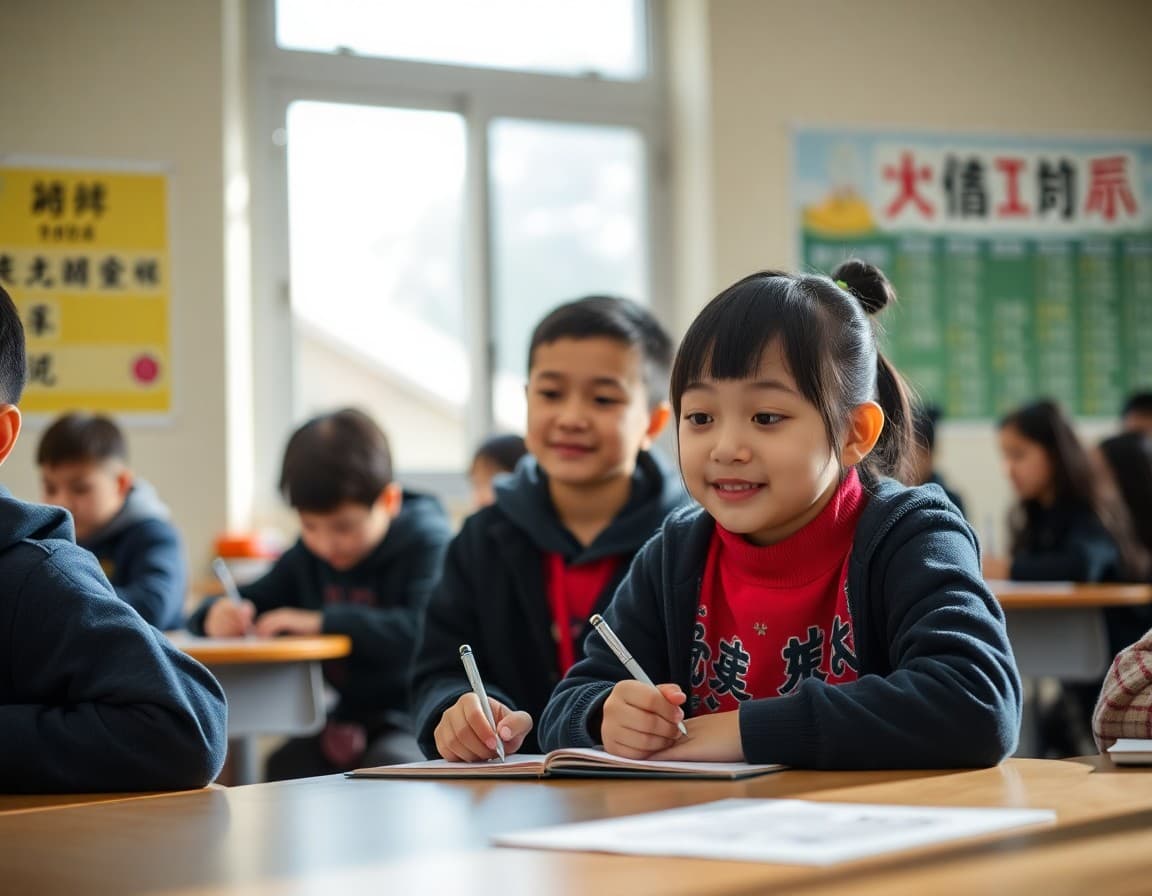
Mandarin immersion programs are among the fastest-growing bilingual programs in North America, and they serve one of the most linguistically and culturally diverse family populations in school programming. The newsletter faces a unique challenge: communicating across a wide range of Chinese language backgrounds (Mandarin-native, Cantonese-speaking, Chinese-heritage but not Chinese-literate, and completely non-Chinese families) while consistently advancing the program's identity as a bilingual academic community.
Use Both Chinese Characters and Pinyin
Your newsletter should include Chinese content in two forms: characters (the written Chinese script your students are learning) and Pinyin (the romanized phonetic system). Characters for families and students who read Chinese; Pinyin for non-Chinese families who want to attempt pronunciation and for students in early stages of character learning.
A Chinese greeting at the top of every newsletter in this dual format: 你好,亲爱的家人们!(Nǐ hǎo, qīn'ài de jiā rén men! / Hello, dear families!) gives non-Chinese families immediate contact with both Chinese scripts in a low-stakes context. The exclamation point conveys warmth that tone information alone cannot.
Explain the Character Learning Process to Non-Chinese Families
Families without Chinese background are often surprised to learn that their kindergartner is not learning an alphabet but a system of thousands of individual characters. A brief explanation in your early-year newsletter prevents confusion: "Mandarin Chinese uses characters rather than an alphabet. There is no direct sound-symbol correspondence in the way English phonics works. Instead, students learn the meaning and pronunciation of characters through repeated exposure, drawing, and reading. By end of kindergarten, students typically recognize 50-100 basic characters."
Showing 5-10 characters the class is currently learning in each newsletter, with their Pinyin pronunciation and English meaning, gives families a concrete measure of progress. Parents who can see their child has learned 60 characters by December understand the depth of the academic accomplishment in a way that a general "making progress" statement cannot convey.
Acknowledge the Diversity Within Chinese Heritage
Chinese-heritage families in Mandarin immersion programs come from many different backgrounds. Mandarin-native families from Mainland China. Cantonese-speaking families from Hong Kong or Guangdong. Taiwanese families who use Traditional characters. Third-generation Chinese-American families who speak no Chinese at home but feel cultural connection to the language. Recent immigrants whose relationship with the language is tied to a specific regional dialect.
A newsletter that treats "Chinese families" as a monolith misses this diversity and may alienate the very families who have the most personal investment in the program's success. Acknowledge the variety of Chinese language backgrounds in your community and explain how the program's Mandarin focus relates to (and differs from) other Chinese language varieties.
Feature Chinese Cultural Traditions Beyond Chinese New Year
Chinese New Year is the most widely known Chinese cultural celebration and it should absolutely appear in your newsletter. But a Mandarin immersion program that only references Chinese New Year reduces a 5,000-year-old civilization to a single holiday. Feature Mid-Autumn Festival (中秋节) with its moon cakes and mythology. Include Dragon Boat Festival (端午节) and its history. Describe Qingming (清明节), the Tomb Sweeping Day, and its significance for Chinese concepts of family continuity.
Include contemporary Chinese culture: a Chinese children's book author, a celebrated Chinese-language film, a piece of modern Chinese art or music that connects to what students are experiencing in class. This contemporary content signals that Chinese is a living, evolving language and culture, not only a historical tradition.
Provide Mandarin Support Resources for Non-Chinese Families
Non-Chinese families are deeply interested in supporting their child's Mandarin development but often feel helpless without fluency. Your newsletter should provide specific, accessible resources that do not require parental Mandarin skill. Chinese children's apps: Duolingo Chinese, Chineasy for Kids, and the Kidsbooks series. Streaming content: CCTV-14 children's programming on YouTube, Sesame Street in Mandarin, Chinese animated series like Xi Yang Yang (喜羊羊). Library resources: many urban library systems have extensive Chinese children's book collections.
Include a "try this at home" suggestion each month that requires no Chinese fluency: "Ask your child to write the character we learned this week on a piece of paper and explain what it means. Then post it somewhere visible. Seeing Chinese characters on your refrigerator next to an English grocery list sends a powerful message about which languages matter in your home."
Connect the Program to the Global Mandarin-Speaking Community
Mandarin is the most widely spoken language in the world by native speakers, and the economic, cultural, and diplomatic significance of Mandarin proficiency is increasing. Your newsletter can occasionally share this context to reinforce for families why the program's academic rigor matters. Not as pressure, but as purpose: "Your child is learning a language that connects them to one billion people. That connection has social, professional, and cultural dimensions we cannot fully anticipate."
This framing helps families maintain motivation during the difficult early months when progress feels invisible. The program is not just an academic choice. It is an orientation toward a broader world.
Get one newsletter idea every week.
Free. For teachers. No spam.
Frequently asked questions
Should a Chinese immersion newsletter use Simplified or Traditional characters?
The choice between Simplified and Traditional Chinese depends on your school's program focus and the primary heritage community you serve. Simplified Chinese is used in Mainland China and Singapore; Traditional Chinese is used in Taiwan, Hong Kong, and many overseas Chinese communities in North America. If your program serves a mixed heritage population, clarify which writing system the program teaches and use that system in newsletters. A brief note in your first newsletter of the year explaining this choice prevents confusion.
How do we communicate Mandarin tone information to non-Chinese families?
Including Pinyin (the romanized phonetic system for Mandarin) alongside Chinese characters gives non-Mandarin-speaking families a pronunciation guide. A brief explanation in your early-year newsletter of what the four tones are, with audio resources linked if digital, helps families engage with the language even without fluency. Tone mispronunciation by well-meaning non-Mandarin parents is fine and children find it funny rather than damaging.
How do we serve Chinese-heritage families who speak Cantonese rather than Mandarin?
Cantonese and Mandarin are related but different languages with partially shared written form (using Chinese characters). Cantonese-speaking heritage families are a distinct linguistic community from Mandarin-speaking families, and conflating them creates the impression that the school sees all Chinese-heritage families as interchangeable. Acknowledge this distinction directly in your newsletter and explain how the program's Mandarin focus relates to Cantonese-speaking families' heritage context.
What Chinese cultural content should be featured in a Mandarin immersion newsletter?
China is geographically and culturally vast, and Mandarin is spoken across many distinct cultural contexts. Feature Chinese New Year traditions but also Mid-Autumn Festival, Dragon Boat Festival, and Lantern Festival. Include stories and cultural practices from different regions of China, as well as from Taiwan, Singapore, and overseas Chinese communities. Include contemporary Chinese culture (literature, film, technology) alongside traditional practices to present a modern, complete picture.
Can Daystage support Chinese Mandarin immersion newsletters with complex script formatting?
Yes. Daystage supports rich text formatting that accommodates Chinese characters, Pinyin annotations, and parallel bilingual layouts. The newsletter template can be designed with dedicated sections for Chinese and English content, and the professional visual formatting gives equal weight to both writing systems. Schools that use Daystage for Mandarin immersion communication find the clean layout particularly important for Chinese character content, which requires more space per character than alphabetic scripts.

Adi Ackerman
Author
Adi Ackerman is a former classroom teacher and curriculum writer with 8 years in K-8 schools. She writes about school communication, parent engagement, and what actually works in real classrooms.
More for Bilingual
Bilingual Back-to-School Newsletter: Welcoming Multilingual Families at the Start of the Year
Bilingual · 6 min read
Dual Language Immersion Newsletter: Two Languages One School
Bilingual · 6 min read
Bilingual Community Outreach Newsletter: Reaching Multilingual Families Beyond the School Building
Bilingual · 6 min read
Ready to send your first newsletter?
3 newsletters free. No credit card. First one ready in under 5 minutes.
Get started free