
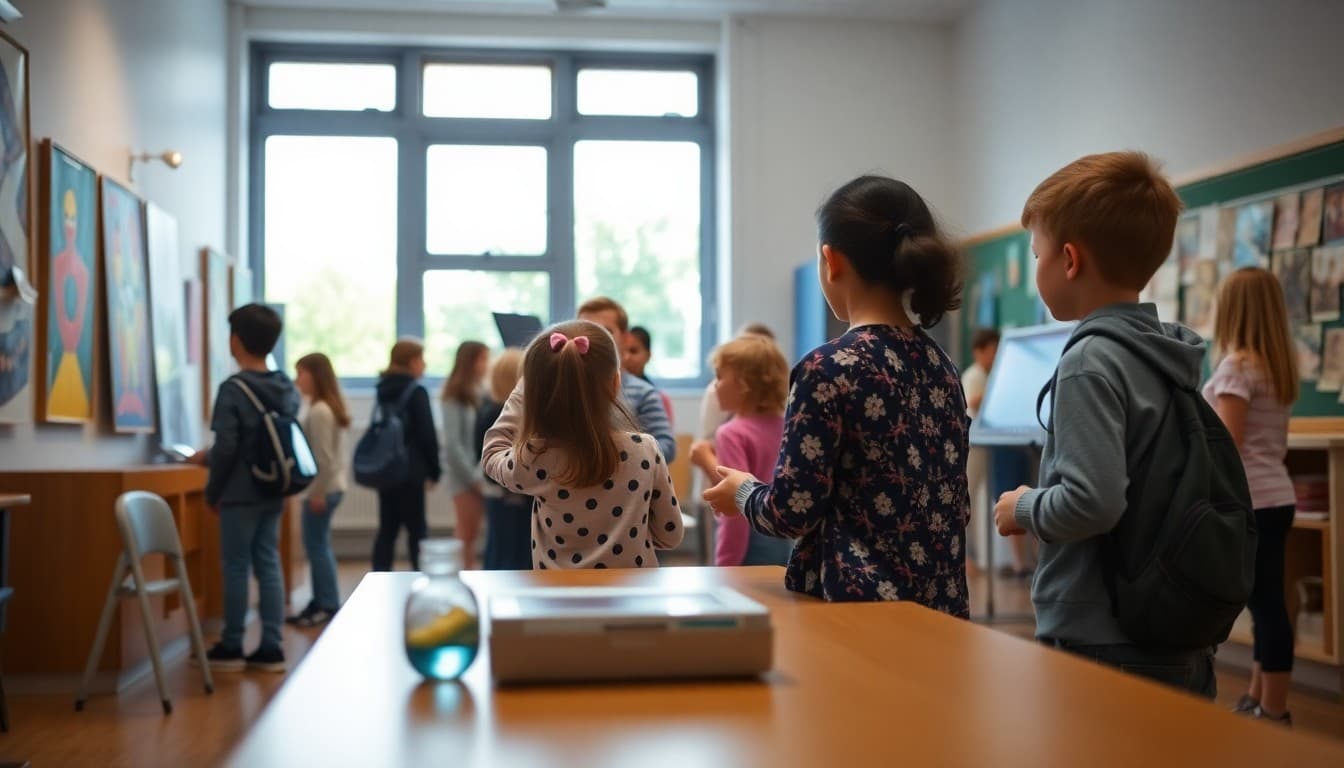
School Arts Showcase Newsletter: Multi-Discipline Celebration

An arts showcase newsletter has to do something unusual: describe multiple disciplines in a single document without making any of them feel like an afterthought. Every art form your school teaches deserves equal presence in the newsletter, and the families of students in each program need to feel that their child's work is being celebrated alongside the others, not in the shadow of them.
Open with the scope and scale of the showcase
Begin by giving families the full picture of how large and how varied the event is. The scope itself is impressive and worth communicating.
"This year's Arts Showcase includes work from 340 students across eight disciplines: visual art, ceramics, photography, film, creative writing, concert band, choir, and drama. The event spans the main auditorium, the gymnasium, three hallways, and the performing arts wing. Every student in every arts elective has work represented. It will take approximately 90 minutes to see and hear everything."
Describe each discipline's contribution specifically
Give every discipline its own paragraph with enough specificity that families of students in that program feel genuinely celebrated. Do not cluster disciplines together in a way that makes one feel less important.
"Visual art: 84 paintings, drawings, and mixed media pieces displayed in the main hallway and gymnasium, organized by theme rather than class. Ceramics: the studio gallery in the ceramics room displays 60 functional ceramic pieces from the year's major projects. Photography: a darkroom exhibition of 40 black-and-white prints alongside a digital slideshow of color work. Film: three student films screened on a loop in the lecture room starting at 6:30 PM."
Create a clear event map and timeline
Families who arrive at a multi-discipline showcase without a map or a schedule often spend 20 minutes wandering and miss performances they would have wanted to see. A newsletter that includes a simple text description of where everything is and when fixed performances begin prevents that problem.
"Event map: Enter through the main building front doors. Visual art and ceramics: main hallway and gymnasium (self-paced all evening). Photography: room 108, open 6 to 8 PM (self-paced). Film: lecture room 204, screenings at 6:30, 7:00, and 7:30 PM. Concert band performance: auditorium, 7:00 PM (40 minutes). Drama workshop preview: black box theater, 7:30 PM (20 minutes). Creative writing readings: library, 6:15 and 7:15 PM (15 minutes each)."
Build in guidance for meaningful engagement
Families who arrive knowing how to engage with what they are about to see have a fundamentally different experience than families who wander politely through rooms. Give families specific things to do and ask at each station.
"In the visual art hallway, look for the artist statement cards beside each piece. Every student wrote one. Read the card before looking at the piece, then look at the piece, then read the card again. Notice if your reading of the piece changed. That is the experience the artist intended."
Sample newsletter template excerpt
The annual Arts Showcase is Friday, May 16th, 6 to 8:30 PM. Here is how to make the most of your visit:
Arrive before 6:30 PM to see the self-paced gallery work before the auditorium performance begins at 7 PM. The concert band performance is 40 minutes. After the concert, visit the film screening room and the creative writing readings in the library. End in the reception space near the gymnasium where student artists will be standing near their work from 7:45 to 8:30 PM.
If you have a student in multiple disciplines, this schedule allows you to see work from every program in one evening.
Invite the full community, not just arts families
An arts showcase is one of the school's best arguments for the value of arts education. Families of students who are not in arts programs should be invited explicitly, because many of them have never seen the scope of what the arts departments produce.
"This event is open to the entire school community. You do not need to have a student in an arts program to attend. The quality and range of work produced by students in this school deserves an audience, and we want you to be part of it."
Follow up with a post-showcase newsletter with photos
The post-showcase newsletter should document the event with photos from across all disciplines, report attendance numbers, and thank the arts faculty and student artists. This newsletter serves as institutional memory and builds anticipation for the following year.
Get one newsletter idea every week.
Free. For teachers. No spam.
Frequently asked questions
What is a school arts showcase and how does it differ from individual department events?
A school arts showcase brings together all of the school's arts disciplines in a single event: visual art exhibitions, musical performances, theater and drama presentations, dance, film screenings, creative writing readings, and digital arts. Unlike individual department concerts or gallery shows, a showcase creates a comprehensive picture of the school's creative culture. It gives students in every arts program visibility alongside each other and gives families who have children in multiple programs a single event to attend rather than separate events across the year.
How do you structure a school arts showcase that runs smoothly for families?
Effective arts showcases give families a map and a schedule before they arrive. A newsletter that describes the physical layout of the event, where each discipline is presenting, the times of any fixed performances or demonstrations, and how long families should expect to spend at each station allows families to plan their visit rather than wander. Showcases that have performances at fixed times alongside self-paced gallery elements allow families to anchor their visit around a performance and explore the gallery work before or after.
How do you ensure all arts disciplines get equal visibility in a showcase newsletter?
A showcase newsletter ensures equal visibility by describing each participating discipline with a separate paragraph of roughly equal length. Photography class, ceramics, orchestra, drama, film, creative writing, and dance all deserve the same newsletter real estate. Programs that are larger or more traditionally supported in a school, like band or visual art, naturally get more general attention. A newsletter that explicitly describes what the less-known programs are presenting communicates that the school values the full range of creative work, not just the traditional disciplines.
How do you communicate about a school arts showcase to families who have no children in arts programs?
Arts showcases benefit from community attendance beyond the families of participating students. A newsletter that frames the showcase as a community cultural event, rather than only as a student performance event, broadens the audience. Describing the quality and range of work on display, noting that professional-caliber work is being produced by student artists at this school, and inviting the full community to experience it positions the showcase as something worth attending for its own sake, not just as family support.
How does Daystage help arts coordinators communicate about school arts showcases?
Daystage lets arts coordinators send a single comprehensive showcase newsletter that covers every participating discipline, includes a map of the event layout, links to any ticket purchasing or RSVP system, and reaches every school family simultaneously. When a family receives a Daystage newsletter showing photos from last year's showcase alongside descriptions of what this year's showcase will include, attendance increases significantly compared to paper flyers distributed through individual departments.

Adi Ackerman
Author
Adi Ackerman is a former classroom teacher and curriculum writer with 8 years in K-8 schools. She writes about school communication, parent engagement, and what actually works in real classrooms.
More for Arts & Music
Ready to send your first newsletter?
3 newsletters free. No credit card. First one ready in under 5 minutes.
Get started free