
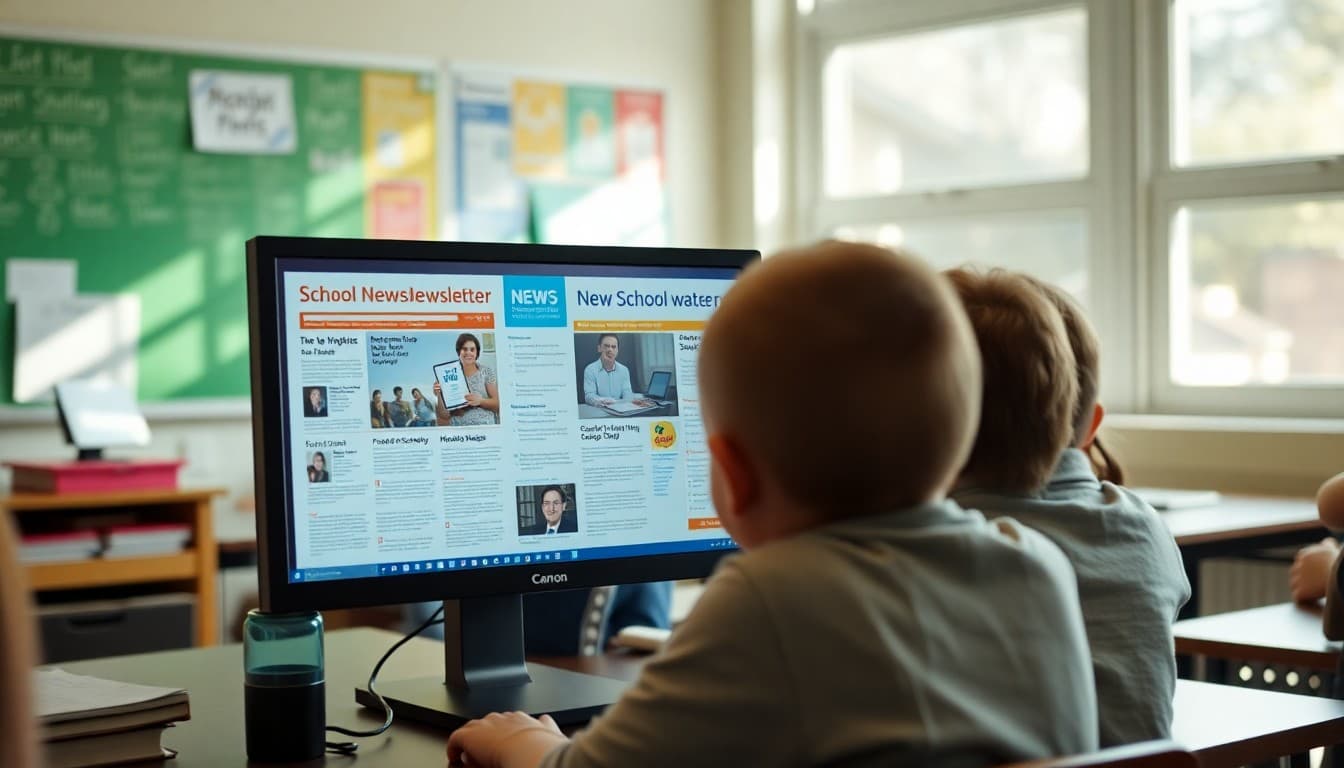
Free School Newsletter Templates: What to Look For and What to Avoid
Free newsletter templates for schools are everywhere, and most of them have significant problems that are not visible until you are in the middle of trying to fill them in. This guide covers what to actually look for in a school newsletter template, what the common failure modes are, and what to consider when choosing between a free template and a purpose-built newsletter platform.
Mobile responsiveness is non-negotiable
The majority of families now read school newsletters on a smartphone. A template that looks clean and professional on a desktop may render as a broken mess on a phone, with text that is too small to read, images that overflow the screen, or multi-column layouts that collapse into unreadable stacks. Before committing to any template, view it on a phone. If it does not look right on a phone, it will not be read.
Edit speed matters more than design quality
A template that produces a beautiful newsletter but takes 45 minutes to fill in each week will not be used consistently. A teacher who can fill in a template in 15 minutes will send newsletters every week. One who needs 45 minutes will send them when they have time to spare, which is inconsistently at best. Evaluate templates by how long they realistically take to complete, not how impressive they look empty.
Section structure should match how you actually write
Many free templates have section structures based on aesthetic design decisions rather than communication logic. A template with six sections labeled with clever names does not help a classroom teacher who has two types of content: what families need to do and what students are learning. Find a template whose section structure matches the categories of content you actually have, rather than trying to force your content into a structure designed for a different purpose.

Print versus digital: know which you need
Many free school newsletter templates are designed for print: they are laid out for 8.5 x 11 paper, use multi-column print layouts, and are exported as PDF. If you distribute newsletters digitally by email or web, a print-designed template will not serve you well. PDF attachments have lower open rates than embedded email newsletters because families have to open a separate file. If digital distribution is your primary channel, find a template designed for email, not for print.
Sustainability: can you maintain it for 36 weeks?
The best test for a newsletter template is not the first newsletter you produce with it. It is the newsletter you produce in week 20 of the school year, on a Thursday evening, after a full week of school. If the template is still manageable then, it is sustainable. If it requires fresh motivation and design energy each time, it will be abandoned long before the end of the year. Sustainability is the most important template quality for school use.
When a template is not enough
Free templates cover format. They do not cover distribution, subscriber management, delivery reliability, or analytics. A teacher emailing a formatted newsletter to 30 families they manage in a personal contact list is using a template in its appropriate context. A school newsletter reaching 800 families needs distribution infrastructure, unsubscribe handling, and delivery reliability that templates do not provide. When the audience size or organizational complexity exceeds what a template can handle, a purpose-built platform becomes the practical choice.
Get one newsletter idea every week.
Free. For teachers. No spam.
Frequently asked questions
What should schools look for in a free newsletter template?
Mobile responsiveness (most families read newsletters on phones), clear visual hierarchy that makes the most important content easy to find, a structure that matches the type of content you produce regularly, ease of editing without design skills, and email delivery capability if the template is designed for web. A template that looks good on a desktop but breaks on mobile is not useful for school communication.
What are the most common problems with free school newsletter templates?
Design that does not translate well from desktop to mobile, static formats that cannot be edited without design software, placeholder content that is hard to replace cleanly, section structures that do not match how school newsletters are actually organized, print-only formats that do not work for email distribution, and templates that look impressive but take an hour to fill in each week.
Should schools use Word or Google Docs templates for newsletters?
For print distribution, yes. For email or digital distribution, these formats create significant problems: Word and Google Docs do not render reliably as email, images may not display, and formatting often breaks when converted to PDF and attached. For digital newsletters, purpose-built newsletter tools are significantly better than repurposed word processor templates.
What is the difference between a newsletter template and a newsletter platform?
A template is a format that you fill in manually each time. A newsletter platform provides templates plus the infrastructure to send, manage subscribers, and track whether recipients are reading. For a classroom teacher sending to 30 families, a simple template may be sufficient. For a school or district newsletter reaching thousands of families, a platform handles distribution and management that templates alone cannot.
How is Daystage different from using a free template?
Daystage provides newsletter templates designed specifically for schools, plus the distribution infrastructure to send them, plus the subscriber management to maintain family lists, plus analytics to track whether communications are being read. A free template gives you a format. Daystage gives you a complete communication system built for the way schools actually operate.

Adi Ackerman
Author
Adi Ackerman is a former classroom teacher and curriculum writer with 8 years in K-8 schools. She writes about school communication, parent engagement, and what actually works in real classrooms.
More for Templates
Ready to send your first newsletter?
3 newsletters free. No credit card. First one ready in under 5 minutes.
Get started free