

What to Include in Your Physics Newsletter to Parents
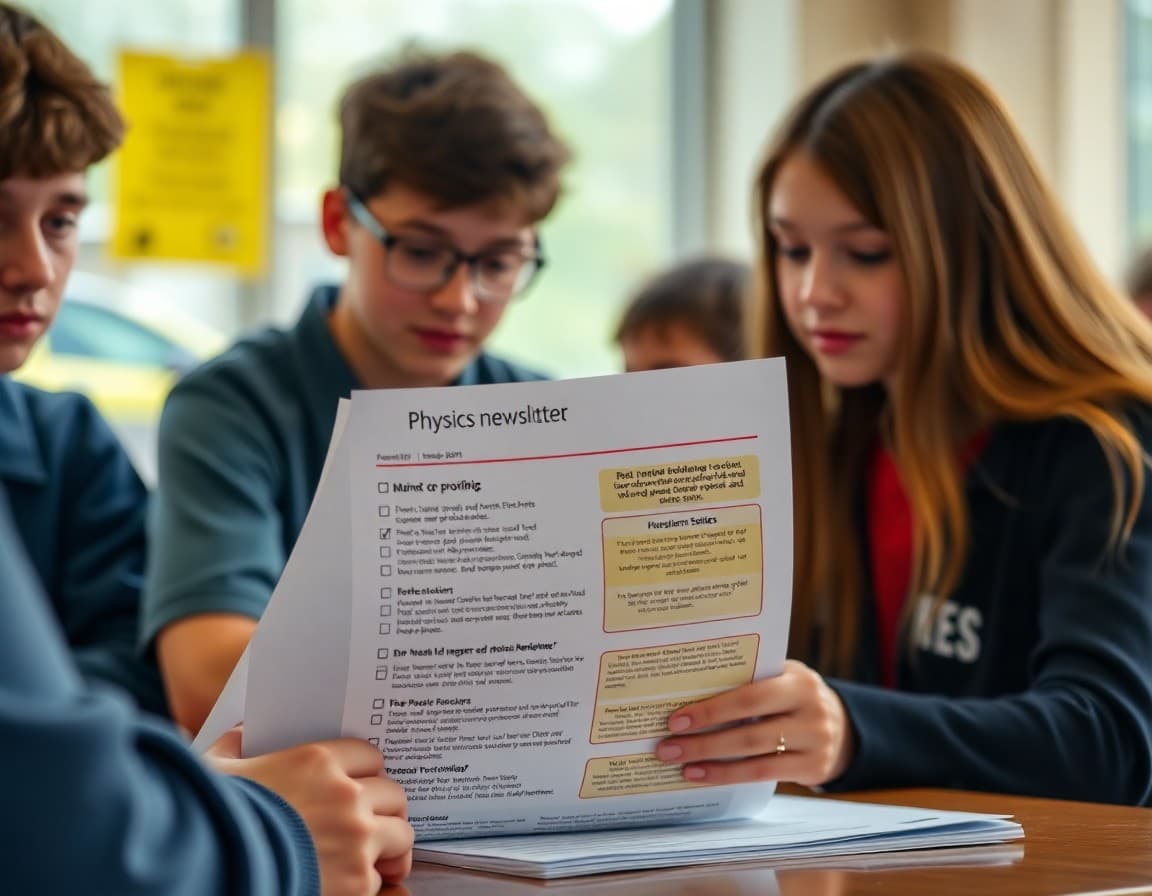
Physics newsletters are easy to overthink. Teachers who want to be thorough sometimes include formulas, detailed topic lists, and lengthy explanations that most parents will not read. The more useful approach is a checklist: five or six specific elements, each serving a clear purpose. Here is what belongs in a physics newsletter and what to leave out.
Element 1: The Current Unit in Plain Language
Start with the unit name and a one-sentence plain-language explanation. Every physics unit can be translated into everyday terms. Kinematics: we are studying how objects move and how to predict where they will be. Electromagnetism: we are learning how electricity and magnetism are actually two aspects of the same force. Write the unit name, then immediately follow it with the accessible version.
Element 2: The Central Question
Give families the question driving the unit. Not a textbook learning objective, but the real question that makes the unit interesting. "Why do satellites stay in orbit instead of falling?" "What makes some materials conduct electricity and others block it?" "Why does a rainbow always appear in the same order of colors?" A good question gives parents something to discuss with their student at home.
Element 3: A Lab or Demonstration Description
Tell parents about one investigation students are running or have recently completed. Describe the question, what students measured, and what happened. Here is an example for an optics unit:
"This week we ran a refraction lab where students measured how light bends as it passes from air into water. They predicted the angle using Snell's law, then measured the actual angle, and the match between prediction and measurement was within 2 degrees. That kind of verification is one of the most satisfying moments in experimental physics."
Element 4: The Next Assessment Date and Format
Tell families when the next test or lab practical is scheduled, what it covers, and how students should prepare. For physics, practicing applying concepts to problems they have not seen before is more useful than reviewing notes. Encourage students to try working through practice problems without looking at the solution until they get stuck.
Element 5: A Real-World Physics Connection
Give families one specific way to see the current unit in the world around them. For waves: ask your student why your voice sounds different on a recording than it does to you when you speak. For thermodynamics: ask why a metal chair feels colder than a wooden chair at the same temperature. For mechanics: ask what would happen if a car's brakes applied force to only one wheel.
Element 6: Homework and Study Expectations
Tell parents what type of homework their student should expect this month and how long it should take. If there are problem sets, lab reports, or study guides, name them. If your class uses a specific textbook or online resource for practice, mention it by name so parents can check whether homework is happening.
Optional: AP Exam Timeline or Testing Notes
If you teach AP Physics, include a brief update on the AP exam timeline once per semester. Parents who know the exam is in May and that preparation should begin in January can support consistent study habits rather than relying on the last few weeks.
What to Leave Out
Leave out formula sheets, full topic lists, lengthy procedural lab descriptions, and any content that requires a physics background to understand. If you are unsure whether something is too technical, imagine explaining it to a neighbor at a school event. If it would require significant background explanation, leave it out of the newsletter and save it for a direct conversation.
Close with your contact information and a warm invitation to reach out. Daystage makes it straightforward to build a checklist-based template and send it consistently to your class list each month.
Get one newsletter idea every week.
Free. For teachers. No spam.
Frequently asked questions
What are the five essential sections of a physics newsletter?
Every physics newsletter should include: the current unit in plain language, a brief lab or demonstration description, the next assessment date and format, one real-world physics connection, and your contact information. Those five elements create a complete newsletter in about 350 words.
What should I not include in a physics newsletter?
Do not include formula sheets, long lists of topics covered, technical explanations that require a physics background to understand, or anything that reads like a course outline. Your newsletter is for parents, not for students. Write it at the level of a curious adult who has not studied physics since high school.
How do I include lab safety information in a physics newsletter?
For most physics labs, safety notes are brief. Mention that students wear appropriate protective equipment when using lab equipment, that teacher supervision is constant, and that lab safety procedures are reviewed before every investigation. Three sentences is enough unless a specific lab has unusual considerations.
Should I mention the AP Physics exam in my newsletter?
Yes, if you teach AP Physics. Mention the exam date in your fall newsletter, then remind families of the timeline every few months as it approaches. Parents who know the exam schedule can plan around it and support consistent study habits rather than last-minute cramming.
What makes Daystage useful for physics newsletters?
Daystage is a clean, easy-to-use platform that handles the formatting and delivery of your newsletter to your class parent list. Physics teachers who use it build a template with the five essential sections and update it monthly. The process takes about 15 minutes per newsletter once the template is in place.

Adi Ackerman
Author
Adi Ackerman is a former classroom teacher and curriculum writer with 8 years in K-8 schools. She writes about school communication, parent engagement, and what actually works in real classrooms.
More for Subject Teachers
Ready to send your first newsletter?
3 newsletters free. No credit card. First one ready in under 5 minutes.
Get started free