
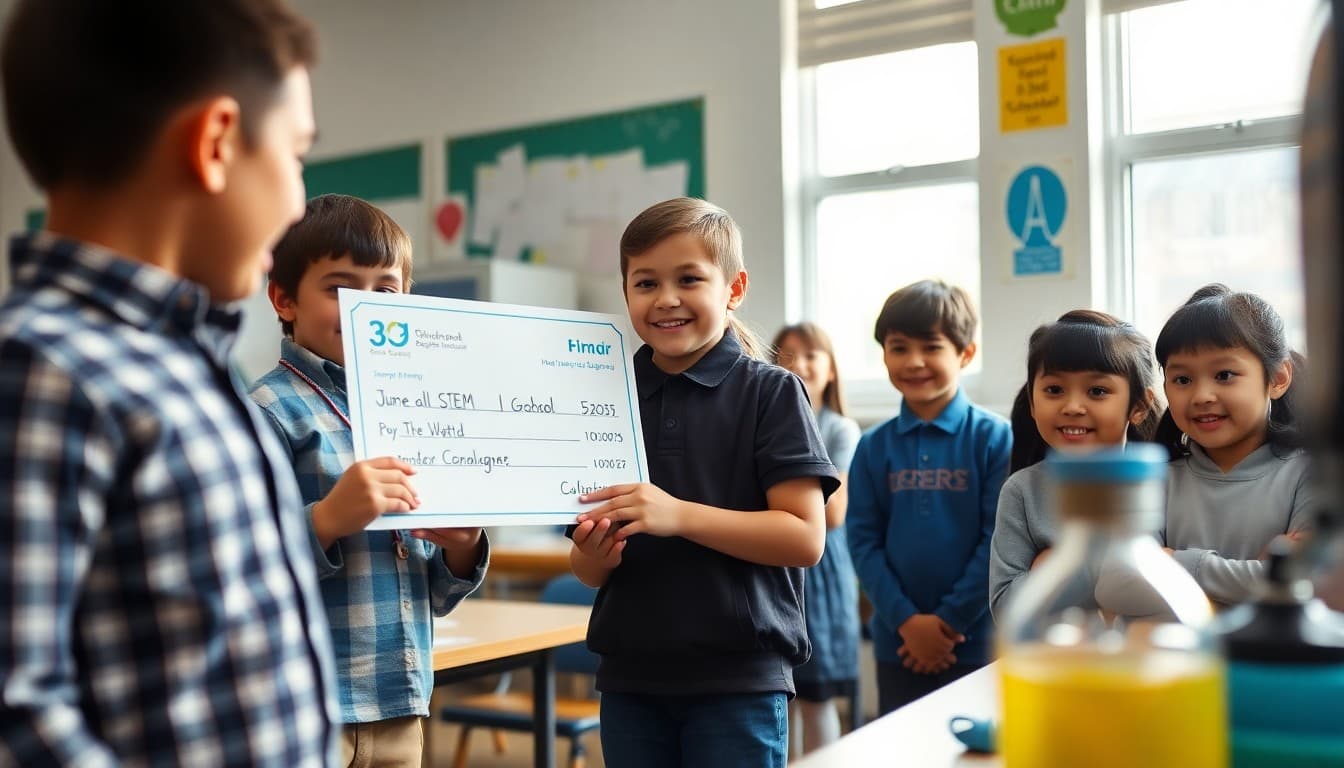
School STEM Grant Newsletter: Announcing New Funding
A STEM grant announcement newsletter does more than share good news. It builds community trust, acknowledges contributors, and sets expectations for how and when families will see the investment show up in their child's education. Do all three and the announcement becomes an asset that pays forward into future support for the program.
Lead with the student impact, not the dollar amount
Grant amounts are meaningful to administrators and grant writers. Families care about what the grant means for their child's school day. Open with the student experience, then use the dollar figure as context for scale.
"Starting in January, every student at Lincoln Middle School will have access to a fully equipped fabrication lab where they can design and build physical objects using 3D printers, a laser engraver, and professional-grade hand tools. This is possible because our STEM department was awarded a $32,000 grant from the state Department of Education's Innovation Learning Initiative."
Explain specifically what will be purchased or built
Families respond better to a specific equipment list than to a general description of what the grant funds. Be precise about what is being purchased, what it does, and why each piece was chosen.
"The grant funds: six Bambu Lab X1 3D printers ($4,200), one xTool M1 laser engraver ($1,400), full electronics workbench with components ($1,800), hand tool and safety equipment ($2,600), consumable materials for the full school year ($3,200), and teacher professional development for three STEM staff members ($2,800). Remaining funds will cover curriculum development and program administration for the first year."
Acknowledge the funder with specificity and gratitude
A grant acknowledgment should name the funder and say something specific about why their support matters, not just offer generic thanks.
"The Innovation Learning Initiative is funded by the state education department to specifically support schools in communities where students have historically had less access to advanced STEM resources. Our school was one of 14 selected from 87 applicants statewide. We are grateful to the program and to the educators who wrote a compelling application on behalf of our students."
Describe the rollout timeline clearly
Families who hear about a grant often expect immediate changes. A newsletter that explains the realistic timeline from funding to student access prevents disappointment and shows that the school is managing the investment carefully.
"Here is the timeline for this grant: October through November, equipment orders placed and received. December, teacher professional development and lab setup. January, pilot program begins with 7th grade science classes. February through May, pilot evaluation and full curriculum development. September of next year, full school access for all eligible students."
Sample newsletter template excerpt
We have exciting news to share: Roosevelt Elementary School received a $15,000 STEM innovation grant from the Greenfield Community Foundation.
Here is what this means for your student: starting in the spring semester, every grade 4 and grade 5 class will complete a six-week maker unit using equipment purchased with this grant. Students will design and build physical projects using 3D printers, circuitry kits, and woodworking tools appropriate for their grade level.
Thank you to the Greenfield Community Foundation for their investment in our students. If you see a Foundation representative in the community, please tell them how much this means to our school.
Invite community and family involvement in the new program
Grant-funded programs grow stronger when the community feels ownership over them. Invite families to contribute to the program's success: volunteering as mentors, donating materials, attending the launch event, or joining a program advisory committee.
"We are forming a community advisory group to provide feedback during the program's first year. If you work in a STEM field and would like to be involved, or if you have materials to donate, please reach out. We especially want student-facing volunteers who can share how they use STEM skills in their actual work."
Connect the grant to the school's broader STEM vision
Individual grants land better with families when they connect to a broader vision the school is working toward. If this grant is part of a multi-year plan to build STEM capacity, describe where it fits. Families who see a coherent plan are more trusting of the investment than families who see a random new program appearing without context.
Get one newsletter idea every week.
Free. For teachers. No spam.
Frequently asked questions
What information should a STEM grant announcement newsletter include?
A STEM grant announcement should cover the grant amount, the funding organization, what specifically will be purchased or built with the funds, which students will benefit and when, and how families can be involved as the programs launch. If the grant involved a competitive application process, briefly describing that process helps families understand the significance of the award. Transparency about how public or donor funds are being used builds community trust and increases the likelihood of future donations and grants.
How do you explain a STEM grant in terms families will care about?
Translate every dollar amount into what it means for students specifically. 'A $25,000 grant' is abstract. 'A $25,000 grant that will purchase six 3D printers, two laser engravers, and a full year of consumable materials, giving every 7th and 8th grade student access to professional fabrication tools for the first time' is concrete. Families respond to what their child will actually experience, not to dollar figures or program names. Lead with the student experience and use the numbers to give it scale.
Should a school thank the grant funder in the newsletter?
Yes, always. Acknowledging the funder by name in the newsletter is both appropriate and strategically important. Funders who see their contributions publicly acknowledged are more likely to fund again in the future. If the funder is a local business or community organization, naming them also creates a positive community relationship. If the funder has specific acknowledgment requirements as part of the grant agreement, meeting those requirements in your newsletter fulfills your obligation while also giving families important context.
How do grant-funded STEM programs typically roll out in schools?
Most grant-funded STEM programs follow a phased rollout: equipment purchase and installation in the first one to three months, teacher professional development and curriculum design in months two through four, pilot program with one class or grade level in months three through six, and full school rollout in year two if the pilot goes well. Families benefit from knowing this timeline so their expectations match reality. A newsletter that explains the rollout schedule prevents the common frustration of parents asking why their child is not yet using the new equipment.
How does Daystage help schools communicate about STEM grant programs?
Daystage lets school administrators send grant announcement newsletters that reach every family simultaneously, include photos of the new equipment or space, and provide clear timelines for when students will have access. When families receive a Daystage newsletter celebrating a major STEM investment on the same day the school receives the news, the announcement feels like a community achievement rather than a bureaucratic update.

Adi Ackerman
Author
Adi Ackerman is a former classroom teacher and curriculum writer with 8 years in K-8 schools. She writes about school communication, parent engagement, and what actually works in real classrooms.
More for STEM
Ready to send your first newsletter?
3 newsletters free. No credit card. First one ready in under 5 minutes.
Get started free