
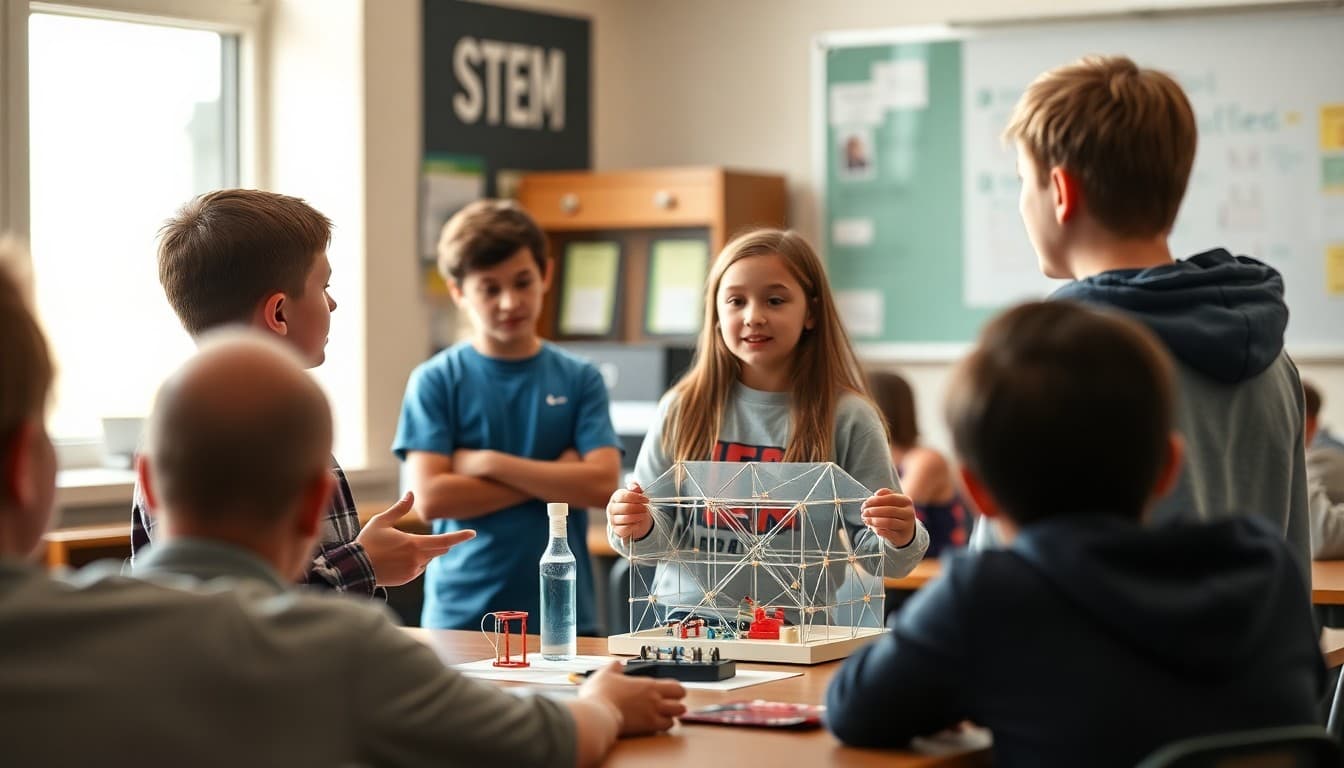
STEM Challenge Newsletter: Monthly Design Projects

A monthly STEM challenge newsletter is one of the most satisfying communications a teacher can send, because the results are concrete, the learning is visible, and families have something specific to ask their child about. The trick is describing the challenge and the results in a way that shows the engineering thinking, not just who won.
State the challenge clearly with all constraints
The best challenge descriptions are precise enough that a family could attempt the same challenge at home. Name the problem, the materials allowed, the constraints, and the performance metric.
"October challenge: build a structure using only 25 index cards and 50 centimeters of tape that supports the weight of a full water bottle (approximately 500 grams) at a height of at least 15 centimeters. The structure cannot touch any wall and must hold the load for 10 seconds without collapsing. Teams have 30 minutes to design and build."
Report results with actual performance numbers
The newsletter should read like a competition recap: who built what, how each design performed against the metric, and which approaches were most successful. Families who see specific numbers understand the challenge better than families who read a general summary.
"Results: 14 of 18 teams met the base challenge. The top structure held 1,400 grams, nearly three times the target. Four teams failed to hold the target weight. The two most common failure modes were tower buckling at the midpoint and base spread when weight was applied. Both failure modes were predictable from the designs, and students who documented their designs before building could identify which was more likely in their own structure."
Explain what the winning design did differently
After reporting results, describe the design principles behind the top performers. What structural feature allowed Team A to hold three times the target weight? Was it triangulation, material distribution, base width, or something else? That explanation teaches engineering principles in a memorable context.
"The top-performing structure used a triangulated tower design with a wide base and a tapered top. The triangles at the joints prevented lateral movement. The wide base distributed the load over more contact area, preventing the base spread that caused four teams to fail. The taper reduced top weight, lowering the center of gravity. The team explained all three design decisions before building. Their structure performed exactly as they predicted."
Highlight a specific revision story
One of the most valuable stories a challenge newsletter can tell is the revision story: a team whose first design failed, identified why, changed one thing, and tested again. That narrative is the engineering design process in action and worth more space than the leaderboard.
"Team Torres's first structure collapsed at 200 grams because the base was too narrow. Rather than rebuilding, they added two additional cards as base stabilizers and retested. Their second attempt held 650 grams. The change took four minutes and required only two additional pieces of material. That is exactly what good engineering decision-making looks like."
Sample newsletter template excerpt
November STEM Challenge results are in:
Challenge: design and build a paper bridge that spans a 20 cm gap and holds the maximum possible weight. Materials: 15 sheets of paper, 30 cm of tape, scissors. Time limit: 25 minutes.
Strongest bridge: Team Ibrahim, 1,720 grams. They corrugated their paper into ridges for stiffness before building, a technique from cardboard engineering that no other team tried. Average bridge strength across all 16 teams: 540 grams. All 16 teams held at least 100 grams. Three teams held over 1,000 grams.
Next month's challenge will be announced December 1st. Ask your student to start thinking about bridge designs before then.
Connect the challenge to the science or math curriculum
A STEM challenge newsletter is most powerful when it explicitly connects the challenge to what students are studying in class. That connection shows families that the challenge is not a break from the curriculum but an application of it.
"This month's challenge was specifically designed to connect to the force and motion unit we completed last week. Students who understood how compression and tension forces work in a structure had a significant design advantage. Several students referenced the unit vocabulary in their design documentation."
Preview next month's challenge to build anticipation
Ending each newsletter with a teaser for the next challenge builds anticipation and gives students a reason to keep thinking about engineering problems between sessions. Keep the teaser vague enough to be intriguing without giving away the constraints.
Get one newsletter idea every week.
Free. For teachers. No spam.
Frequently asked questions
What makes a good monthly STEM challenge for a school program?
A good monthly STEM challenge has a clear testable outcome, real material constraints that force design decisions, multiple viable approaches so no single solution dominates, a connection to a science or engineering concept the class is studying, and enough complexity that students cannot succeed without iterating at least once. Challenges with only one correct solution or no constraint on materials produce less learning than challenges where the constraint is the point.
How do you assess STEM challenges fairly when outcomes vary so much?
Most effective STEM challenge assessments evaluate process as much as performance. Criteria typically include quality of the design documentation, evidence of at least one revision cycle, ability to explain the reasoning behind key design decisions, and meeting the defined constraints. Performance metrics like load held or distance traveled are part of the assessment but rarely the majority. A student whose bridge failed but who documented three iterations and identified the failure mode clearly learns more than a student whose first design succeeded without reflection.
How often should a teacher run STEM challenges throughout the year?
Monthly challenges work well for most programs because they give enough time for a full design-build-test-revise cycle without creating scheduling conflicts with the broader curriculum. Some teachers run shorter weekly mini-challenges alongside a deeper monthly project. The key is consistency: students who know a challenge is coming each month develop habits of noticing design problems in their environment and thinking ahead about solutions, which is exactly the disposition that STEM education aims to build.
How do you keep advanced students challenged in a mixed-ability STEM challenge?
The most effective strategy is to layer the challenge criteria. All students meet the base challenge. Students who meet the base goal quickly are given an extension constraint or an optimization target. 'Your bridge holds 500 grams? Now redesign it to hold 500 grams while using 25% less material.' The extension becomes its own competition. Advanced students can also be assigned the role of engineering consultant to teams that are struggling, which deepens their understanding through peer teaching.
How does Daystage help teachers share STEM challenge results with families?
Daystage lets teachers publish STEM challenge newsletters with photos of student designs, performance data from the testing phase, and descriptions of the engineering reasoning behind each approach. When families receive a newsletter showing a ranked leaderboard from the month's challenge alongside explanations of why certain designs outperformed others, the learning inside those results becomes visible and worth talking about at home.

Adi Ackerman
Author
Adi Ackerman is a former classroom teacher and curriculum writer with 8 years in K-8 schools. She writes about school communication, parent engagement, and what actually works in real classrooms.
More for STEM
Ready to send your first newsletter?
3 newsletters free. No credit card. First one ready in under 5 minutes.
Get started free