
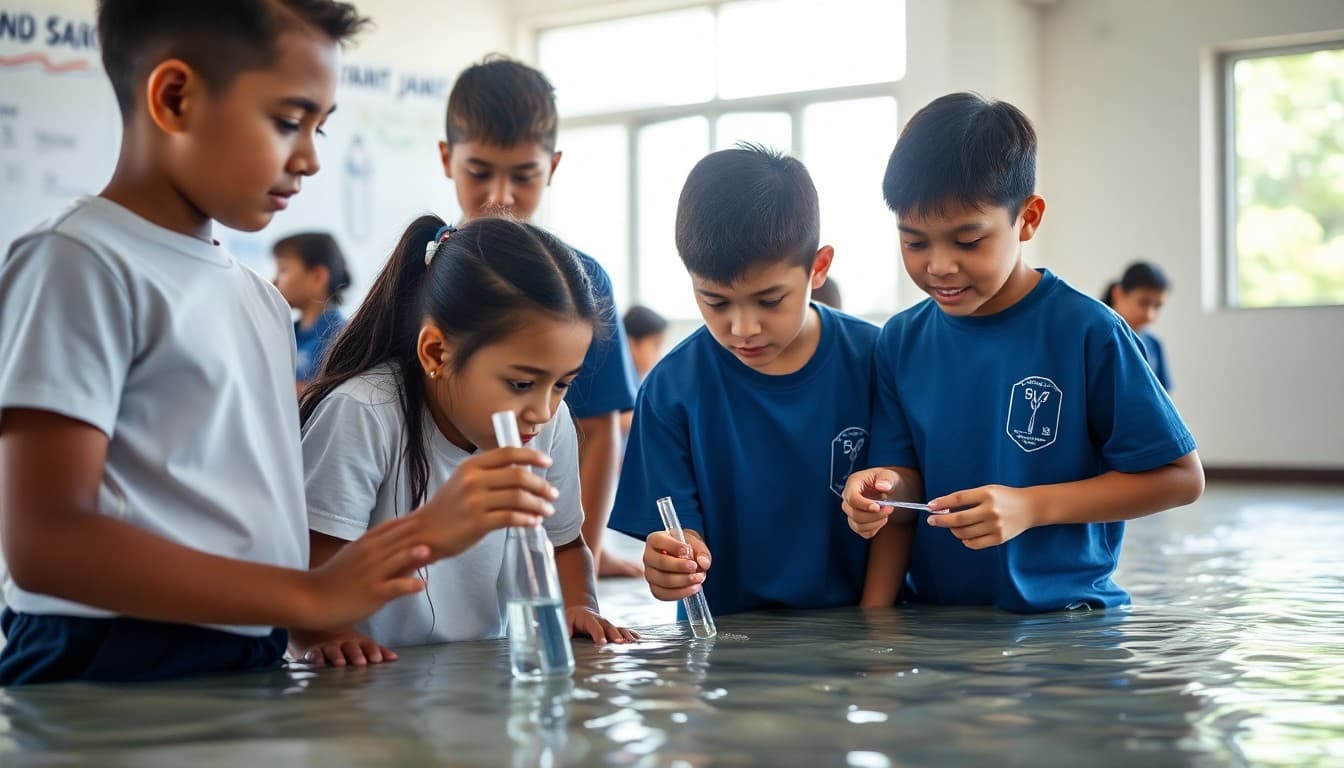
Hawaii STEM Program Newsletter: Local Resources and Guide

Hawaii offers a STEM education context unlike anywhere else. Some of the world's most powerful telescopes sit on a mountain in this state. The surrounding ocean is one of the most intensively studied bodies of water on earth. Volcanic geology is visible and active. Traditional Hawaiian wayfinding navigation represents one of the most sophisticated applications of applied mathematics and astronomy in human history. A STEM newsletter that brings any of these contexts to life gives Hawaii families something real to connect to.
Astronomy on Mauna Kea
The summit of Mauna Kea is one of the best astronomical observing sites on earth. The W. M. Keck Observatory, the Subaru Telescope, the Canada-France-Hawaii Telescope, and others conduct research that makes global scientific news regularly. For Hawaii students, this is not a distant scientific institution. It is on their island. The UH Institute for Astronomy runs programs connecting students and teachers to the research happening there.
When a science unit on stars, galaxies, or planetary science comes up in class, the connection to Mauna Kea makes it immediate and local.
Ocean science: Hawaii's living laboratory
Hawaii's location in the middle of the Pacific makes it a critical monitoring station for ocean temperature, chemistry, and circulation patterns. The Hawaii Ocean Time-series has been collecting continuous ocean data from a station north of Oahu for decades, providing one of the longest oceanic records in the world. Students can access this real data for science projects. Marine biology, fisheries science, coral reef ecology, and ocean acidification research are all active fields in Hawaii.
Hawaiian wayfinding as indigenous STEM
Traditional Hawaiian navigation used star positions, ocean swells, wind patterns, cloud formations, and bird behavior to navigate thousands of miles of open ocean without instruments. This is applied astronomy, meteorology, and ecology at the highest level. The Polynesian Voyaging Society and the voyaging canoe Hokule'a have revived these navigation traditions and documented them scientifically. Connecting STEM instruction to this tradition honors Hawaiian culture while making mathematics and science culturally relevant.
Volcanology and earth science
Hawaii is the only state where active volcanic processes are visible. The Hawaii Volcanoes National Park and the USGS Hawaiian Volcano Observatory study ongoing volcanic activity. Kilauea is one of the most studied volcanoes in the world. For earth science instruction, Hawaii offers a real-time connection to geological processes that students elsewhere only see in textbooks.
Template: Hawaii STEM newsletter excerpt
"This semester our science class is studying ocean ecosystems with data from the Hawaii Ocean Time-series, a long-term monitoring project that has been running for over 30 years in the Pacific Ocean north of Oahu. Students are analyzing real temperature and pH data to understand how ocean chemistry has changed over time. We are also connecting our astronomy unit to traditional Hawaiian wayfinding: we will be learning how Hawaiian navigators used star positions to travel between islands and comparing those methods to modern GPS navigation."
University of Hawaii STEM pathways
UH Manoa has strong programs in oceanography, astronomy, and engineering. UH Hilo has a natural sciences program connected to Mauna Kea research. Hawaii Pacific University offers technology and science programs. These institutions run outreach programs and dual enrollment opportunities for high school students. Mentioning these pathways in your newsletter helps families see the connection between current coursework and college STEM options.
Daystage makes it easy to build a year-round newsletter series that keeps Hawaii families connected to the distinctive STEM opportunities available in their state.
Get one newsletter idea every week.
Free. For teachers. No spam.
Frequently asked questions
What STEM programs are available to Hawaii students?
Hawaii has the Hawaii STEM Partnership Network and support from the Hawaii Department of Education. The Mauna Kea observatories and the Institute for Astronomy at UH run education programs. The Hawaii Ocean Time-series (HOT) and the Pacific Islands Ocean Observing System (PacIOOS) provide ocean science resources. The Pacific Missile Range Facility and Pearl Harbor Naval Shipyard create defense technology career pathways. The Bishop Museum offers science education programs.
How does astronomy connect to STEM education in Hawaii?
Mauna Kea on the Big Island hosts some of the world's most powerful telescopes because of its exceptional atmospheric conditions. The W. M. Keck Observatory, Subaru Telescope, and others conduct world-class astronomical research there. UH Institute for Astronomy runs educational outreach. For Hawaii students, world-class astronomical research is happening in their own state, making astronomy a highly relevant STEM context.
How does Hawaii's ocean environment shape STEM education opportunities?
Hawaii is entirely ocean-surrounded with some of the most biodiverse marine environments on earth. Ocean science, marine biology, oceanography, and climate research are all active scientific fields in Hawaii. The Pacific Ocean provides a real-time classroom for understanding climate systems, coral reef ecology, and fisheries management. Programs through UH Sea Grant and the Hawaii Division of Aquatic Resources connect schools to active ocean science.
What military and defense STEM careers exist in Hawaii?
Hawaii has major US military installations including Pearl Harbor, Hickam Air Force Base, and Schofield Barracks. These installations and their contractors employ electrical engineers, computer scientists, communications technology specialists, and systems engineers. The military sector is a significant STEM employer in Hawaii that is often overlooked in career conversations, particularly for students on Oahu.
How can Daystage support Hawaii STEM program communication?
Daystage helps Hawaii STEM teachers send professional newsletters to families across all islands. For schools serving native Hawaiian communities, newsletters that connect STEM to traditional wayfinding navigation, ecological knowledge, and ocean science help build cultural resonance. Consistent communication through Daystage keeps families engaged with the unique STEM opportunities that Hawaii's environment and industries provide.

Adi Ackerman
Author
Adi Ackerman is a former classroom teacher and curriculum writer with 8 years in K-8 schools. She writes about school communication, parent engagement, and what actually works in real classrooms.
More for STEM
Ready to send your first newsletter?
3 newsletters free. No credit card. First one ready in under 5 minutes.
Get started free