

Engineering Club Newsletter: Building and Design Updates
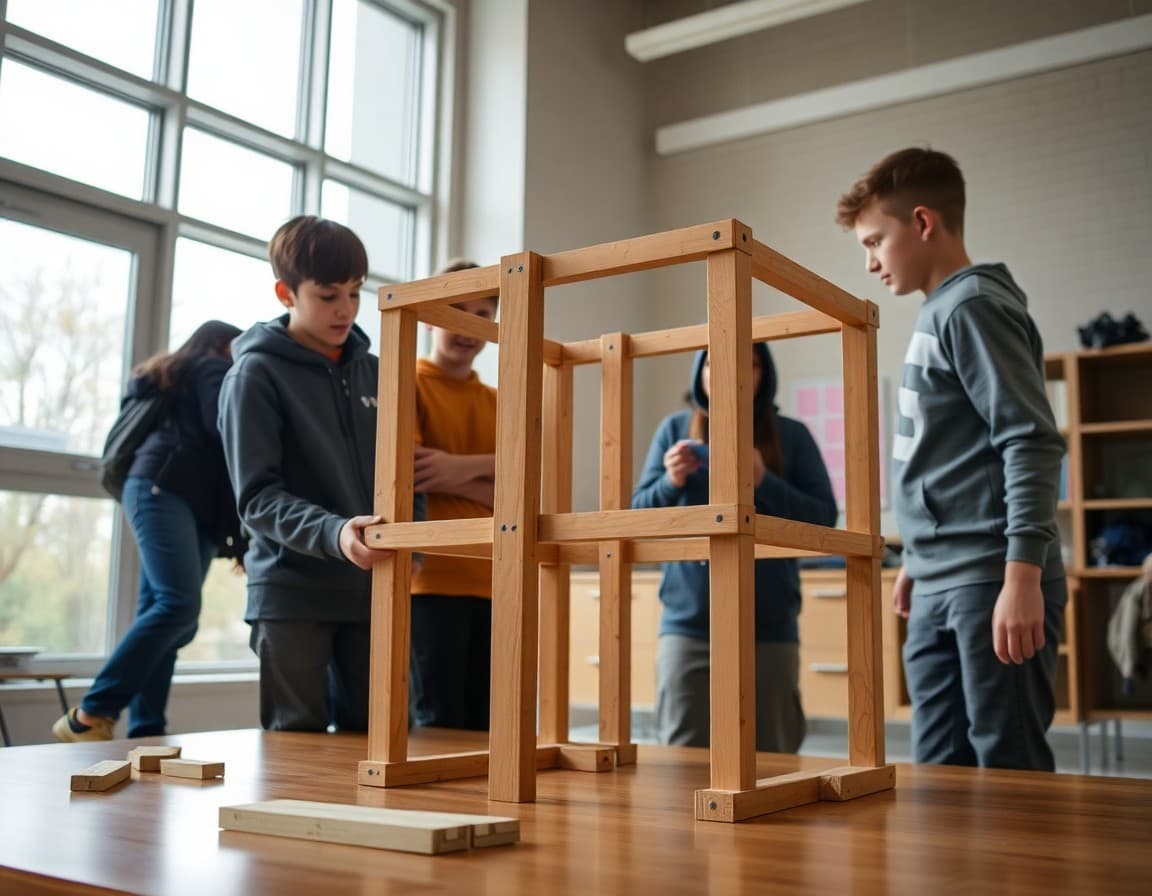
Engineering club newsletters need to show families that students are solving real problems, not just doing crafts. The distinction is in how you describe the work: constraints, performance metrics, and iterations tell a different story than "students built a bridge today."
Frame every project around a specific challenge and constraint
Real engineering never starts with "build something." It starts with a problem to solve, materials to work with, and constraints to respect. Your newsletter should describe all three for every project students tackle.
"This month's challenge: design and build a structure that can hold the maximum weight possible using only 50 popsicle sticks, 1 meter of tape, and 10 minutes of build time. The structure must span a 30-centimeter gap and the load is applied at the center. Teams had to choose between a truss design, an arch design, or a hybrid, with no outside guidance. They had to figure out which approach made structural sense and why."
Report test results with actual numbers
Numbers make engineering results real. When you report that a structure held 4.2 kilograms while weighing only 43 grams, families understand something specific. When you report that a team's best design was twice as strong as their first prototype, families can see progress. Replace "students did well" with the actual measurements.
"Results from last week's bridge challenge: Team A held 3,400 grams before failure. Team B held 2,800 grams. Team C held 4,100 grams and won the challenge. Team C's design used a triangular truss pattern that concentrated load at the supports rather than the midpoint. Every team built three test versions before their final submission."
Describe what failed and what students changed
The most educational part of engineering club is often the failure analysis. When a design fails, students must diagnose why, decide what to change, and test the revised design. That process is the core of engineering thinking, and families who hear about it understand why failing quickly is actually a sign of good engineering practice.
"Team B's first bridge failed at 600 grams because the joints were glued with too thin a bead. Their second bridge failed at 1,800 grams because the central beam buckled. Their third bridge held 2,800 grams after they added a lateral brace. Three failures in one session. That is a productive day."
Connect the engineering design process to professional practice
The define-design-build-test-iterate cycle students follow in engineering club is the same process civil engineers use to design bridges, product designers use to develop consumer goods, and aerospace engineers use to build aircraft. Naming that connection gives families context for why these after-school sessions matter.
"The iterative design work students are doing this year mirrors how professional engineers at firms like AECOM, Tesla, and Lockheed Martin develop physical systems. The timeline is compressed and the materials are simpler, but the thinking process is identical."
Sample newsletter template excerpt
Engineering Club update for October:
We completed the wind turbine design challenge this month. The task was to design a turbine blade that generates the maximum voltage when placed in front of a box fan at 50% speed. Each team got 20 craft sticks, cardboard, aluminum foil, and one small motor with a voltage meter.
Best result: Team Mendez, 0.38 volts. Average across all six teams: 0.21 volts. The Mendez team used a three-blade design with a 15-degree pitch angle. They calculated the angle using math from their 8th grade science class before cutting a single piece of cardboard. That kind of pre-calculation is what separates engineering from guessing.
Preview competition season logistics
If your engineering club participates in any competitions, families need the details early enough to plan. Cover registration deadlines, travel logistics, costs, and what materials the team is responsible for bringing. A well-organized competition information section in your newsletter reduces the last-minute scramble significantly.
Invite families to suggest real problems to solve
One of the most motivating project sources for engineering clubs is real problems from the community around them. A newsletter can invite families to submit problems they have encountered at home or work that they have not been able to solve: a door that slams, a garden bed that floods, a shelf that sags. Student engineers who tackle real problems for real people learn more than students who solve textbook challenges.
Get one newsletter idea every week.
Free. For teachers. No spam.
Frequently asked questions
What kinds of projects do engineering clubs typically work on?
Engineering club projects range from structural challenges like building the tallest tower from spaghetti and marshmallows or the most efficient truss from balsa wood, to functional device building like mousetrap cars, Rube Goldberg machines, water filtration systems, and wind turbines. More advanced clubs tackle real school building problems, designing solutions to actual facilities or operations challenges on campus. The best projects have a testable performance metric so students know objectively whether their design succeeded.
How do engineering clubs differ from a general STEM club?
Engineering clubs focus specifically on the design-build-test cycle as their core learning model. While a general STEM club might cover a range of science topics and demonstrations, an engineering club stays anchored to the engineering design process: define the problem, research constraints, brainstorm solutions, select and build a prototype, test against the target criteria, and iterate. Students in engineering clubs build physical objects and measure their performance against defined specifications in almost every session.
What competitions do school engineering clubs participate in?
Engineering clubs compete in FIRST Robotics, Science Olympiad build events, SkillsUSA Technology Demonstration, TSA (Technology Student Association) competitions, regional bridge-building and egg-drop contests, and university-sponsored engineering design challenges. Many schools also enter the annual Egg Drop, Cardboard Boat Race, or concrete canoe competitions run by local engineering schools. Most competitions are available at both middle school and high school levels.
How can families support engineering club participation?
The most practical support families can provide is access to a workspace where students can experiment with materials outside of school. A garage, basement, or even a kitchen table with newspapers down works fine. Families who work in any technical field, including construction, plumbing, electrical, HVAC, or manufacturing, can offer enormous value by sharing how they solve design problems professionally. Connecting real work to school projects makes the learning stick.
How does Daystage help engineering club advisors share updates with families?
Daystage lets engineering club advisors publish photo-rich newsletters showing student builds in progress, test results, and competition preparation. When a family sees their child's team measuring load results on a bridge prototype, the learning happening in that club room becomes visible and meaningful. Daystage makes it easy to send those updates consistently without taking significant time away from the club itself.

Adi Ackerman
Author
Adi Ackerman is a former classroom teacher and curriculum writer with 8 years in K-8 schools. She writes about school communication, parent engagement, and what actually works in real classrooms.
More for STEM
Ready to send your first newsletter?
3 newsletters free. No credit card. First one ready in under 5 minutes.
Get started free