

Start-of-Year Science Newsletter: A Template Parents Will Read
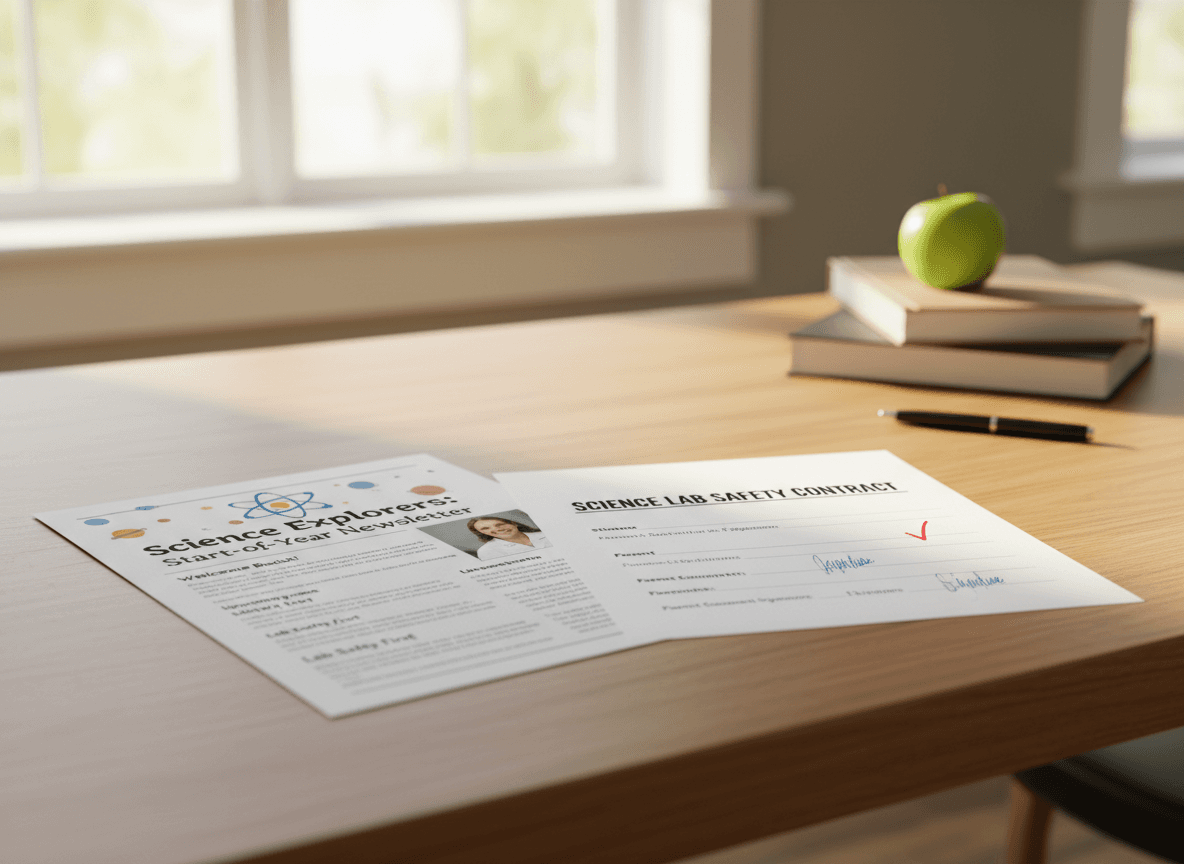
The first science newsletter of the year does more work than any other. Parents are deciding right now whether your emails are worth opening. You have one shot to set the rules, hand over the supply list, get the safety contract back, and tell families where to write when they have a question. This template covers all of that in seven sections, in an order parents actually read.
Section 1: Welcome and what we will study
Three sentences. Your name, the course, the big arc of the year. "Welcome to 7th grade science. This year we move through chemistry, ecosystems, weather, and a final engineering design project. We do real lab work every week." That tells a parent what kind of class their kid is in.
Section 2: Safety contract (sign and return)
Bold deadline. One sentence about what the contract covers. One sentence about the consequence of not returning it. "Students who have not returned the safety contract by Friday cannot work in the lab and will sit out the first investigation." Parents respond to clarity. Vague asks get ignored.
Section 3: Supply list
Bullet points. Three categories: needed by Monday, needed by end of the first week, nice to have. "Needed Monday: a composition notebook (any color, 100 pages). End of first week: a basic calculator and a ruler. Nice to have: colored pencils we can keep in class." Parents triage. Help them do it.
Section 4: Lab partner norms
Three rules, in plain language. "Lab partners are assigned for two weeks at a time. Every partner shares the work, no one does it all for the other. If a partnership is not working, the student tells me first, not a parent." Parents read this and stop emailing you about their child's lab partner in week 3.
Section 5: How we communicate
One channel. One sentence. "The best way to reach me is reply to this newsletter. I read replies every weekday afternoon. I do not check the school portal messages, so emails sent there will be slower." Now you have one inbox, not five.
Section 6: Calendar dates for the first month
Four dates max. Curriculum night, first quiz, field trip, parent conference window. Anything else can come in a later newsletter. Overloading the calendar in week one means parents miss the important date because it is buried in seven.
Section 7: What to ask your child this week
One question. "Ask your child what their first 'safety scenario' was and how the class handled it." Gives parents a hook into a dinner conversation and teaches them that the newsletter has actual prompts for them, not just announcements.
Example: an 8th grade start-of-year newsletter
Welcome, brief course arc, signed safety contract due Friday, notebook needed Monday, lab partner norms summarized in three lines, reply-to-this as the contact channel, curriculum night on the 15th and first quiz on the 22nd. Closing question: ask your child which safety rule they think will be hardest to follow. Parents reply, students get a story to tell, and the year is on the right footing by Friday of week one.
Why this template works
It answers every question a parent has on day one before they ask it. Safety contract due date is in bold. Supply list is triaged so parents do not panic-buy. The contact line cuts inbound traffic from five channels to one. By week three, parents know the rhythm and you have one less daily distraction.
How Daystage helps with start-of-year science newsletters
Daystage has the seven-section start-of-year template with a slot for the safety contract attachment, a sign-and-return deadline field, and a "reply directly" address so parents land in one inbox. Build it once, reuse it next year, and the formatting stays clean every time you send.
Get one newsletter idea every week.
Free. For teachers. No spam.
Frequently asked questions
When should the start-of-year science newsletter go out?
The day before school starts, or the first day at the latest. Parents are sorting supply lists, schedules, and forms in the first 48 hours. Get into that pile or you will be opening it three weeks later when you actually need them to act.
Should the safety contract be in the first newsletter?
Yes, as an attachment or a link, with a clear due date and a one-sentence summary of what it covers. Parents who skim still need to know there is a thing to sign. Put the due date in bold and at the top of that section.
What is the 'single best contact method' line for?
Parents will email you on six platforms by October if you do not tell them where to write. Pick one. School email or your Daystage reply. Tell them in the first newsletter that this is the channel and other channels do not get checked. Then enforce it.
How long should the start-of-year newsletter be?
Under 500 words. It is dense by necessity (safety, supplies, norms, contact, calendar), but if it runs longer than a one-screen scroll parents will close it and figure it out from another parent in the carpool line.
Does Daystage have a start-of-year science newsletter template?
Yes. Daystage has the start-of-year template ready with all seven sections, plus a safety contract attachment slot and a 'sign and return' deadline field. You build it once and reuse the structure every year, swapping content for your new classes.

Adi Ackerman
Author
Adi Ackerman is a former classroom teacher and curriculum writer with 8 years in K-8 schools. She writes about school communication, parent engagement, and what actually works in real classrooms.
More for Science Newsletter
Elementary Science Newsletter Template: Hands-On Without the Jargon
Science Newsletter · 6 min read
High School Science Newsletter: Communicating AP Bio, Chem, and Physics
Science Newsletter · 6 min read
Lab Safety Newsletter for Parents: What They Need to Know Before Day One
Science Newsletter · 6 min read
Ready to send your first newsletter?
3 newsletters free. No credit card. First one ready in under 5 minutes.
Get started free