

Sixth Grade Science Newsletter: A Template Worth Stealing
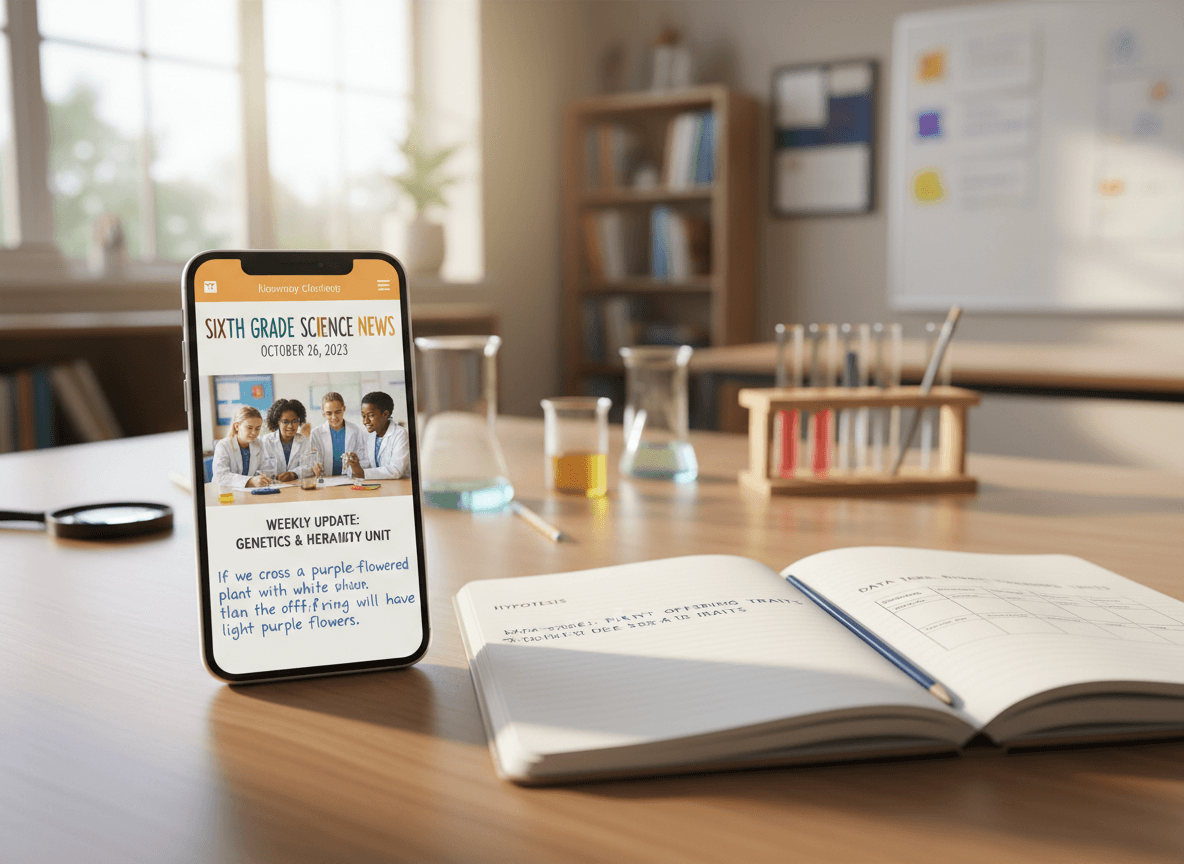
Sixth grade is the first year most students have a science specialist instead of a generalist. The newsletter has to do new work. It has to explain how your classroom runs, build credibility with parents who do not know you yet, and translate middle school science into language that does not require a teaching degree. Five sections, slightly more technical than fifth grade, written for parents whose oldest child just hit middle school.
Section 1: What we investigated
Three sentences. The question, the procedure, and one finding. "This week we modeled plate boundaries with graham crackers, frosting, and a gentle push. Convergent boundaries built mountains. Divergent boundaries created new crust. Students wrote a one-paragraph explanation in their lab notebooks." Same shape works for matter cycling. "Students traced one carbon atom from the atmosphere through a tomato plant, into a sandwich, and back out as exhaled CO2. R. argued that a single atom would not actually make it through digestion intact, which led to a real conversation about how cycles work at the scale of trillions of atoms, not one."
Section 2: Vocabulary we are using
Five words tied to the unit. For plate tectonics: "Lithosphere (the rigid outer layer of Earth), Convergent boundary (plates moving together), Divergent boundary (plates moving apart), Transform boundary (plates sliding past each other), Subduction (one plate sinking under another)." Sixth graders can handle this density. Parents will look up the unfamiliar ones, which is fine.
Section 3: Photo of the week
One image. A lab notebook page with a clean data table, a model in progress, a student writing on the board. Lab notebook pages are gold. Parents see them and understand exactly what level of work is expected, which prevents the "but he is so smart, why does he have a C" email. A 5-day temperature graph drawn in pencil with axes labeled in Celsius, gridlines drawn by hand, and a one-paragraph caption that reads "the temperature dropped 4 degrees on day 3, the same day air pressure dropped, which matches what we see on a real forecast" is the kind of artifact that resets a parent's expectations for what sixth grade looks like.
Section 4: Do at home
One independent task. "Watch the next earthquake or volcano news story and note the location. Bring it to class Monday." Or "Pick one weather symbol on tonight's forecast and bring a definition." Independent, low friction, connects to content.
Section 5: Coming up
Three lines. Test dates, project due dates, supply requests, field trips. Mention what is in the lab notebook this week so parents who want to look know what to expect. "Lab notebook check Friday. Students should have five entries from this unit." Field trip permission slips get their own line. Same place every issue, dated, with the due day named, every single issue.
Template excerpt: a real sixth grade weather unit issue
Here is what the template looks like during a weather and climate unit:
What we investigated: Students tracked daily weather for ten days and built line graphs of temperature, pressure, and precipitation. We saw that pressure dropped before each rainy day, which led to a class discussion about how meteorologists predict storms.
Vocabulary: Air pressure (the weight of air pushing down), Front (a boundary between two air masses), High pressure system (associated with clear weather), Low pressure system (associated with storms), Forecast (a prediction based on patterns).
Do at home: Watch tonight's weather forecast and note any mention of pressure or fronts. Bring your notes Monday.
Coming up: Weather unit test Friday. Study guide in Google Classroom. Lab notebook check the same day. Students should have all six unit entries.
Why this template works for sixth grade
Sixth grade parents need three things from a science newsletter: proof that their student is doing real work, clarity on grading and deadlines, and a way to support without becoming the homework police. Five sections deliver that. The lab notebook callout in the coming-up section is the smallest section and does the most work. It tells parents what to look for without telling them to nag. By winter break, parents have a clear picture: lab notebook means a bound composition book, one entry per investigation, dated, with a data table and a one-paragraph reflection. Five entries per unit. Six units per year. Thirty notebook entries by May, all in the student's own handwriting. That is the proof point.
How Daystage helps with sixth grade science newsletters
Daystage gives sixth grade teachers a five-section template you build once and duplicate every two weeks. Lab notebook callouts, test dates, and coming-up sections sit in the same place every issue, so parents learn where to look. It sends to your full class roster as a real email. You can write the next issue from your phone during cafeteria duty.
Get one newsletter idea every week.
Free. For teachers. No spam.
Frequently asked questions
What does sixth grade science cover?
Most sixth grade NGSS courses cover weather and climate, plate tectonics, and energy and matter cycles. Some districts split sixth grade into Earth science only, others integrate all three domains. Your newsletter should reflect what your specific course covers, not the standards document.
How is a sixth grade newsletter different from fifth grade?
Sixth grade is the first year most students have a dedicated science teacher, not a generalist. The newsletter format gets a little more technical and assumes parents know what a hypothesis is. The biggest change is the introduction of a lab notebook routine, which deserves its own section in the first newsletter of the year.
Should I include grades or recent assessment results in the newsletter?
Skip individual grades. Mention class-wide patterns. 'Most students did well on the rock cycle quiz. The hardest question was about metamorphic rocks, which we will review on Monday.' That gives parents context without violating any student's privacy.
What at-home extension works for middle schoolers?
Skip the family activity. Sixth graders want to do science themselves. 'Watch the weather forecast tonight and note three things the meteorologist says. Bring your notes Monday.' That is independent, low-friction, and connects to current content.
Does Daystage have a sixth grade science newsletter template?
Yes. Daystage gives sixth grade teachers a five-section template (what we investigated, vocabulary, photo, do at home, coming up) you build once and duplicate biweekly. It sends to your full class roster as a real email and works from your phone if you are writing between periods.

Adi Ackerman
Author
Adi Ackerman is a former classroom teacher and curriculum writer with 8 years in K-8 schools. She writes about school communication, parent engagement, and what actually works in real classrooms.
More for Science Newsletter
Ready to send your first newsletter?
3 newsletters free. No credit card. First one ready in under 5 minutes.
Get started free