

Seventh Grade Science Newsletter: Sections That Work Each Week
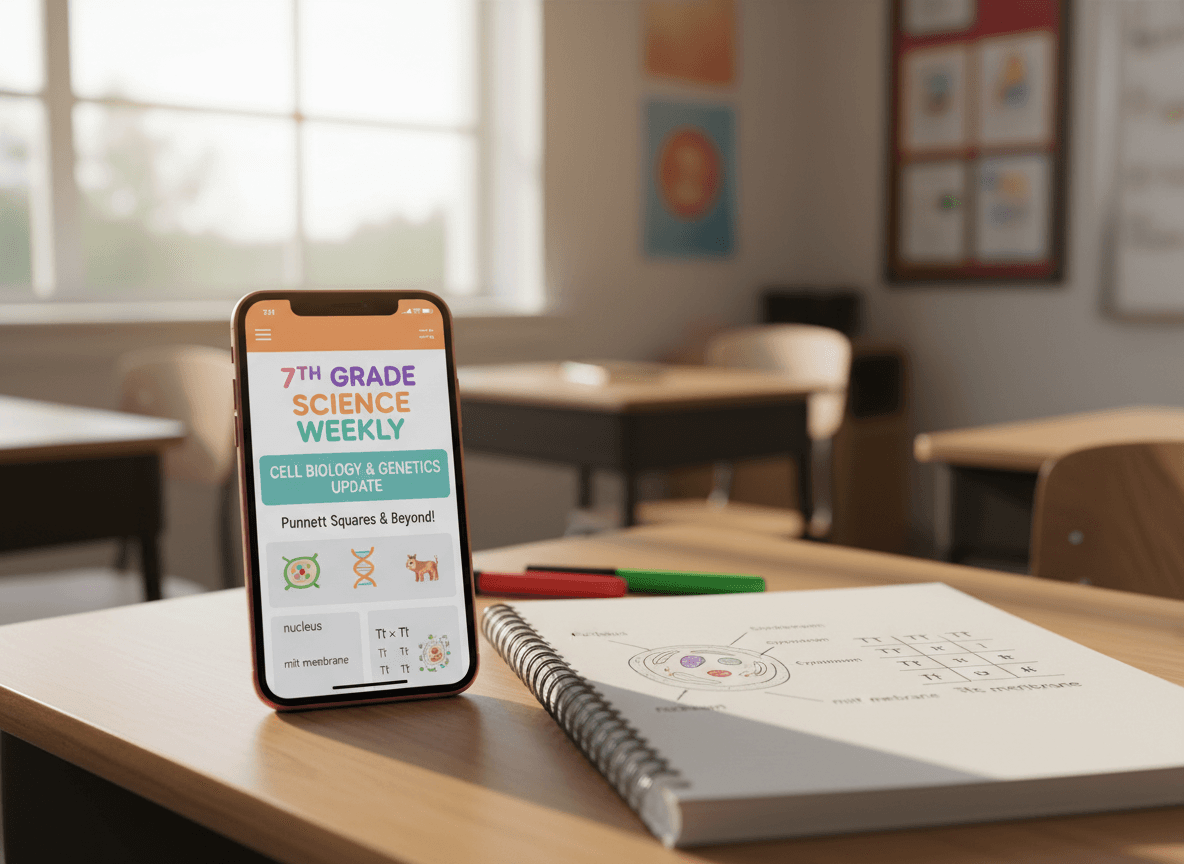
Seventh grade is when science gets personal. Students see their own cells under a microscope. They start tracking inherited traits in their own families. They argue about why their dog looks like their dog. The newsletter should match that shift. Five sections, with content students will talk about at dinner whether you ask them to or not.
Section 1: What we investigated
Three sentences. The question, the procedure, one finding. "This week students prepared wet mount slides of cheek cells and looked at them under 400x. Most could find the cell membrane and the nucleus. A smaller group spotted what they thought were mitochondria and we will confirm with a stain on Tuesday." For genetics, the same shape: "Students ran Punnett squares for eye color in their own families. D. predicted brown for her two siblings based on her parents' genotypes and was right on both. We talked about why a single trait prediction does not work for real eye color, which has at least three genes involved."
Section 2: Vocabulary we are using
Six words at this grade. For a cells unit: "Cell membrane (the outer boundary of an animal cell), Nucleus (contains the genetic material), Mitochondria (the energy producers of the cell), Cell wall (the rigid outer layer of a plant cell), Cytoplasm (the gel inside the cell), Organelle (a structure inside a cell with a job)." Seventh graders absorb this fast.
Section 3: Photo of the week
One image. A microscope photo a student took with a phone through the eyepiece, a labeled Punnett square, a dissection in progress. Real student work, not stock images. Microscope photos taken by students are particularly powerful because parents have not seen anything like it since their own middle school year. The classic shot is the onion skin slide. One thin layer of red onion, a drop of water, a coverslip, a 400x view, and the rectangular cells with their dark nuclei jump out instantly. Students hold a phone over the eyepiece and the photo lands clean. Send that and a parent who has not thought about a cell since 1998 suddenly cares.
Section 4: Do at home
One independent task. "Trace one trait through your family. Eye color, hair color, attached or detached earlobes, your choice. Bring a chart Monday." Or "Watch a documentary scene about cells and write three sentences about what you noticed." Independent, low friction.
Section 5: Coming up
Three lines. Test dates, lab dates, project sign-ups, supply requests. If the next unit is sensitive (reproduction, evolution), name it here the week before so parents are not surprised. A one-line note like "next two weeks we cover human reproduction, opt-out form attached" prevents the angry email later. Clear, factual, no apology.
Template excerpt: a real seventh grade genetics issue
Here is what the template looks like in the second week of a genetics unit:
What we investigated: Students used Punnett squares to predict offspring traits for pea plants. We tracked dominant and recessive alleles for three traits and compared predictions to actual data from Mendel's experiments. The match was closer than most students expected.
Vocabulary: Allele (a version of a gene), Dominant (an allele that shows when present), Recessive (an allele that only shows without a dominant), Genotype (the genetic makeup), Phenotype (the visible trait), Homozygous (two of the same allele).
Do at home: Pick one trait you can see in your family and chart it across two generations. Bring the chart Monday.
Coming up: Genetics unit test next Friday. Study guide in Google Classroom. We start the reproduction unit the following Monday. Opt-out form attached for families who prefer their student skip that section.
Why this template works for seventh grade
Seventh grade parents want to know what their student is studying, what is coming, and what they can do at home without becoming a tutor. Five sections deliver that. The do-at-home prompt is independent on purpose. Seventh graders push back when parents try to help, so the prompt is written for the student, not the family. The vocabulary section is the secret engine. Six words a cycle, twelve cycles a year, and a seventh grader exits the course with 72 content words used in real sentences. That outpaces any flashcard app. Parents who see those words in print are also more likely to recognize them on a unit test and stop asking "why is the grade a B and not an A" when they understand the vocabulary load.
How Daystage helps with seventh grade science newsletters
Daystage gives seventh grade teachers a five-section template you build once and duplicate every two weeks. The vocabulary section scales up easily, the coming-up section handles sensitive unit notes without breaking the layout, and the photo section accommodates student microscope shots. It sends to your full class roster as a real email and works from your phone in five minutes.
Get one newsletter idea every week.
Free. For teachers. No spam.
Frequently asked questions
What does seventh grade science cover?
Most seventh grade NGSS courses focus on life science: cells and body systems, genetics and reproduction, and ecosystems and natural selection. Some districts integrate physical science topics too. Your newsletter should reflect what your course actually covers, not what the state standards document covers.
How do I write about cells without sounding like a textbook?
Lead with what students saw. 'This week students looked at onion skin cells under microscopes. Most could find the cell wall and the nucleus on their own. A few caught chloroplasts and were surprised onion has them.' That is more memorable than a definition of organelles.
Should the newsletter mention puberty or reproduction units?
Yes, the issue before you start. Be plain. 'Next two weeks we cover human reproduction as part of the genetics unit. Topics include inherited traits, reproductive systems, and how DNA passes from parents to offspring. Opt-out form attached for families who prefer.' Clear, factual, no apology.
What at-home extension works for seventh graders?
Independent observation tasks tied to current content. 'Find one trait you share with a parent and one you do not. Be ready to share Monday.' Or 'Watch one nature documentary scene this weekend and write three sentences about what you saw.' Independent, no supplies, no parent labor.
Does Daystage have a seventh grade science newsletter template?
Yes. Daystage gives seventh grade teachers a five-section template (what we investigated, vocabulary, photo, do at home, coming up) you build once and duplicate biweekly. It sends as a real email to your class roster and works from your phone between periods.

Adi Ackerman
Author
Adi Ackerman is a former classroom teacher and curriculum writer with 8 years in K-8 schools. She writes about school communication, parent engagement, and what actually works in real classrooms.
More for Science Newsletter
Ready to send your first newsletter?
3 newsletters free. No credit card. First one ready in under 5 minutes.
Get started free