

Second Grade Science Newsletter: A Working Template
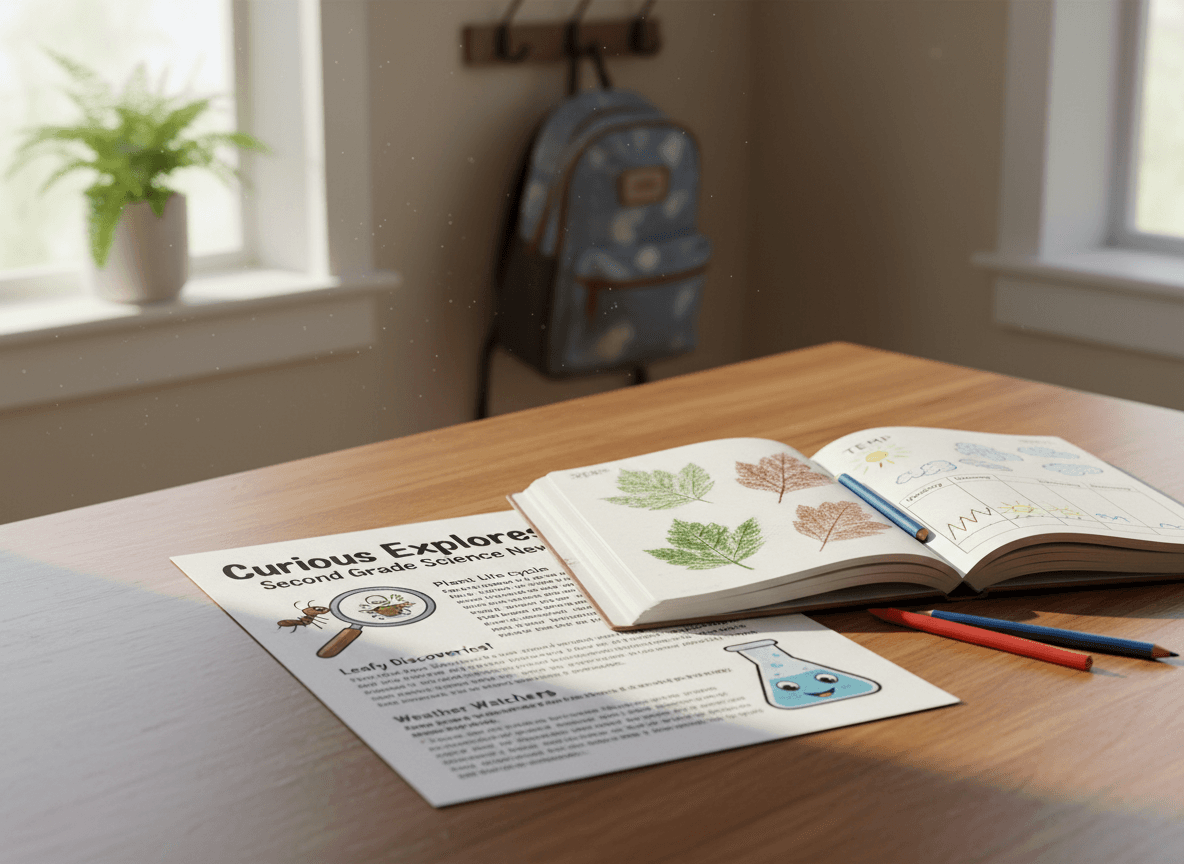
Second grade science lives outside more than any other grade. Students watch the same tree for 36 weeks, track the temperature on a chart by the door, and sort acorns into piles for reasons that make sense to a seven-year-old. The newsletter that supports that work should be just as grounded. Five sections, under 300 words, written so a parent can read it in the carpool line. The tree-watch routine is the spine of the whole year. Pick a tree the first week of September. Name it. The class maple, the corner oak, the one near the kindergarten door. The same tree gets visited every Monday morning, rain or shine, for the next nine months.
Section 1: This week at the tree
Two sentences about your class tree. Name what students noticed and what changed. "Our maple is dropping seeds now. Students collected ten and counted the wings, which is what makes them spin when they fall." That is the section. A parent reads it and knows what their child saw. On the week of November 4 it might read: "Almost every leaf is gone now. J. counted nine leaves left on the lowest branch. We talked about where the leaves go after they fall." Specific kid, specific count, one connecting question. That is what makes a second grader come home and say "we are studying the maple again."
Section 2: Weather data this week
Two or three numbers. High temperature, low temperature, rainy days. Students write these on a class chart every morning, so pulling them into the newsletter takes 30 seconds. Parents who see weather in the newsletter start checking the forecast with their kids, which is free reinforcement of measurement and prediction. Once a month, include a small bar graph students drew themselves. Five bars, one per school day, temperature on the side. It does not need to be pretty. A crooked bar graph from a second grader is more convincing to a parent than any printable. By March, parents will tell you their child checks the weather app on the kitchen counter before breakfast.
Section 3: Vocabulary we are using
Three words. Plain definitions. For a unit on living things: "Habitat: the place where a plant or animal lives. Shelter: a safe spot out of the weather. Survive: to stay alive and healthy." That is enough. Parents pick these up at dinner and use them the next day.
Section 4: At-home extension
One activity, 5 minutes, no supplies. "Walk outside with your child and find the tallest tree on your block. Notice the shape of its leaves and the color of its bark. We will compare on Monday." That is the whole ask. Doable on a weeknight, no resentment. The trick is to write it like a parent would say it, not like a worksheet. "Stand on your porch for one minute after dinner. List three sounds you hear." Or "Look at the sky before bed and tell me one cloud shape you see." Parents send these back the next day with one-line replies. M.'s mom wrote "we heard the ice cream truck and a crow." That is the whole point.
Section 5: What is coming up
Two lines. Permission slip due, new unit starting, field trip date. Parents read this section to put things on the family calendar. Keep it in the same place every issue.
Template excerpt: a real second grade fall issue
Here is what the template looks like filled in for the second week of October:
This week at the tree: The leaves are turning yellow and starting to fall. Students collected six and sorted them by color. We talked about why leaves change in fall and started a class chart of the answers.
Weather: High 62, low 41, two rainy mornings.
Vocabulary: Season (one of four parts of the year), Deciduous (trees that lose their leaves), Temperature (how hot or cold something is).
At-home extension: Find one leaf on a walk this weekend. Notice the shape and the color. Bring it to school Monday.
Coming up: Field trip to the pumpkin patch on October 24. Permission slip in folders today.
Why this template works for second grade
Second grade parents want to know two things: what their child is doing and what they need to remember. Five short sections give them that without making them read a wall of text. The tree-watch column gives every newsletter a continuous story, so parents start asking about it from October to May without you prompting them. By spring, the maple section becomes the most-read part of the newsletter. Grandparents ask about it. Older siblings remember it from their own second grade year. One classroom routine, 36 weeks, builds more family science culture than any printable ever has.
How Daystage helps with second grade science newsletters
Daystage gives second grade teachers a five-section template you build once and duplicate every two weeks. The tree-watch, weather, and coming-up sections stay in the same place every issue, so parents learn where to look and stop skimming past your emails. It sends as a real email to your full class list. You can write the next issue from your phone while students are at recess.
Get one newsletter idea every week.
Free. For teachers. No spam.
Frequently asked questions
What does a second grade science class actually study?
Most second grade NGSS units cover plant and animal needs, properties of materials, and Earth's changing surface. The tree-watch routine is the through-line for most second grade teachers because it covers seasonal change, living things, and weather all at once. Your newsletter should mirror what students are doing, not what the standards document says.
How long should a second grade science newsletter be?
Under 300 words. Second grade parents are usually managing a younger sibling too. If your email takes more than 90 seconds to read, it gets archived. Five short sections beats one long paragraph every time.
Should I include the NGSS standard code in a second grade newsletter?
Skip the code. Translate it into the question students are answering. 2-LS4-1 becomes 'How are the plants and animals in our schoolyard different from the ones we saw last month?' That is a question a seven-year-old can answer and a parent can ask at dinner.
What at-home extension works for second graders?
A 5 minute observation, not a project. 'Stand outside with your child for one minute. List three things you hear, three things you see, three things you smell.' That is doable on a Tuesday night. Anything that requires shopping or scissors will not happen.
Does Daystage have a second grade science newsletter template?
Yes. Daystage gives second grade teachers a five-section template with tree-watch, vocabulary, photo of the week, at-home extension, and what is coming. You build it once, duplicate it every two weeks, and send to your full parent list as a real email. No app, no login, no PDF attachments.

Adi Ackerman
Author
Adi Ackerman is a former classroom teacher and curriculum writer with 8 years in K-8 schools. She writes about school communication, parent engagement, and what actually works in real classrooms.
More for Science Newsletter
Ready to send your first newsletter?
3 newsletters free. No credit card. First one ready in under 5 minutes.
Get started free