

Science Newsletter for a Water Cycle Unit: Plain-Language Sections
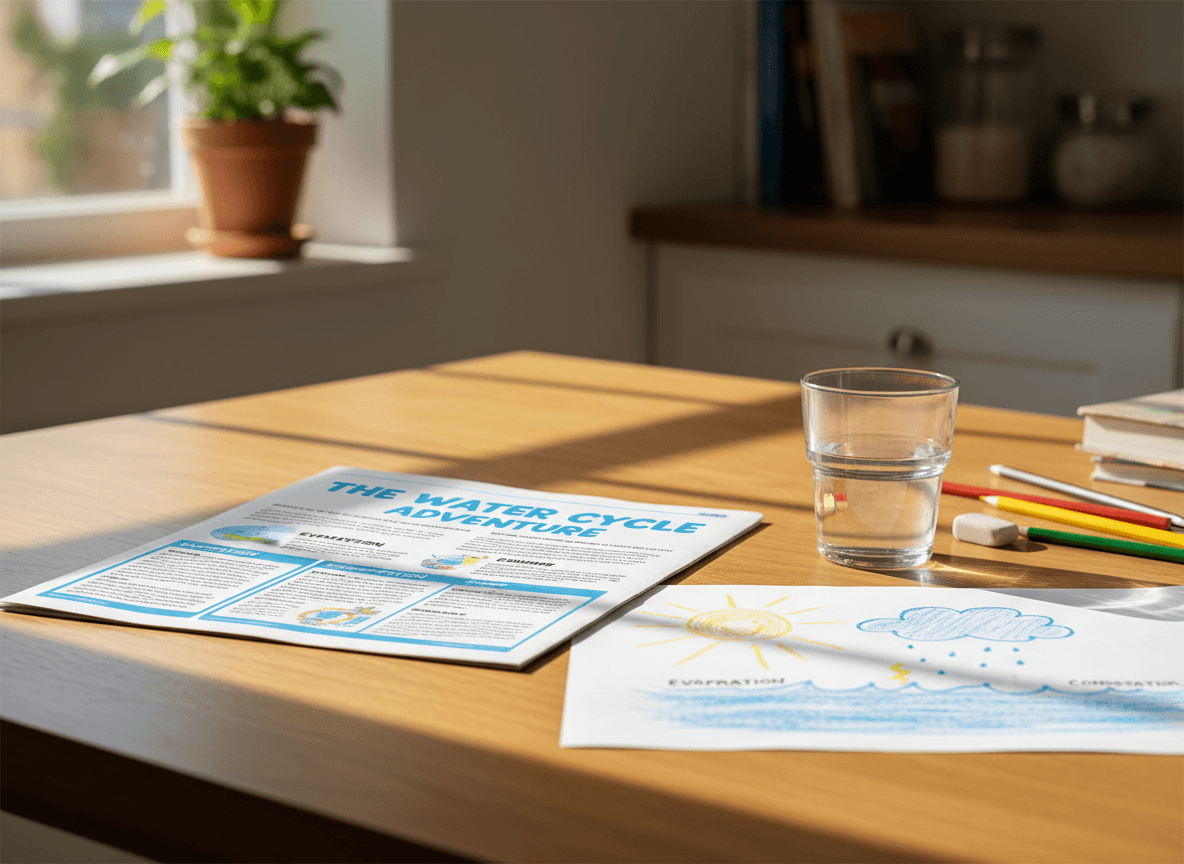
The water cycle shows up in almost every elementary science curriculum at least twice, once in second or third grade and again in fifth. Parents have seen the diagram. Most cannot name the three stages without thinking. The newsletter does not need to teach them. It just needs to point at what students are watching this week and give one home observation. Five short sections, under 300 words.
Open with the bag on the window
If you are running the closed-bag demo, lead with it. "There is a sandwich bag with a little water taped to our sunniest window. By Thursday, students noticed water drops forming on the inside of the bag, even though we never opened it." That is the whole opening. A parent reads it and immediately wants to know how the water moved.
Define the three stages in plain English
Evaporation, condensation, precipitation. One sentence each. "Evaporation is water turning into invisible vapor when it warms up. Condensation is vapor turning back into liquid drops when it cools. Precipitation is water falling from clouds as rain, snow, sleet, or hail." Parents who read those three sentences can hold a real conversation at dinner.
Tie it to something kids already see
Morning dew, steam off a hot shower, foggy car windows, a puddle drying up. Pick one and name it in the newsletter. "Next time you get out of a hot shower, the bathroom mirror is foggy because warm water vapor in the air cools when it hits the cold glass. That is condensation." A parent who reads this points it out the next morning. Reinforcement, free.
Give one home observation
Puddle watch. After the next rain, find a puddle on your street. Check it right after the rain stops. Check it again the next afternoon. Where did the water go? That is the entire activity. It takes ninety seconds twice, and it makes the cycle real in a way the worksheet never quite does.
Template excerpt: a third grade demo week
Here is what one issue looks like filled in:
What we watched: Our bag-on-the-window setup is on day 4. Students noticed water drops on the inside of the bag by Wednesday and tiny pools at the bottom by Friday. The bag has never been opened.
Vocabulary: Evaporation (water turning into invisible vapor), Condensation (vapor turning back into drops), Precipitation (water falling from clouds).
At home: After the next rain, find a puddle. Check it again the next afternoon. Where did the water go?
Coming up: Cloud types lesson Tuesday. We will study why some clouds bring rain and others do not.
Anticipate the snow-and-hail question
Every water cycle unit triggers the same parent question. Why does rain sometimes come down as snow or hail? One sentence in the newsletter handles it. "When the air is cold enough at every layer between the cloud and the ground, water falls as snow. Hail forms when raindrops get tossed up into cold clouds and freeze before they fall." Two sentences. Question answered.
How Daystage helps with a water cycle newsletter
Daystage holds the template so you do not rebuild it each week. Fill in what students saw, the three vocabulary words, the home observation, and what is coming. It sends as a real email to every family on your class list. Parents read it on a phone in two minutes, and you can write the next issue between periods.
Get one newsletter idea every week.
Free. For teachers. No spam.
Frequently asked questions
How do I explain evaporation, condensation, and precipitation to parents?
One sentence each. Evaporation is water turning into invisible vapor when it gets warm. Condensation is vapor turning back into liquid drops when it cools. Precipitation is water falling from clouds as rain, snow, sleet, or hail. Three sentences, and a parent who has never thought about it since fifth grade now has the frame.
What is the bag-on-window demo and should I describe it in the newsletter?
Tape a clear plastic bag with a little water inside to a sunny window. Over a few days, students watch the water evaporate, condense on the bag, and trickle back down. Yes, describe it. Parents who see this in writing can recreate it at home in two minutes with a sandwich bag and a sunny windowsill.
What is a good at-home observation for the water cycle?
Find a puddle after rain and check on it twice. Once right after the rain stops, again the next afternoon. Where did the water go? That question opens the entire concept of evaporation in a way no worksheet matches. No supplies, no setup, just a walk to the same spot twice.
How do we keep the water cycle from sounding like a list to memorize?
Tie it to weather kids already see. Morning dew on grass is condensation. Steam off a hot shower is evaporation. A puddle drying up is the cycle in slow motion. The newsletter should pull at least one of these into every issue. Parents repeat what they read.
Can Daystage help me build a water cycle newsletter?
Yes. Daystage gives you a short template with the recap, vocabulary, demo update, and home observation. You fill in the content each week. It sends as a real email to every family on your class list, no app downloads, no attachments to open, ready to read on a phone screen.

Adi Ackerman
Author
Adi Ackerman is a former classroom teacher and curriculum writer with 8 years in K-8 schools. She writes about school communication, parent engagement, and what actually works in real classrooms.
More for Science Newsletter
Ready to send your first newsletter?
3 newsletters free. No credit card. First one ready in under 5 minutes.
Get started free