

Science Newsletter for a States of Matter Unit: A Template
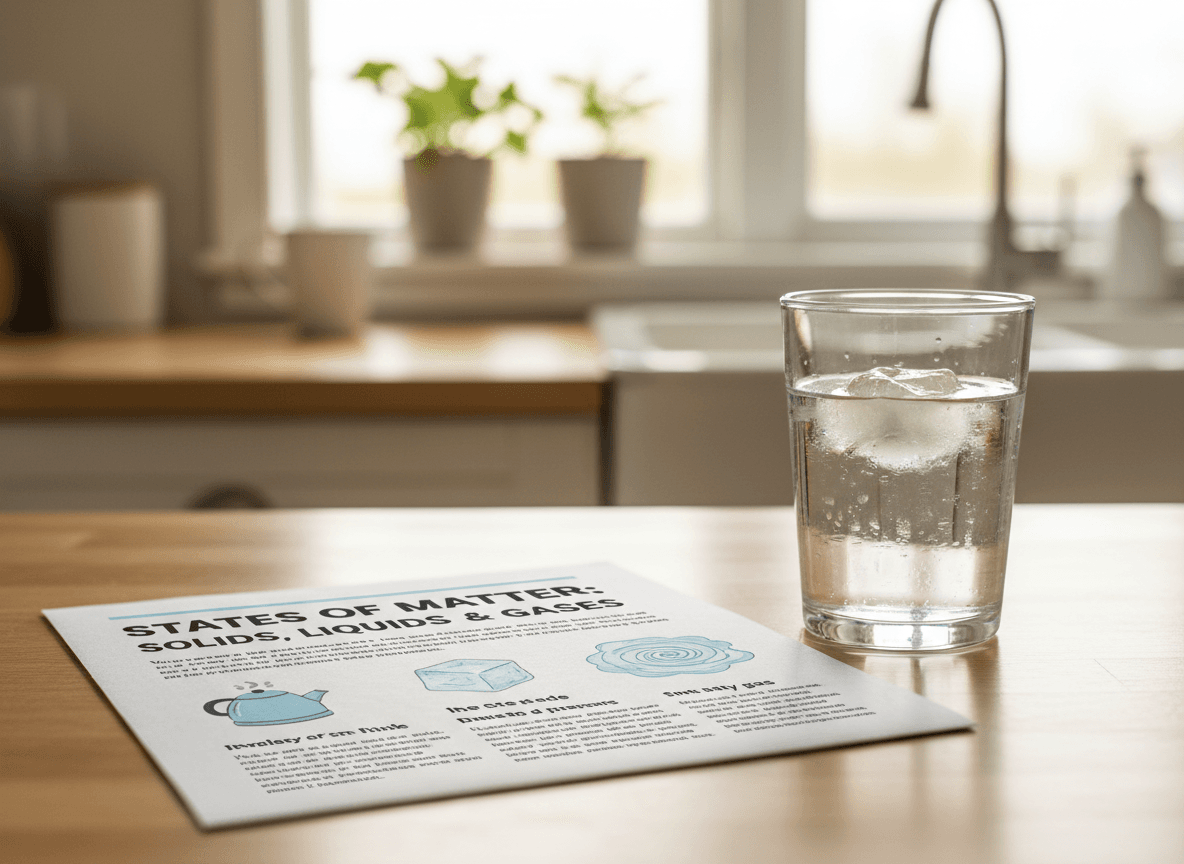
A states of matter unit is one of the easiest science topics to send home. Solid, liquid, gas. Kids already have intuitions about all three. The newsletter does not have to teach the parent the science. It has to give the parent the language and one question to ask at dinner. Done right, the unit becomes a two-week conversation in the kitchen instead of a worksheet that comes home and gets shoved in a backpack.
Open with the big idea, not the activity
Start every issue with one sentence on the big idea. "This week we are figuring out what makes something a solid, a liquid, or a gas." That is what the parent needs. The activity (sorting kitchen items, melting ice, watching steam) sits underneath the idea, not above it. Parents who read the big idea first know what to anchor the rest to.
What we did this week
Two sentences on the investigation. "Students sorted twelve objects into solid, liquid, and gas piles. The trick objects (toothpaste, sand, whipped cream) led to a class discussion on what really counts as a liquid." Specific. Repeatable at dinner. Names the moment that made the lesson click.
Vocabulary parents can use without feeling silly
Three words, plain definitions. "Solid: holds its shape on its own. Liquid: takes the shape of its container. Gas: spreads out to fill whatever space it is in." Skip "particle," "molecule," and "matter has mass and takes up space" for the K-2 newsletter. Those land in fifth grade. Right now you want a parent and a seven-year-old to point at a cup of water and agree on what it is.
The phase change question
Every matter unit asks this: what happens when you heat or cool something? Frame it as a question for the family. "Ask your child what an ice cube turns into when it warms up. Then ask what happens to a puddle on a hot sidewalk." Two questions. One sequence. The kid walks through the whole phase-change cycle without realizing it is a quiz.
At-home extension: the kitchen tour
Ten minutes. No supplies. "Walk through your kitchen with your child. Find one solid, one liquid, and one gas. Steam from a kettle counts. The air in a balloon counts. Take a photo of all three and send it to me." That last bit (send a photo) gives you a piece of student work for the next issue and signals to the parent that their effort matters.
Template excerpt: a second grade matter unit issue
Big idea: Everything around us is a solid, a liquid, or a gas, and many things can switch between them when they get hotter or colder.
What we did: Students timed how long it took an ice cube to melt on a tray at room temperature. The fastest cube was on a metal tray. The slowest was on a wooden plate. We talked about why.
Vocabulary: Solid, liquid, gas, melt, freeze.
Ask at home: Would your bedroom look different if water was a solid at room temperature? What would happen to your drink?
Coming up: Boiling water demo next Thursday (safety goggles provided). Field trip permission slip due Friday.
Why this works better than a unit recap PDF
A PDF gets archived. A short, scannable email with one question becomes a dinner conversation. Parents do not want a curriculum document. They want one specific thing to ask their kid that will not be answered with "fine." The states of matter unit is built for this. Use it.
How Daystage helps with a states of matter unit newsletter
Daystage gives you the five-section template ready to fill. Big idea, what we did, vocabulary, ask at home, coming up. You build it once at the start of the unit, duplicate it for the second issue, and edit only the content. It sends to your class roster as a clean email, not an attachment, and you can write the next issue from your phone during morning car line.
Get one newsletter idea every week.
Free. For teachers. No spam.
Frequently asked questions
What grade does a states of matter newsletter usually go out to?
Most commonly second grade in NGSS-aligned districts, but the unit also appears in kindergarten (sorting solid vs. liquid) and fifth grade (particles and phase change). The newsletter structure stays the same. Only the vocabulary depth changes.
How do I explain phase change to parents without using the word 'molecule'?
Use temperature as the lever. 'When we heat ice, the solid gets enough energy to become a liquid. When we keep heating it, the liquid gets enough energy to become a gas.' That is accurate, that is the right mental model, and it works for a parent who has not thought about chemistry since high school.
What is a good at-home extension for a states of matter unit?
The kitchen. 'Find one solid, one liquid, and one gas in your kitchen tonight. The gas is the tricky one. Hint: open the freezer.' That is a 10 minute conversation, no supplies, and it surfaces the misconception that gases are invisible and therefore not real.
Should I mention the 'fourth state of matter' (plasma) in the newsletter?
Only if a curious student brings it up in class. Parents do not need it. Adding plasma to a second grade newsletter confuses more than it teaches. Save it for the kid who asks, give them a one-paragraph answer, and keep the newsletter focused on the three states the standard covers.
Does Daystage have a template for a matter unit newsletter?
Yes. Daystage gives you a five-section template (big idea, what we did, vocabulary, at-home extension, what is coming) you build once and reuse every two weeks. It sends to your full class roster as a real email, so parents do not need an app to read it.

Adi Ackerman
Author
Adi Ackerman is a former classroom teacher and curriculum writer with 8 years in K-8 schools. She writes about school communication, parent engagement, and what actually works in real classrooms.
More for Science Newsletter
Ready to send your first newsletter?
3 newsletters free. No credit card. First one ready in under 5 minutes.
Get started free