

Science Newsletter on Electricity and Magnetism: A Template
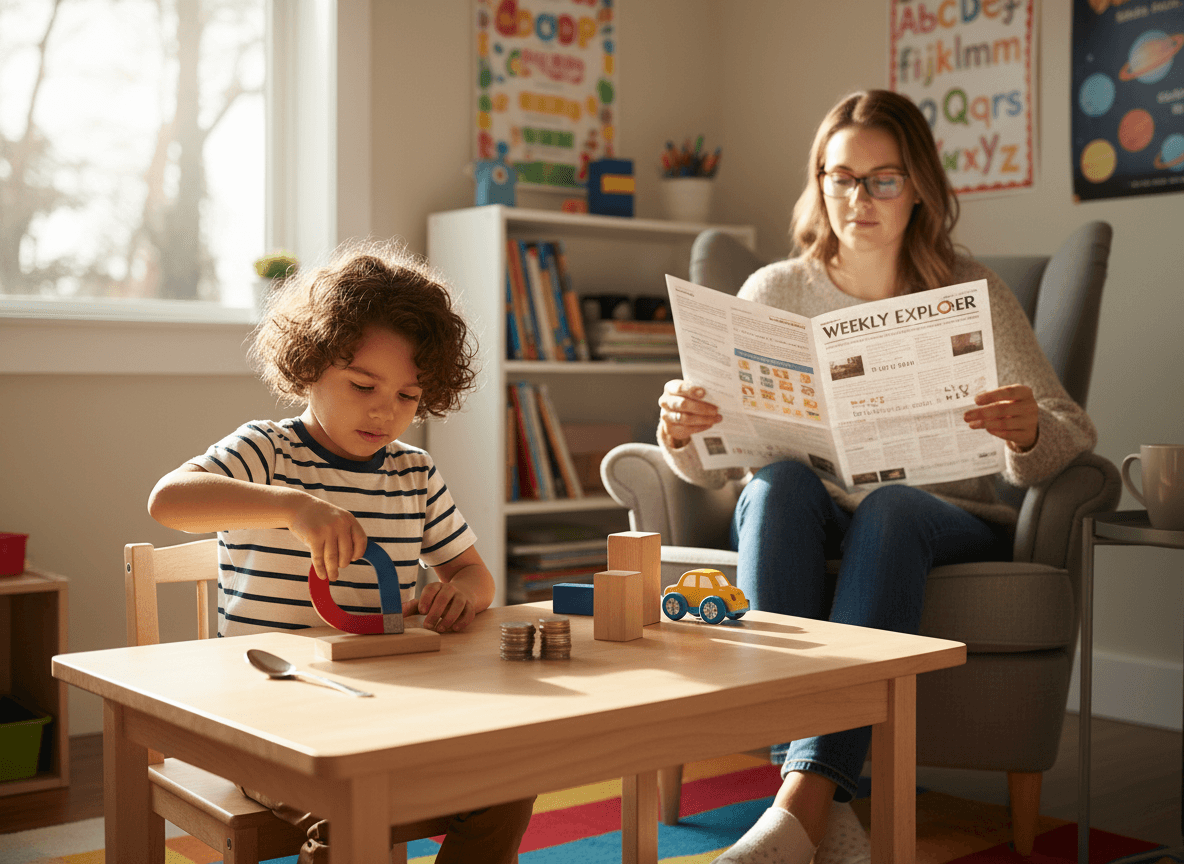
Electricity and magnetism is one of the units where parents most want a clear rule on what is okay at home. Wall outlets, no. Battery and bulb, yes. The newsletter has to make that boundary obvious in the first issue and then move on to the cool stuff. Five short sections, under 300 words, and the unit communicates cleanly all the way to the magnet hunt and beyond.
Open with the circuit students built
Lead with the activity. "This week our fourth graders built a simple circuit with one AA battery, a small bulb, and two wires. Every student got the bulb to light up by the end of class. We then took one wire away and watched the bulb go dark. That is an open circuit vs. a closed circuit." A parent reads that and the unit is in their head.
State the safety rule once, in writing
"All our investigations use single AA or AAA batteries. We never plug anything into a wall outlet for class experiments, and please do not try wall-outlet projects at home. Batteries are completely safe and that is what we work with." One paragraph. Parents read it once and the rule is set.
Define open vs. closed circuit
Closed circuit (a complete loop from the battery, through the wires, through the bulb, and back). Open circuit (a break in the loop, so nothing flows). That is the whole vocabulary section for the first week. Parents who see those two terms can ask the kid which is which when the lamp on the desk is switched off.
Move to magnets in week two
The second issue introduces magnetic metals. Iron, nickel, cobalt. Aluminum and copper are not. Most steel cans stick. Aluminum soda cans do not. That single fact is what students test in class with a bin of mixed household objects. Send it home as a hunt.
Give the magnet hunt as a home activity
"Walk around the house with a small magnet and find five things that stick to it and five that do not. Look for patterns. Bring the list Monday." Ten minutes, no supplies. Real practice with the concept.
Template excerpt: a circuits week
Here is what a clean issue looks like:
What we did: Built simple circuits with one AA battery, a small bulb, and two wires. Every student got the bulb to light up. Compared closed circuits (bulb on) vs. open circuits (bulb off when one wire is removed).
Safety note: We only use batteries for class investigations. Please do not try wall-outlet experiments at home.
Vocabulary: Closed circuit (complete loop, bulb lights up), Open circuit (broken loop, bulb dark).
At home: Look around your house and find three examples of switches. A wall switch, a lamp switch, a flashlight button. Talk about what is happening inside.
Coming up: Magnet hunt Tuesday. Bring a small refrigerator magnet from home if you can.
Anticipate the static-shock question
Every electricity unit triggers questions about static electricity and lightning. Address it in one paragraph. "Static is a buildup of electric charge on something, like socks on a carpet. Lightning is the same kind of charge on a giant scale. Both are real electricity, and that is why we stay away from outlets and stay inside in storms." Question answered.
How Daystage helps with an electricity and magnetism newsletter
Daystage gives you the five-section template ready to fill each week with the recap, the safety note, the vocabulary, and the home activity. It sends as a real email to every family on your class list. You can write the next issue from your phone during prep, and the safety section stays consistent every time.
Get one newsletter idea every week.
Free. For teachers. No spam.
Frequently asked questions
How do I explain open vs. closed circuits to parents?
A closed circuit is a complete loop from the battery through the wires and back. The electricity can flow and the bulb lights up. An open circuit has a break in the loop. The electricity stops and nothing happens. That is the whole concept at the fourth grade level. Parents who read it can ask their kid what happens when the switch is flipped off.
What is safe to do at home with electricity?
Battery-powered investigations only. A single AA or AAA battery, a small bulb, copper wire, alligator clips. Wall outlets are not for science experiments. Say it once in writing in the newsletter so parents have the rule clearly. That single sentence saves a lot of follow-up.
Which metals are magnetic, and which are not?
Iron, nickel, and cobalt are the three common magnetic metals. Aluminum, copper, gold, and silver are not. A refrigerator magnet sticks to a steel can (steel has iron in it) but not to an aluminum soda can. That distinction is the whole magnetism vocabulary section. Kids test it at home in two minutes.
What is a good at-home activity for this unit?
Magnet hunt. Walk around the house with a small magnet and find five things that stick and five that do not. Notice patterns. Most metal cans stick. Aluminum foil does not. The fridge sticks (most fridges). Plastic, wood, and glass never do. Ten minutes, real practice with the concept.
Can Daystage help me build an electricity and magnetism newsletter?
Yes. Daystage gives you a five-section template ready to fill each week. Recap, vocabulary, safety note, the home activity. It sends to every family on your class list as a real email, formatted clean for a phone screen, no app downloads or attachments needed.

Adi Ackerman
Author
Adi Ackerman is a former classroom teacher and curriculum writer with 8 years in K-8 schools. She writes about school communication, parent engagement, and what actually works in real classrooms.
More for Science Newsletter
Ready to send your first newsletter?
3 newsletters free. No credit card. First one ready in under 5 minutes.
Get started free