

High School Biology Newsletter: A Template With Examples
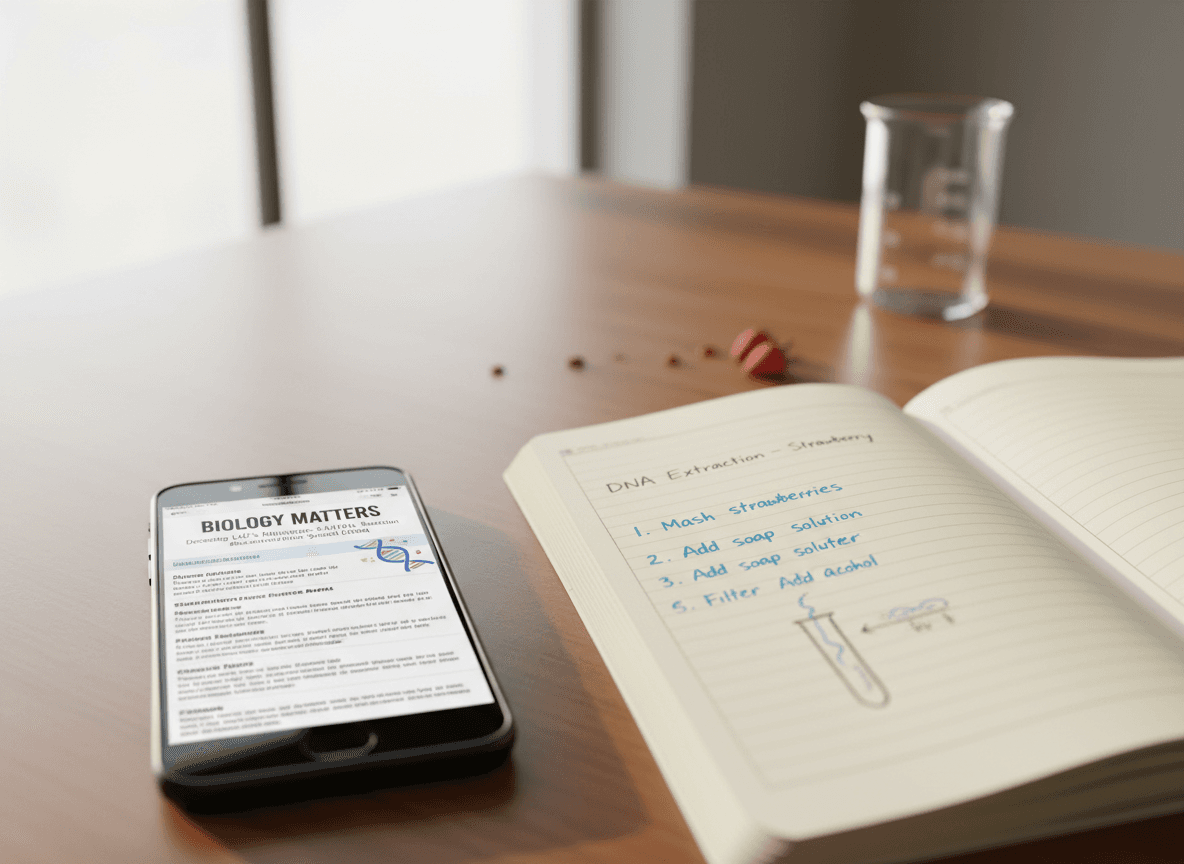
High school biology parents have one main question. Is my student going to be ready for the next thing, whether that is AP, anatomy, nursing school, or the SAT subject content. Your newsletter answers that question every two weeks without saying it directly. Five sections, scaled to high school content, written for parents who are reading on the train home.
Section 1: What we investigated
Three or four sentences. The question, the lab, the finding, and what good work looked like. "This week students extracted DNA from strawberries using detergent, salt, and isopropyl alcohol. They wrote a lab report with a claim, evidence, and reasoning. The strongest reports included a diagram of the protocol and a paragraph explaining why detergent breaks open cell membranes." For an evolution unit, the equivalent: "Students compared beak shape data from Darwin's finches across three islands and graphed the shifts after a drought year. The connection between food source, beak depth, and survival rate is the entire concept of natural selection in one data set. Strong lab notebooks included a bio sketch of one finch species and a one-paragraph reasoning section linking the graph to the trait."
Section 2: Vocabulary we are using
Eight words for high school. For a DNA and genetics unit: "Nucleotide (the building block of DNA), Base pair (A with T, C with G), Double helix (the shape of DNA), Gene (a sequence that codes for a trait), Allele (a version of a gene), Mutation (a change in the DNA sequence), Transcription (DNA to RNA), Translation (RNA to protein)."
Section 3: Photo of the week
One image. A lab notebook page with claim-evidence-reasoning, a DNA extraction tube held up to the light, a Punnett square on a whiteboard. Real student work, not stock images. Lab notebook pages do the most work because they show what good high school writing looks like. A gel electrophoresis photo with five lanes and visible DNA bands, taken under a transilluminator, is the iconic high school biology image. Most parents have never seen one. The first time it lands in their inbox, they save it. By February, half the families have a printed copy on the fridge.
Section 4: Do at home
One independent task. "Read one science news article from a real outlet this week, bring the headline and three sentences Monday." Or "Watch one 10 minute video on CRISPR and write a paragraph on what it could change." Independent, college-prep style, no parent labor.
Section 5: Coming up
Four lines. Test dates, lab dates, project due dates, course selection windows, AP exam registration deadlines. Mention what good work looks like one item per issue. "DNA replication quiz Friday. Strong answers include the role of helicase, polymerase, and the leading vs lagging strand."
Template excerpt: a real high school biology DNA issue
Here is what the template looks like in the second week of a DNA unit:
What we investigated: Students built models of DNA using paper nucleotides, then traced transcription and translation to produce a six-amino-acid protein. Most groups completed the model and wrote a one-paragraph explanation of how a single base change can shift the entire protein. We covered sickle cell as a real-world example.
Vocabulary: Codon (three bases that code for one amino acid), Amino acid (the building block of a protein), Protein (a chain of amino acids that does a job in the cell), Mutation (a change in DNA), Frameshift (a mutation that shifts the entire reading frame), Substitution (a mutation that swaps one base for another), mRNA (the messenger that carries the code), tRNA (the carrier that brings amino acids to the ribosome).
Do at home: Read one article on sickle cell or CRISPR and bring a three-sentence summary Monday.
Coming up: DNA and protein synthesis test next Friday. Study guide on Google Classroom. AP Biology registration deadline March 1. Sophomore science track conversations open next week with counselors.
Why this template works for high school biology
High school parents are doing one of the toughest jobs: supporting a student who does not want to be supported. The newsletter respects that by giving parents context, not assignments. Five sections deliver what students did, what is coming, what good work looks like, and what the student can do independently. Parents who want to engage have a clear path. Parents who only want awareness get exactly that. The what-good-work-looks-like line is the most powerful sentence in the newsletter. A parent who reads "strong answers include the role of helicase, polymerase, and the leading vs lagging strand" can recognize a one-line answer when their student shows it to them. They do not need to know the content to ask "did you include all three?" That is the support pattern that works at this age.
How Daystage helps with high school biology newsletters
Daystage gives high school biology teachers a five-section template you build once and duplicate every two weeks. AP registration notes, course selection callouts, and what-good-work-looks-like lines drop in cleanly. It sends to your full parent list as a real email, not a PDF attachment, and works from your phone during a planning period or before the bus duty shift.
Get one newsletter idea every week.
Free. For teachers. No spam.
Frequently asked questions
Do high school parents actually read a biology newsletter?
Yes, more than most teachers assume. High school parents read newsletters that respect their time, give them grade context without violating privacy, and surface deadlines they would otherwise miss. They stop reading newsletters that read like a syllabus or recap the lesson plan.
How often should a high school biology newsletter go out?
Every two weeks during the unit, weekly during the two weeks before a major exam or project deadline. Daily is too much. Monthly leaves parents in the dark when grades arrive.
What should the first newsletter of the year include?
Course pacing for the year, lab safety contract status, how the grade book works (categories, weights, late policy), and your contact info. Skip cute graphics. Get the logistics right and parents will trust the next 30 issues.
Should I include AP or honors track information in the newsletter?
Yes, when relevant. Sophomore year is when students start choosing junior and senior science tracks. Mention AP Biology, anatomy, environmental science, or other pathway courses two or three times across the year. Parents need lead time to plan.
Does Daystage have a high school biology newsletter template?
Yes. Daystage gives high school biology teachers a five-section template (what we investigated, vocabulary, photo, do at home, coming up) you can duplicate every two weeks. It sends to your class roster as a real email and handles AP track notes and pathway callouts cleanly.

Adi Ackerman
Author
Adi Ackerman is a former classroom teacher and curriculum writer with 8 years in K-8 schools. She writes about school communication, parent engagement, and what actually works in real classrooms.
More for Science Newsletter
Ready to send your first newsletter?
3 newsletters free. No credit card. First one ready in under 5 minutes.
Get started free