
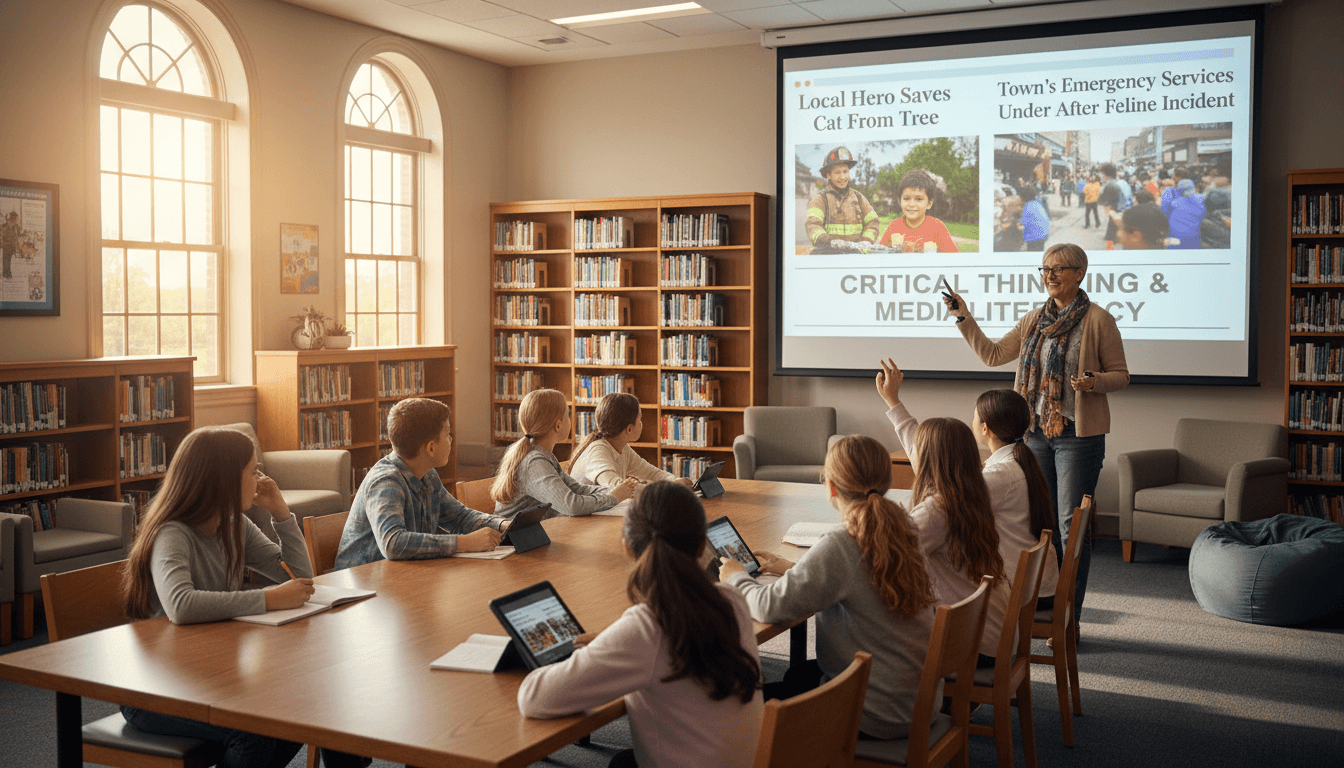
Library Newsletter on Media Literacy: A Template That Explains It
Media literacy is the skill kids think they have because they grew up with screens. The truth is that growing up with screens makes kids fluent in the platforms, not in the messages. A sixth grader can navigate TikTok in their sleep and still cannot tell the difference between a sponsored video and a regular one. The media literacy newsletter is the librarian's chance to teach the difference, one issue at a time.
What the newsletter is for
Two jobs. Give families one framework for evaluating media messages, and give them one example they can apply this week. The newsletter is not a current events brief. It is a teaching tool that uses current events as raw material.
Source versus opinion
The first distinction. A news source reports what happened. An opinion piece tells you what the writer thinks about what happened. Both have value. Mixing them up is the most common mistake kids make when they form an idea about a topic from social media. One sentence in the newsletter: "When your kid shares something they read, ask whether it is a news story or an opinion. If they cannot tell, look at the section the article is in on the original site. News sites label opinion pieces. Social media often does not."
Finding the original
Most of what kids see is a quote of a quote of a quote. A screenshot of a tweet that was about a TikTok that was reacting to a news article. The original is buried three layers down, and the original usually says something different from the screenshot. Teach families to ask "where did this come from" and to trace back to the source before forming an opinion. Three minutes of source tracing fixes most of what is wrong with how families process news.
The lateral reading trick
This is the single most useful technique in the newsletter. Lateral reading is what professional fact-checkers do. Instead of staying on a page and trying to evaluate it from the inside, you open new tabs and search for what other sites say about it. Drop a two-sentence explanation: "Lateral reading means leaving the page to check the page. Open a new tab, search the site name, and read what three other sources say about it. It is faster than any other media literacy trick."
One concrete classroom example
"This week, sixth graders looked at two headlines about the same scientific study. One headline said 'New study proves coffee helps you live longer.' The other said 'Coffee linked to small increase in life expectancy, researchers caution results are preliminary.' Same study, two different impressions. The kids spent twenty minutes finding the original press release from the university. The press release used the second framing. The first headline was a stretch. That single exercise taught them more about media literacy than a month of definitions."
The home activity
One paragraph. "This week, when your kid shows you something they saw online, ask three questions. Where did this come from originally? Is this a news story or an opinion? What do two other sources say about the same thing? Three questions, ninety seconds, and your kid builds the habit that protects them for the rest of their life."
Cadence
Media literacy belongs in the regular monthly rotation, alternating with information literacy. Once a quarter is the minimum, once a month is ideal. Send on the first Tuesday of the month, 7 to 9 AM. Keep it short. Three sections, eight hundred words, one example.
How Daystage helps with media literacy newsletters
Daystage gives media specialists a template that handles side-by-side examples, framework boxes, and a clean home activity block in one email. Build the source-versus-opinion block once, refill the example each month, and the newsletter goes out branded and easy to skim. Media literacy stops being a vague worry and becomes a regular part of how families talk about what they read.
Get one newsletter idea every week.
Free. For teachers. No spam.
Frequently asked questions
What is the difference between media literacy and information literacy?
Information literacy is about evaluating sources for research. Media literacy is about evaluating messages for influence. A kid writing a report needs information literacy. A kid scrolling social media needs media literacy. The newsletter should keep them separate. Mixing them turns into vocabulary, not learning.
What is lateral reading and why is it the most useful trick?
Lateral reading is what professional fact-checkers do. Instead of staying on a page trying to figure out if it is reliable, you open new tabs and search for what other sites say about that page. Three lateral searches usually reveal what a site is and whether it can be trusted. It is faster than the CRAAP test for breaking news, and it is the single most useful media literacy trick a sixth grader can learn.
How do you teach the difference between a source and an opinion?
Side-by-side examples. Pick a news event, find one news article and one opinion piece about the same event, and show them next to each other. Ask the kids what is different. Most kids name the difference instantly when they see it side by side. Trying to define source versus opinion without examples just creates more confusion.
Is it OK to use real political examples in a school library newsletter?
Use the example for the framework, not for the politics. The point is to teach the skill of finding the original source, not to make a political argument. Pick examples where both sides are uncontroversial. Sports, weather, animal stories, science news. The framework transfers to political topics later. The newsletter is not the right place for the politics itself.
What is the easiest way to send a newsletter with two side-by-side examples?
Daystage was built for school staff who need to send clean newsletters with image columns and side-by-side comparisons. Drop in two headlines, add the framework block, and the email goes out branded and easy to follow. Media specialists who use it tend to keep media literacy as a recurring section in the regular newsletter rotation.

Adi Ackerman
Author
Adi Ackerman is a former classroom teacher and curriculum writer with 8 years in K-8 schools. She writes about school communication, parent engagement, and what actually works in real classrooms.
More for School Librarian
Ready to send your first newsletter?
3 newsletters free. No credit card. First one ready in under 5 minutes.
Get started free