
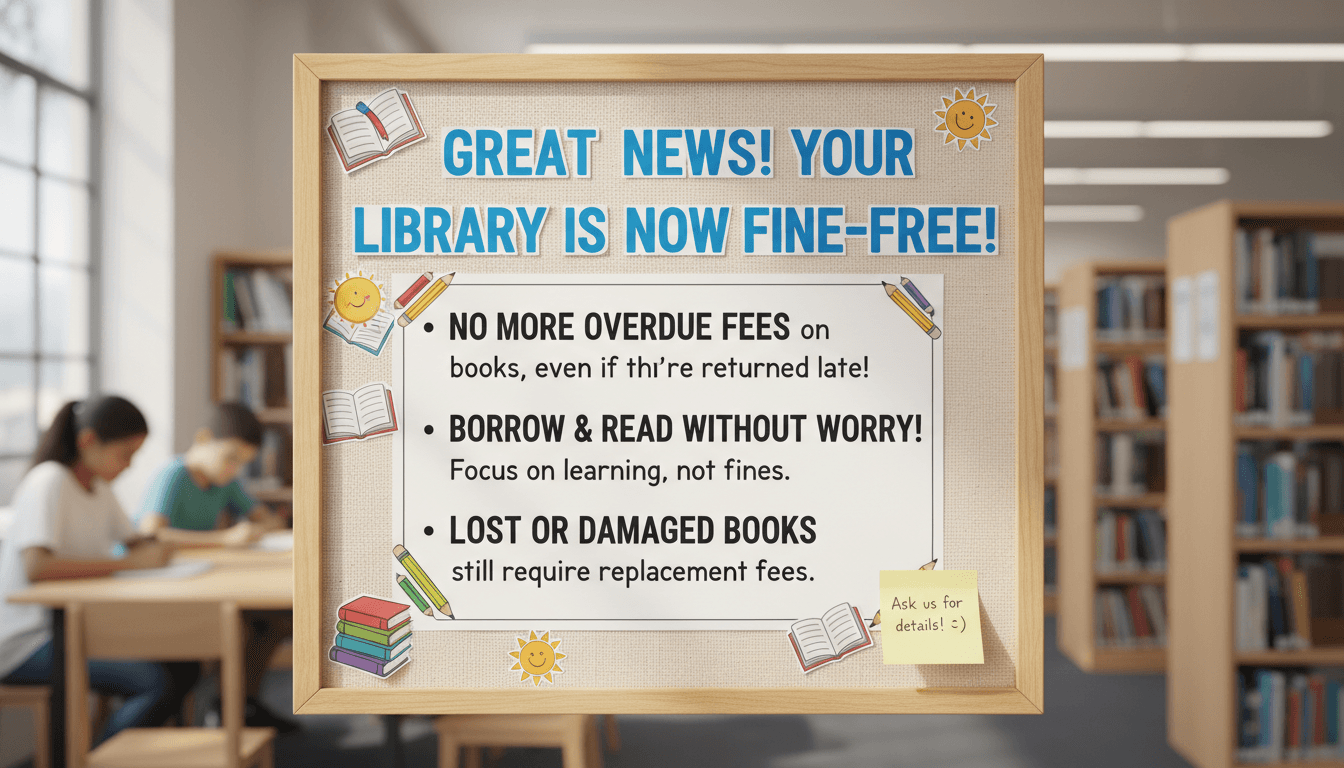
Library Newsletter on the Library Fines Policy: A Plain Template

A fines policy newsletter is a moment to be plain. Families have carried a low-level fine anxiety since they were kids themselves, and a policy change is news either way. Whether you are going fine-free, adjusting the fee structure, or just clarifying the existing rules, the newsletter that lands well is the one that treats families like adults.
State the policy in one sentence
First line is the policy. "Starting September 1, the library is fine-free." Or, "Late fees stay at 10 cents per day for elementary and 25 cents per day for middle school, capped at $5." Whatever the version, lead with it. The reasons belong in the next paragraph, not the first one.
Make the case for fine-free if that is the move
Three sentences of substance, no hedging. Fines reduce library use among families who already have the least access. Return rates do not drop when fines are removed, according to multiple public library systems that have published their numbers. The job of a school library is to put books in front of kids, and fines work against that job. Frame it like a decision, not an apology.
Say what is staying the same
The most common parent worry is that fine-free means "no accountability." Address it directly. "What stays: due dates, overdue reminders, replacement cost for lost books, the 60-day lost book threshold." Three to four bullet points. The library still works the same. The penalty math just changed.
Show the data, but lightly
One sentence with a number. "Over the past three years, fines on our shelves totaled about $340 a year, and we wrote off two thirds of it. The administrative time alone outweighed the revenue." Real numbers in your school are more persuasive than a national study. Pull from your circulation system and round to clean figures.
Handle the equity point without making it political
One careful sentence. "We saw families avoid the library because of small balances, and we want every kid in the building to read without that worry." Do not lecture. Do not lean on jargon. Families recognize fairness when it is named simply.
Walk through how it works in practice
A short paragraph on what a family experiences day to day. Kid checks out a book. Book is due in two weeks. If late, a reminder email at 30 days. If still not returned at 60 days, a replacement cost note. No daily counter, no balance growing in the system, no report card hold. The cleaner the description, the less fear the change generates.
Invite questions, name a way to reach you
Close with a real invitation. "If you want to talk this through, reply to this email or stop by during morning drop-off Tuesdays. Happy to walk through the why or the how." Policy emails that leave space for conversation get fewer angry follow-ups than ones that read like a finished verdict.
A working example for a fine-free announcement
"Hi families, starting September 1 the library is fine-free. Why: fines reduce library use among the families who need the library most, return rates do not drop when fines are removed, and our own data shows the fines on our shelves cost more to administer than they collected. What stays the same: due dates, reminders at 30 days, replacement cost for lost books at 60 days. What goes away: per-day late fees and any holds on report cards tied to balances. Questions, reply any time. See you in the library."
How Daystage helps with library fines policy newsletters
Daystage gives librarians a saved announcement template with the policy statement at the top, the what-stays-the-same block, the data line, and the invitation to talk at the bottom. Send once, resend a reminder version one month in, and keep the tone consistent across the whole family list. The policy change reads as deliberate instead of one-off.
Get one newsletter idea every week.
Free. For teachers. No spam.
Frequently asked questions
Do fine-free libraries actually get books back?
Yes. Studies from the American Library Association and several large public library systems show return rates do not drop, and in many cases improve. Families who avoided the library because of fine anxiety start using it again. The fear that fines drive returns has not held up in the data.
Is this only an elementary policy or does it work for middle and high school?
It works at every level. Middle and high school fines were rarely large enough to function as a deterrent and frequently functioned as a barrier for the kids most likely to need library access. Fine-free policy makes more sense as students get older, not less.
What replaces fines for overdue books?
Replacement cost for lost books stays. The overdue reminder cadence stays. The difference is no daily-per-book fine accumulating in the background. Books come back through reminders and conversations, not through a fee schedule. Most schools find the workload drops, not rises.
How do I announce the change without it sounding like a giveaway?
Frame it as a policy decision grounded in equity and research, not a treat. 'We are going fine-free starting September 1. Here is why, and here is what stays the same.' Families read it as serious. A celebratory tone makes the policy feel temporary.
Is there an easy way to send the policy update to all families at once?
Daystage sends the same branded email to your full family list in one go. Build the announcement once with the policy statement, the FAQ block, and the 'what stays the same' section, and send. Saved template means you can resend a reminder version a month in if you want.

Adi Ackerman
Author
Adi Ackerman is a former classroom teacher and curriculum writer with 8 years in K-8 schools. She writes about school communication, parent engagement, and what actually works in real classrooms.
More for School Librarian
Ready to send your first newsletter?
3 newsletters free. No credit card. First one ready in under 5 minutes.
Get started free