
Library Newsletter on Lexile and Reading Levels: A Template
Lexile, F&P, AR. Three systems, three different scales, and a lot of families trying to figure out what the number on their kid's report card actually means. The school library newsletter is the best place to explain it once and stop the parent-conference confusion. Here is the template that works.
Open with what families actually want to know
Most families do not want a definition of Lexile. They want to know what book to put in their kid's hand this weekend. Open the section with that promise: "Your kid came home with a reading level on their report card. Here is what it means and how to use it without making reading feel like a math test."
The three systems, in one paragraph each
Lexile: a number from BR (beginning reader) up to about 1700L, based on sentence length and word frequency. A 5th grader reading on grade level is often around 830L to 1010L.
Fountas and Pinnell (F&P): a letter from A through Z, based on text complexity and reader behavior. End of 2nd grade is around level M. End of 5th grade is around level X.
Accelerated Reader (AR): a number and a decimal (4.5 means roughly mid-fourth-grade text difficulty). Used in schools running the AR quiz program.
The just-right book rule
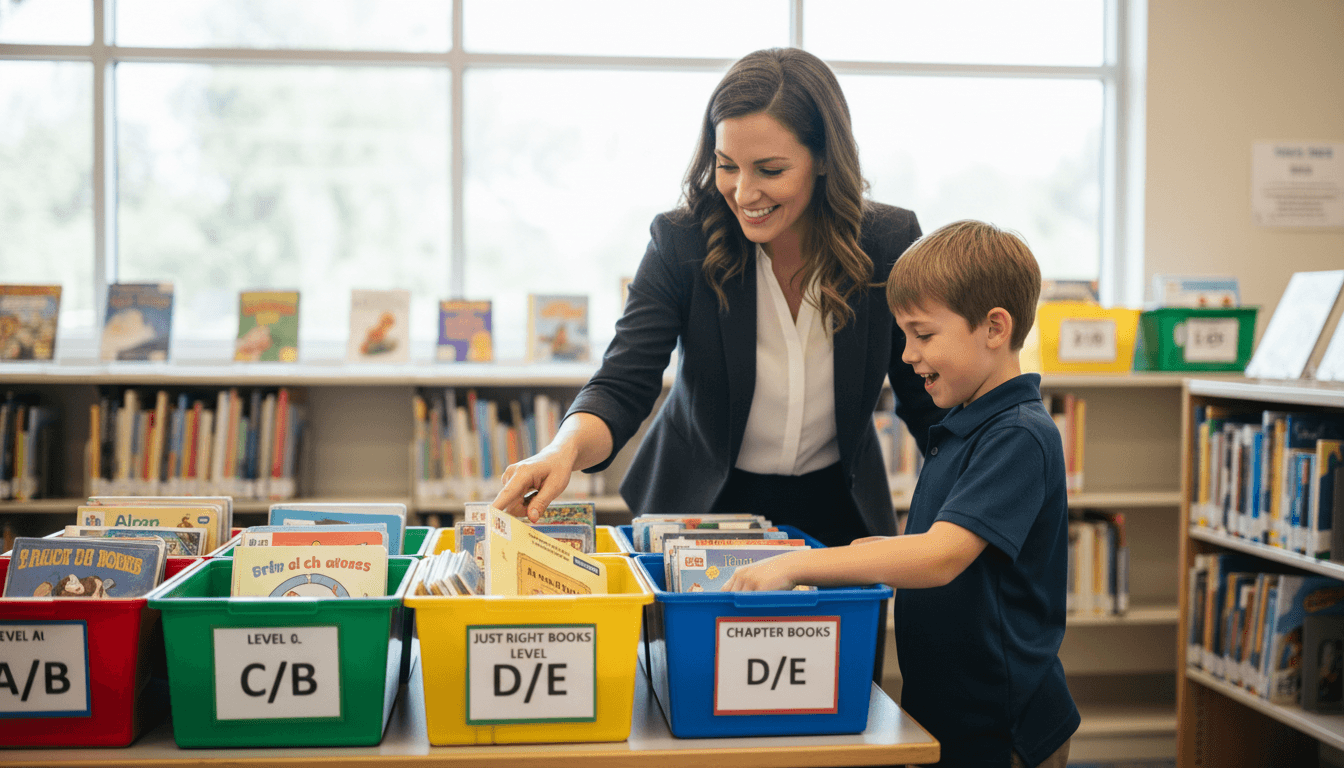
Give families the test they can actually use. "Open the book to a random page. Read one page. If your kid does not know more than five words, the book is too hard for independent reading right now. If they know every word and it feels easy, it is below their level. In between is just right." The rule works at every level and takes 30 seconds.
Why level should not box kids in
State it plainly: "A reading level is a snapshot, not a ceiling. Kids who love dinosaurs will read a dinosaur book two levels above their tested level and finish it. Kids who hate the book they were assigned will struggle with it even at the right level. Motivation beats level almost every time." That paragraph gives families permission to follow interest, not just the number.
What to do with the report card number
Three concrete uses. One: use it to pick a book at the public library when your kid is stuck for an idea. Two: use it to set a rough starting point for a series. Three: use it to celebrate growth across a year. Skip using it as a daily filter for what is allowed and what is not.
Example: Cedar Grove Elementary, 380 students, F&P school. The librarian put a one-page reading-levels explainer in the September newsletter, with the three systems, the just-right rule, and the "motivation beats level" line. Parent emails asking "is this book too hard?" dropped from about four a week to one a month. The principal asked her to send the same explainer to every new family at midyear.
The library policy line
One sentence near the end: "The library does not restrict checkout by reading level. Your kid can pick any book they want. If they grab something too hard or too easy, that is part of how kids learn to pick books." That single sentence prevents the parent email asking why their 2nd grader was allowed to check out a 4th grade book.
How Daystage helps with reading-levels newsletters
Daystage lets you build the reading-levels explainer as a reusable block. Plug it into the September issue at full length, reference it in the parent-conference week issue, and link to it from any month where a level question comes up. The explainer stays consistent across the year and families have one place to return to when the number on the report card confuses them again.
Get one newsletter idea every week.
Free. For teachers. No spam.
Frequently asked questions
What do Lexile, F&P, and AR levels actually measure?
Lexile is a sentence-length and word-frequency score that goes from BR (beginning reader) to about 1700L. Fountas and Pinnell (F&P) uses letters A through Z based on text complexity and is most common in elementary classrooms. Accelerated Reader (AR) uses a number-and-decimal scale based on the ATOS readability formula. All three try to match book difficulty to reader ability. None of them measure interest, motivation, or whether a kid will actually finish the book.
Should a school library shelf books by reading level?
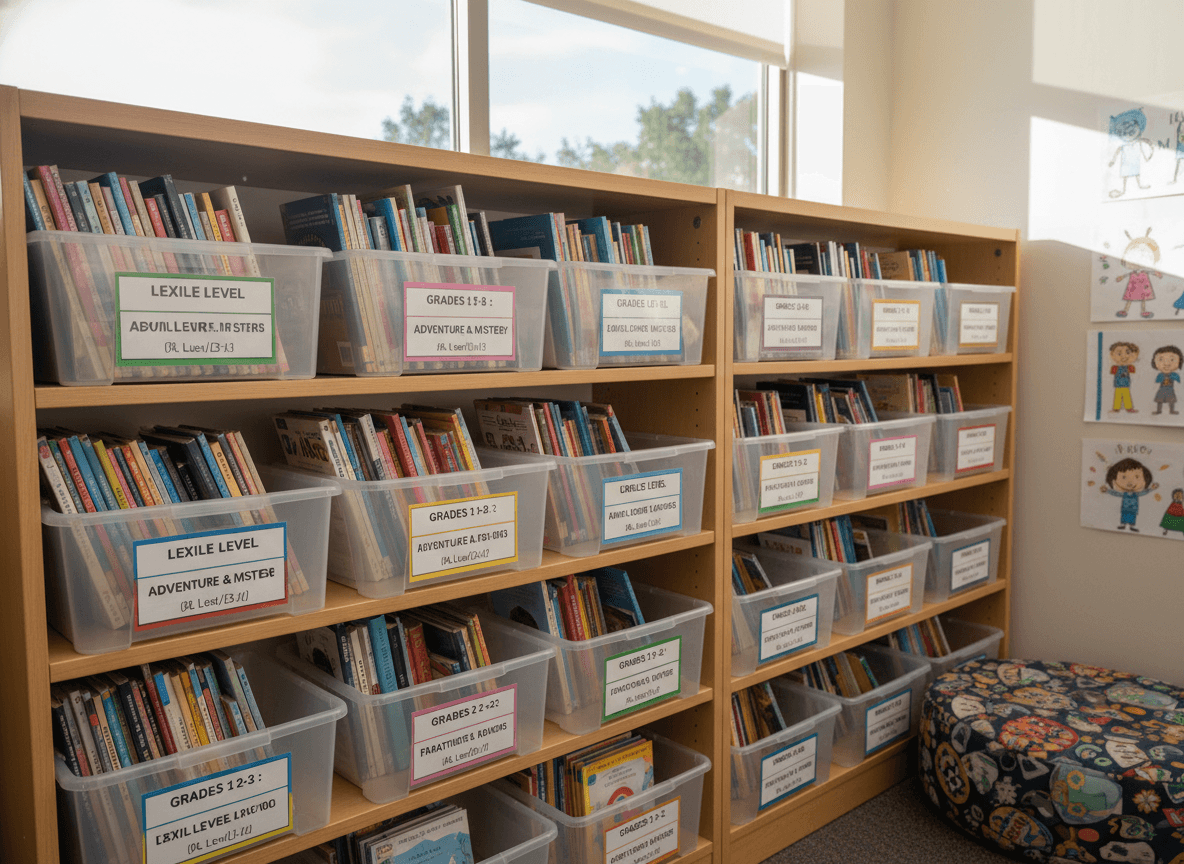
No. Most school librarians shelve by genre or by author last name, not by Lexile. Level-shelving teaches kids that books outside their level are off-limits, which is the opposite of what the library should do. Use level stickers as a soft guide on the spine, not as a sorting system. Kids can still grab the Harry Potter that is two levels above them if they want to.
What is the just-right book rule?
Pick a random page in the book. Read it. If you do not know more than five words, the book is too hard for independent reading right now. If you know every word and it feels easy, it is below your level. Anywhere in between is just right. The rule (sometimes called the five-finger rule) gives families a practical test that takes 30 seconds and works for any book at any age.
How should families use the level number their school sends home?
As a starting point, not a fence. The Lexile or F&P level tells you roughly where the kid is in terms of decoding and comprehension. It does not tell you what they will love, what they will be motivated to finish, or what they need to grow as a reader. A high-interest book one level above is often a better choice than a low-interest book exactly at the level.
Is there a simple tool for sending the reading-levels newsletter section?
Daystage lets school librarians build the reading-levels explainer once and reuse it as a section in the September newsletter, the parent-conference week newsletter, and any time a level question comes up. The explainer stays consistent, families can return to it, and you spend zero time re-explaining the same three systems in email replies.

Adi Ackerman
Author
Adi Ackerman is a former classroom teacher and curriculum writer with 8 years in K-8 schools. She writes about school communication, parent engagement, and what actually works in real classrooms.
More for School Librarian
Ready to send your first newsletter?
3 newsletters free. No credit card. First one ready in under 5 minutes.
Get started free