
Reading Newsletter on Figurative Language: Sections Parents Read
Figurative language is the unit kids enjoy most and parents understand least. Most parents remember the words simile and metaphor but cannot tell them apart. A targeted newsletter fixes that in five short examples and gives families one easy way to keep the practice alive at home.
Open with why figurative language matters
Two sentences. "Figurative language is what makes writing feel alive. A writer who uses similes, metaphors, personification, and hyperbole pulls images into your head instead of just listing facts." That is the framing. Parents now understand the unit is not about memorizing definitions. It is about how strong writing actually works.
Walk through the four types with one example each
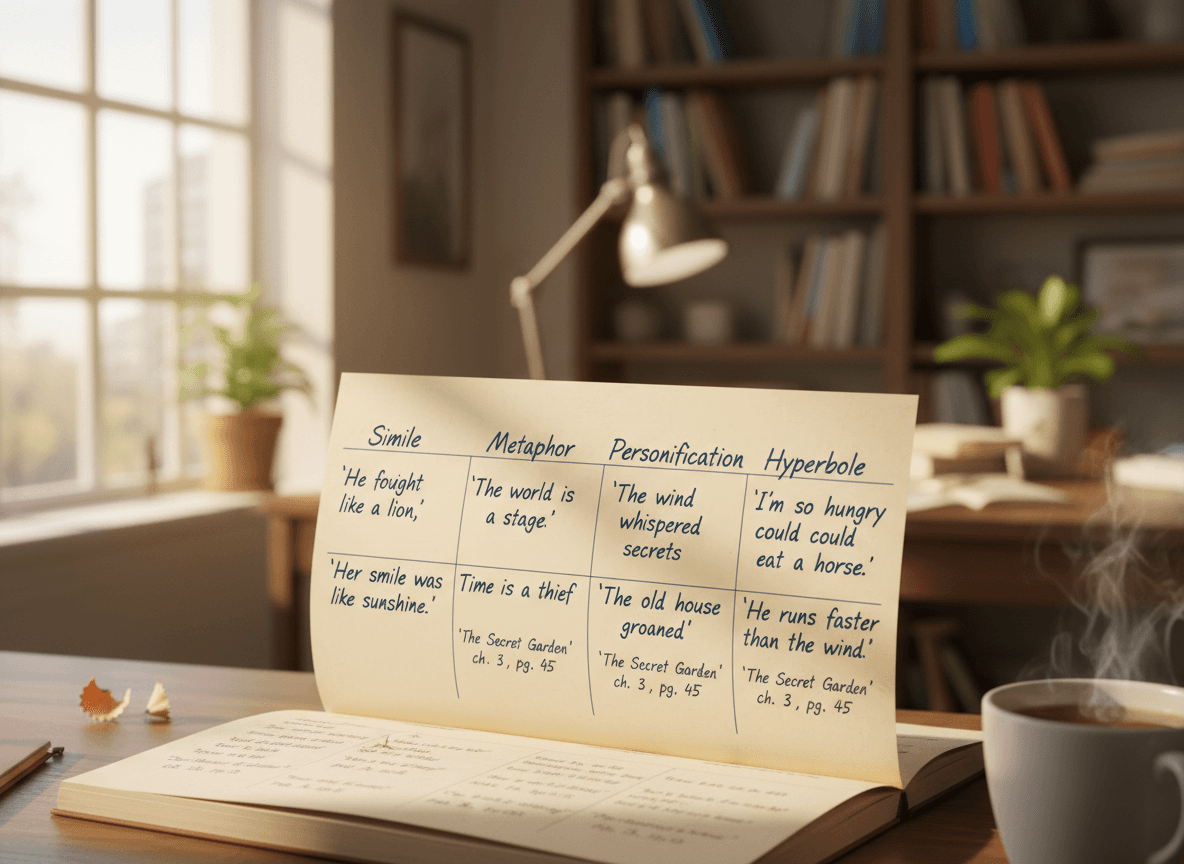
Keep it tight. "Simile uses like or as. Her smile was like the sun. Metaphor states the comparison directly. Her smile was the sun. Personification gives human qualities to something not human. The wind whispered. Hyperbole is exaggeration on purpose. I have told you a million times." Four lines. One example each. Parents read that and remember it for the rest of the year.
Explain why metaphor hits harder than simile
One paragraph. "Her smile was warm tells you something. Her smile was like the sun puts an image in your head. Her smile was the sun is the same image with no escape hatch. The metaphor commits. That commitment is why metaphors carry more weight than similes." That paragraph is the whole craft lesson. Parents now read every comparison in their child's writing differently.
Give one home practice that takes ten seconds
Print it in bold. "Once this week, when you are talking with your child, point out a figurative language move in real life. A song lyric on the radio. A line from an ad. Something one of you just said. Name what kind it is." That is the entire home practice. Ten seconds. Real-life examples beat any worksheet on this skill.
A sample opening for a fifth grade figurative language cycle
"Hello families. For the next two weeks we are studying figurative language. The four types in focus: simile, metaphor, personification, hyperbole. Quick examples:
Simile: her smile was like the sun. Metaphor: her smile was the sun. Personification: the wind whispered through the trees. Hyperbole: I have told you a million times.
At home this week: once, when you are listening to music or watching something with your child, point out a figurative language move and name what kind it is. Ten seconds. Real-life examples beat any worksheet on this skill."
How Daystage helps with a figurative language newsletter
Daystage holds the five-section structure for you. Why it matters. The four types with examples. Why metaphor hits harder. The home practice. Save it once. Drop in fresh examples each cycle. The email lands clean on every parent's phone, with the four examples sitting next to each other on the screen.
Get one newsletter idea every week.
Free. For teachers. No spam.
Frequently asked questions
What is the difference between a simile and a metaphor?
A simile uses like or as. Her smile was like the sun. A metaphor states the comparison directly. Her smile was the sun. The metaphor is stronger because it skips the comparison word and says the two things are the same. Both pull an image into the reader's head. Metaphors usually hit harder.
What is personification and where do kids see it?
Personification is giving human qualities to something that is not human. The wind whispered. The old house groaned. The sun smiled. Picture books are full of it. So are pop songs and ads. Once kids learn the name, they start spotting it everywhere, which is exactly the point.
What is hyperbole and how do kids use it already?
Hyperbole is exaggeration on purpose. I have told you a million times. This backpack weighs a ton. My feet are killing me. Kids speak in hyperbole every day. The unit names what they are already doing. That recognition is half the lesson.
Why teach figurative language at all?
Three reasons. It makes writing stronger. It makes reading richer. It trains the ear to catch word choice everywhere, in songs, in ads, in everyday speech. Kids who study figurative language stop reading on autopilot. That habit pays off in every subject they ever take after.
What tool sends a figurative language newsletter cleanly to families?
Daystage was built for this. Short, formatted, mobile-friendly. Save the structure once with sections for each figurative language type and one home example. Drop in the new examples each cycle. The email lands on every parent's phone in a clean, readable shape with the four examples sitting next to each other on the screen.

Adi Ackerman
Author
Adi Ackerman is a former classroom teacher and curriculum writer with 8 years in K-8 schools. She writes about school communication, parent engagement, and what actually works in real classrooms.
More for Reading Newsletter
Ready to send your first newsletter?
3 newsletters free. No credit card. First one ready in under 5 minutes.
Get started free